top of page

A Handful of Shale Fragments Reveals a Thriving Carboniferous Seafloor of Brittle Stars

Modern brittle stars, members of the class Ophiuroidea, are among the most species-rich groups of echinoderms. They occur from the tropics to the poles and from intertidal habitats to the deepest ocean trenches. With approximately 2,100 living species, Ophiuroidea is the most diverse class of echinoderms. A brittle star's skeleton consists of numerous small ossicles that readily fall apart after death. Complete skeletons are generally preserved only under unusual burial conditions, and larger species with more robust ossicles are more likely to enter the fossil record. Small, slender, and fragile species are far less likely to be preserved. This taphonomic bias suggests that the brittle-star diversity previously recognized from the Late Mississippian represents only a small fraction of the communities that once inhabited Carboniferous seafloors.


Ophionereis schayeri, an extant species(Image source:Mark Norman, CC BY 4.0 )

Near Sulphur, Indiana, the Indian Springs Shale Member of the Big Clifty Formation consists of interbedded light-gray shale and hard limestone dating to the Serpukhovian Stage of the Upper Mississippian. At the time of deposition, the area formed part of a tidally influenced shallow-water ramp that received clastic sediment from deltas to the east-northeast. The shale contains brachiopods, bryozoans, and fish teeth, together with ossicles from crinoids, blastoids, echinoids, holothuroids, and numerous brittle stars. These remains document a rich and diverse seafloor community.
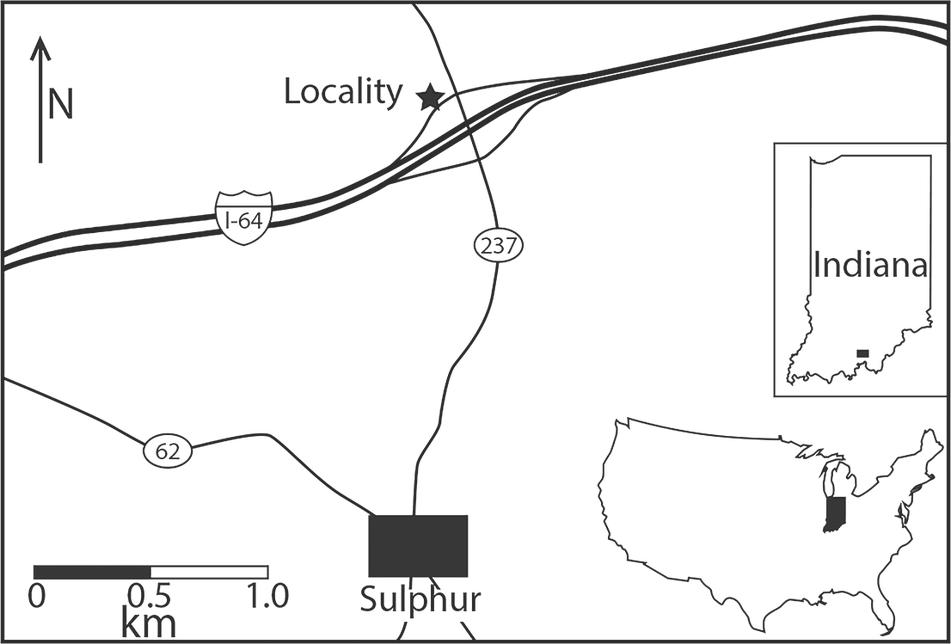

Location of the fossil site(Image source:Smith NS et al. (2025), CC BY 4.0 )

Blastoidea, Pentremites godoni(Image source:Wilson44691,CC0 1.0 )

The researchers collected approximately five kilograms of shale from a roadside exposure and processed the material using micropaleontological methods. The shale was first immersed overnight in a 3% hydrogen peroxide solution to disaggregate the sediment and release individual skeletal fragments. The material was then repeatedly washed to remove the clay fraction, dried, and sieved down to 125 micrometers. Under a dissecting microscope, individual ossicles were hand-picked with a wet paintbrush. Residual sediment was removed with a fine needle, and selected specimens were further cleaned in a sonic water bath. The ossicles were then mounted on aluminum stubs, coated with silver, and examined using scanning electron microscopy. Under high magnification, fragments that had appeared almost indistinguishable within the sediment revealed a remarkable range of fine morphological differences.


The study focused primarily on lateral arm plates, or LAPs, which cover the sides of a brittle star's arms and bear the articulations for the arm spines. Different brittle-star taxa possess lateral arm plates that vary in outline, surface ornamentation, and the number, shape, and arrangement of their spine articulations. These features can therefore provide valuable characters for taxonomic identification. The researchers also examined ambulacrals, or vertebrae, which form the structural core of the arm. By combining information from these skeletal elements, they could assign isolated ossicles to particular genera and, in some cases, individual species even when no complete skeleton was available. This approach has long been used to study Mesozoic and Cenozoic brittle stars, and the present research demonstrates that it can also be successfully applied to much older Paleozoic material.


Skeletal anatomy of the extant brittle star Amphiura chiajei, shown in scanning electron micrographs. (A) Dorsal side of the disc and arms; (B) dorsal view of an arm; (C) dissociated lateral arm plates and lateral arm spine articulations (SA); (D, E) vertebrae dissected from an arm, shown in distal view (D) and proximal view (E); (F) ventral side of the disc and arms; (G) detail of the mouth; (H) dental plate removed from the mouth; (I, J) oral plate, shown in abradial view (I) and adradial view (J)(Image source:Stöhr S et al. (2012), CC BY 4.0 )

The results far exceeded previous estimates of Mississippian brittle-star diversity. Eleven species were identified from this single locality, ten of which had never been formally described. The number of species recovered from the assemblage exceeded the combined diversity previously reported from the entire Mississippian worldwide. The new species were Umerophiura daki, Strataster lisae, Schoenaster limbeckae, Vandelooaster douglasi, Furcaster wardi, Furcaster mccantae, Furcaster coulombeae, Sulphaster odellettorum, Covidaster medicus, and Suchaster granulosus. The assemblage also included ossicles assigned to an indeterminate species of Cholaster.


Each species could be distinguished by a characteristic combination of skeletal features. The lateral arm plates of Umerophiura daki are broad and resemble a glove or racket, with a short, rounded, peg-like vertebral articulation at the proximal end and a row of flattened triangular projections along the distal margin. In Strataster lisae, the lateral arm plates are relatively flat and trapezoidal, while the vertebral articular knob on the inner surface resembles a belt buckle. Schoenaster limbeckae possesses thick, oval lateral arm plates with conspicuous ambulacral groove spine articulations along the ventral edge. The lateral arm plates of Vandelooaster douglasi have a flattened, paddle-like main body and a short, blunt, peg-like proximal portion.


Umerophiura daki: 1, paratype CMCIP-94540, proximal/median lateral arm plate, external view; 2, paratype CMCIP-94543, median/distal lateral arm plate, internal view; 3, the same median/distal lateral arm plate, external view; 4, holotype CMCIP-94541, proximal lateral arm plate, dorsal view; 5, paratype CMCIP-94543, median/distal lateral arm plate, ventral view; 6, paratype CMCIP-94542, unusual proximal lateral arm plate, internal view; 7, the same proximal lateral arm plate, dorsal view; 8, holotype CMCIP-94541, proximal lateral arm plate, external view; 9, the same proximal lateral arm plate, internal view; 10, paratype CMCIP-94542, unusual proximal lateral arm plate, external view. Strataster lisae: 11, paratype CMCIP-94594, median lateral arm plate, external view; 12, the same median lateral arm plate, internal view; 13, paratype CMCIP-94596, distal lateral arm plate, internal view; 14, the same distal lateral arm plate, external view; 15, paratype CMCIP-94591, median lateral arm plate, internal view; 16, the same median lateral arm plate, external view; 17, paratype CMCIP-94593, proximal lateral arm plate, internal view; 18, paratype CMCIP-94595, distal lateral arm plate, ventral view; 19, the same distal lateral arm plate, external view; 20, holotype CMCIP-94592, proximal left lateral arm plate, dorsal view; 21, the same proximal left lateral arm plate, external view; 22, paratype CMCIP-94593, proximal lateral arm plate, external view; 23, the same proximal lateral arm plate, dorsal view; 24, the same proximal lateral arm plate, ventral view; 25, holotype CMCIP-94592, proximal left lateral arm plate, ventral view; 26, enlarged view of the arm spine base on the same proximal left lateral arm plate; 27, the same proximal left lateral arm plate, internal view(Image source:Smith NS et al. (2025), CC BY 4.0 )

Schoenaster limbeckae: 1, paratype CMCIP-94553, median right lateral arm plate, ventral view; 2, the same median right lateral arm plate, external view; 3, the same median right lateral arm plate, dorsal view; 4, the same median right lateral arm plate, internal view; 5, paratype CMCIP-94555, median right lateral arm plate, ventral view; 6, the same median right lateral arm plate, dorsal view; 7, paratype CMCIP-94558, median right lateral arm plate, ventral view; 8, the same median right lateral arm plate, external view; 9, paratype CMCIP-94555, median right lateral arm plate, external view; 10, paratype CMCIP-94561, median right lateral arm plate, dorsal view; 11, the same median right lateral arm plate, internal view; 12, paratype CMCIP-94558, median right lateral arm plate, internal view; 13, paratype CMCIP-94555, median right lateral arm plate, internal view; 14, paratype CMCIP-94561, median right lateral arm plate, external view; 15, the same median right lateral arm plate, ventral view; 16, paratype CMCIP-94558, median right lateral arm plate, dorsal view; 17, paratype CMCIP-94557, distal right lateral arm plate, internal view; 18, the same distal right lateral arm plate, external view; 19, the same distal right lateral arm plate, dorsal view; 20, the same distal right lateral arm plate, ventral view; 21, paratype CMCIP-94554, very proximal right lateral arm plate, possibly originally situated within the disc, oblique distal view; 22, the same very proximal right lateral arm plate, external view; 23, the same very proximal right lateral arm plate, dorsal view; 24, the same very proximal right lateral arm plate, internal view; 25, the same very proximal right lateral arm plate, ventral view; 26, holotype CMCIP-94552, proximal right lateral arm plate, internal view; 27, enlarged view of the ambulacral groove spine articulations on the same proximal right lateral arm plate; 28, the same proximal right lateral arm plate, external view; 29, the same proximal right lateral arm plate, ventral view; 30, the same proximal right lateral arm plate, dorsal view; 31, paratype CMCIP-94559, distal right lateral arm plate, external view; 32, the same distal right lateral arm plate, internal view; 33, the same distal right lateral arm plate, dorsal view; 34, the same distal right lateral arm plate, ventral view; 35, enlarged view of a lateral arm spine articulation on the very proximal right lateral arm plate of paratype CMCIP-94554(Image source:Smith NS et al. (2025), CC BY 4.0 )

Cholaster sp. indet.: 1, CMCIP-94550, proximal right lateral arm plate, external view; 2, the same proximal right lateral arm plate, distal view; 3, the same proximal right lateral arm plate, internal view; 4, CMCIP-94551, median to distal lateral arm plate, internal view; 5, the same median to distal lateral arm plate, external view. Vandelooaster douglasi: 6, paratype CMCIP-94546, median lateral arm plate, internal view; 7, paratype CMCIP-94548, distal lateral arm plate, internal view; 8, the same distal lateral arm plate, dorsal view; 9, the same distal lateral arm plate, ventral view; 10, the same distal lateral arm plate, external view; 11, paratype CMCIP-94546, median lateral arm plate, external view; 12, the same median lateral arm plate, dorsal view; 13, the same median lateral arm plate, ventral view; 14, holotype CMCIP-94545, proximal right lateral arm plate, external view; 15, the same proximal right lateral arm plate, internal view; 16, paratype CMCIP-94549, proximal lateral arm plate, internal view; 17, the same proximal lateral arm plate, external view; 18, holotype CMCIP-94545, proximal right lateral arm plate, dorsal view; 19, the same proximal right lateral arm plate, ventral view; 20, paratype CMCIP-94547, relatively elongate proximal lateral arm plate, internal view; 21, paratype CMCIP-94544, proximal lateral arm plate, external view; 22, the same proximal lateral arm plate, internal view; 23, paratype CMCIP-94547, relatively elongate proximal lateral arm plate, external view; 24, the same relatively elongate proximal lateral arm plate, distal view; 25, paratype CMCIP-94544, proximal lateral arm plate, ventral view; 26, the same proximal lateral arm plate, dorsal view(Image source:Smith NS et al. (2025), CC BY 4.0 )

Three species of Furcaster were also present in the same assemblage, indicating that the genus had already undergone substantial local diversification. Furcaster wardi has large, robust, strongly arched lateral arm plates bearing as many as eight large lateral arm spine articulations. The plates of Furcaster mccantae are lower and less strongly arched, with a very coarsely meshed surface and generally only four large lateral arm spine articulations. In contrast, Furcaster coulombeae has small, thin, fragile, strongly arched triangular plates bearing as many as eight comparatively small spine articulations. These differences could be traced consistently from proximal to distal arm plates and could not be explained by growth-related variation. The three forms were therefore recognized as separate species. They also represent the first formally named Carboniferous species of Furcaster.


Furcaster wardi: 1, paratype CMCIP-94598, distal right lateral arm plate, external view; 2, the same distal right lateral arm plate, internal view; 3, paratype CMCIP-94606, median left lateral arm plate, distal view; 4, paratype CMCIP-94598, distal right lateral arm plate, distal view; 5, the same distal right lateral arm plate, ventral view; 6, paratype CMCIP-94599, distal left lateral arm plate, external view; 7, the same distal left lateral arm plate, ventral view; 8, the same distal left lateral arm plate, distal view; 9, the same distal left lateral arm plate, internal view; 10, paratype CMCIP-94606, median left lateral arm plate, internal view; 11, paratype CMCIP-94604, median right lateral arm plate, ventral view; 12, paratype CMCIP-94606, median left lateral arm plate, external view; 13, paratype CMCIP-94604, median right lateral arm plate, distal view; 14, the same median right lateral arm plate, internal view; 15, the same median right lateral arm plate, external view; 16, paratype CMCIP-94603, median left lateral arm plate, internal view; 17, the same median left lateral arm plate, distal view; 18, the same median left lateral arm plate, external view; 19, the same median left lateral arm plate, ventral view; 20, paratype CMCIP-94605, median left lateral arm plate, distal view; 21, the same median left lateral arm plate, internal view; 22, the same median left lateral arm plate, external view; 23, paratype CMCIP-94602, proximal right lateral arm plate, distal view; 24, holotype CMCIP-94601, proximal right lateral arm plate, internal view; 25, the same proximal right lateral arm plate, distal view; 26, the same proximal right lateral arm plate, external view; 27, the same proximal right lateral arm plate, ventral view; 28, enlarged view of the ventralmost lateral arm spine articulation on the same proximal right lateral arm plate; 29, paratype CMCIP-94602, proximal right lateral arm plate, ventral view; 30, the same proximal right lateral arm plate, internal view; 31, the same proximal right lateral arm plate, external view(Image source:Smith NS et al. (2025), CC BY 4.0 )

Furcaster mccantae: 1, paratype CMCIP-94610, distal right lateral arm plate, external view; 2, the same distal right lateral arm plate, internal view; 3, the same distal right lateral arm plate, ventral view; 4, paratype CMCIP-94609, median left lateral arm plate, external view; 5, the same median left lateral arm plate, ventral view; 6, the same median left lateral arm plate, internal view; 7, the same median left lateral arm plate, distal view; 8, holotype CMCIP-94611, proximal right lateral arm plate, distal view; 9, the same proximal right lateral arm plate, external view; 10, paratype CMCIP-94607, proximal right lateral arm plate, external view; 11, holotype CMCIP-94611, proximal right lateral arm plate, internal view; 12, paratype CMCIP-94607, proximal right lateral arm plate, internal view; 13, the same proximal right lateral arm plate, distal view; 14, the same proximal right lateral arm plate, ventral view; 15, holotype CMCIP-94611, proximal right lateral arm plate, ventral view; 16, enlarged view of a lateral arm spine articulation on the same proximal right lateral arm plate. Furcaster coulombeae: 17, holotype CMCIP-94612, proximal right lateral arm plate, dorsal view; 18, the same proximal right lateral arm plate, internal view; 19, the same proximal right lateral arm plate, ventral view; 20, paratype CMCIP-94613, median to distal right lateral arm plate, ventral view; 21, holotype CMCIP-94612, proximal right lateral arm plate, distal view; 22, the same proximal right lateral arm plate, external view; 23, paratype CMCIP-94613, median to distal right lateral arm plate, internal view; 24, the same median to distal right lateral arm plate, dorsal view; 25, the same median to distal right lateral arm plate, external view(Image source:Smith NS et al. (2025), CC BY 4.0 )

The assemblage contained three particularly important species with skeletal features associated with modern-type brittle stars. Sulphaster odellettorum was a very small and fragile form with thin, elongate, strongly constricted lateral arm plates. Its plates possessed a large tentacle notch and freestanding spine articulations shaped like rugose volcanic cones. The species was tentatively interpreted as a relatively basal stem member of the infraclass Metophiurida.


In Covidaster medicus, the lateral arm spine articulations consist of offset dorsal and ventral lobes surrounding separate muscle and nerve openings. This distinctive arrangement is characteristic of members of the living order Ophiacanthida. Covidaster medicus predates the previously oldest known ophiacanthid by at least 75 million years, pushing the origin of the order back into the Carboniferous.


Sulphaster odellettorum: 1, paratype CMCIP-94571, median lateral arm plate, external view; 2, the same median lateral arm plate, internal view; 3, paratype CMCIP-94568, distal lateral arm plate, external view; 4, the same distal lateral arm plate, internal view; 5, paratype CMCIP-94569, distal lateral arm plate, external view; 6, the same distal lateral arm plate, internal view; 7, holotype CMCIP-94570, proximal left lateral arm plate, dorsal view; 8, paratype CMCIP-94567, proximal right lateral arm plate, external view; 9, holotype CMCIP-94570, proximal left lateral arm plate, external view; 10, the same proximal left lateral arm plate, ventral view; 11, the same proximal left lateral arm plate, internal view; 12, enlarged view of an arm spine base on the proximal right lateral arm plate of paratype CMCIP-94567. Covidaster medicus: 13, holotype CMCIP-94562, proximal lateral arm plate, ventral view; 14, the same proximal lateral arm plate, dorsal view; 15, paratype CMCIP-94564, median to distal lateral arm plate, internal view; 16, the same median to distal lateral arm plate, dorsal view; 17, the same median to distal lateral arm plate, ventral view; 18, holotype CMCIP-94562, proximal lateral arm plate, internal view; 19, the same proximal lateral arm plate, external view; 20, paratype CMCIP-94564, median to distal lateral arm plate, external view; 21, paratype CMCIP-94565, proximal lateral arm plate, ventral view; 22, the same proximal lateral arm plate, dorsal view; 23, enlarged view of the ventral pair of arm spine bases on the lateral arm plate of paratype CMCIP-94566. The original caption does not indicate whether this lateral arm plate came from the proximal, median, or distal part of the arm; 24, paratype CMCIP-94563, proximal lateral arm plate, ventral view; 25, paratype CMCIP-94565, proximal lateral arm plate, external view; 26, the same proximal lateral arm plate, internal view; 27, paratype CMCIP-94563, proximal lateral arm plate, dorsal view; 28, the same proximal lateral arm plate, external view; 29, the same proximal lateral arm plate, internal view(Image source:Smith NS et al. (2025), CC BY 4.0 )

The lateral arm plates of Suchaster granulosus are elongate and constricted, producing an outline reminiscent of a crocodile's head. Their outer surfaces have a coarse, reticulate texture, and the ventral margin contains a very large, deep tentacle notch. The researchers assigned the species to the order Ophioscolecida and regarded it as the oldest known representative of that group. Together, Suchaster granulosus and Covidaster medicus indicate that the early diversification of several major living brittle-star lineages had already begun during the Carboniferous.


Suchaster granulosus: 1, paratype CMCIP-94583, distal right lateral arm plate, external view; 2, the same distal right lateral arm plate, ventral view; 3, paratype CMCIP-94585, distal right lateral arm plate, dorsal view; 4, the same distal right lateral arm plate, external view; 5, paratype CMCIP-94584, distal right lateral arm plate, internal view; 6, the same distal right lateral arm plate, ventral view; 7, the same distal right lateral arm plate, external view; 8, holotype CMCIP-94586, proximal left lateral arm plate, ventral view; 9, the same proximal left lateral arm plate, dorsal view; 10, paratype CMCIP-94588, median right lateral arm plate, external view; 11, the same median right lateral arm plate, ventral view; 12, holotype CMCIP-94586, proximal left lateral arm plate, external view; 13, the same proximal left lateral arm plate, internal view; 14, paratype CMCIP-94588, median right lateral arm plate, internal view; 15, paratype CMCIP-94587, distal left lateral arm plate, dorsal view; 16, the same distal left lateral arm plate, ventral view; 17, paratype CMCIP-94589, distal right lateral arm plate, dorsal view; 18, the same distal right lateral arm plate, ventral view; 19, the same distal right lateral arm plate, external view; 20, the same distal right lateral arm plate, internal view; 21, paratype CMCIP-94587, distal left lateral arm plate, internal view; 22, the same distal left lateral arm plate, external view; 23, enlarged view of an arm spine base on the same distal left lateral arm plate(Image source:Smith NS et al. (2025), CC BY 4.0 )

The Sulphur assemblage includes ancient groups such as Stenurida, Protasteridae, Cheiropterasteridae, and Furcasteridae, alongside early representatives of three modern-type lineages. Brittle-star communities on Late Paleozoic seafloors had therefore already achieved a surprisingly high degree of taxonomic diversity. The study also demonstrates that the fossil record does not consist only of complete, visually striking specimens. Tiny, isolated ossicles can preserve enough anatomical information to transform our understanding of the diversity and evolutionary history of an entire group of animals.


Author: Shui-Ye You


References:

  1. Smith NS et al. (2025). A diverse brittle star (Ophiuroidea: Echinodermata) fauna from the Upper Mississippian (Serpukhovian) of Sulphur, Indiana, USA, and its implications for late Paleozoic brittle star biodiversity. Journal of Paleontology.

  2. Stöhr S et al. (2012). Global Diversity of Brittle Stars (Echinodermata: Ophiuroidea). PLOS One.


Comments


bottom of page