
Agassiz's Dwarf Cichlid

Updated: Apr 10

The Agassiz's dwarf cichlid (Apistogramma agassizii) is native to the Marañón and Ucayali Rivers in Peru. From these rivers it spreads along numerous tributaries throughout the Amazon lowlands of Brazil, with its distribution extending even toward river systems near the Atlantic estuary. One of the most fascinating aspects of this species is the remarkable breadth of its geographic range and the striking diversity in body coloration found across populations. Some researchers have even proposed that the fish currently recognized as Apistogramma agassizii may not represent a single species. Instead, it could comprise several closely related species that evolved independently in different drainage systems, each developing distinct coloration and morphological characteristics.
In its natural habitat, the Agassiz's dwarf cichlid favors shallow stretches of water with slow current. The riverbed is typically covered with fallen leaves and branches. These layers of plant debris provide shelter and concealment while also contributing to the formation of brown-tinted blackwater environments. Such waters are usually soft and acidic. These habitats also support large numbers of insects, larvae, and small invertebrates that form the primary food sources for this fish. In the wild, Agassiz's dwarf cichlids feed mainly on insect larvae, particularly those belonging to the order Diptera. Insects that fall onto the water surface also become part of their diet.
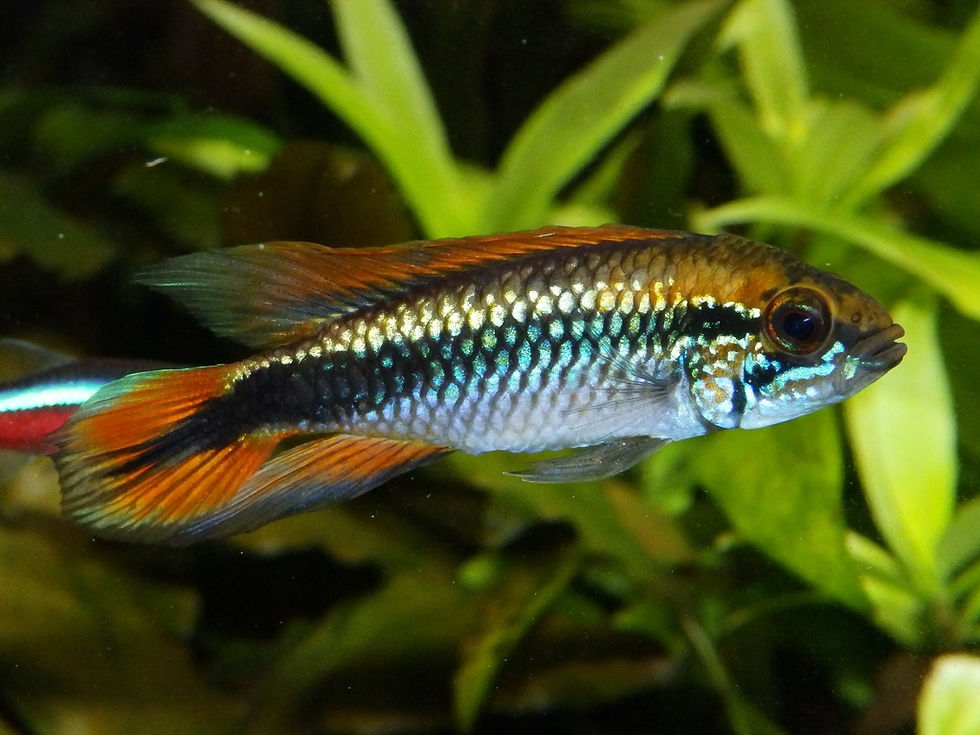
This species displays pronounced sexual dimorphism. Males are larger and far more colorful, with elongated and ornate fin rays often displaying shades of red, blue, or gold. Females are comparatively subdued in coloration, usually brown or pale yellow. However, during the period of brood care, females transform dramatically into a bright yellow coloration accompanied by black markings. During the breeding season, males actively establish territories and attract females through vivid coloration and elaborate fin displays. Their coloration also reflects their status within social interactions.
Each female releases only one clutch of eggs per breeding cycle, and females within a population do not spawn simultaneously. This reproductive pattern represents an adaptation to the dramatic seasonal fluctuations of water levels in the Amazon basin. By staggering reproduction across individuals, the population can continuously produce new generations and reduce the risk that a single environmental disturbance could eliminate an entire cohort. These fish typically live in small groups or pairs. A male may tolerate several females within his territory, forming a polygynous social structure.
Housing Requirements in Captivity
To maintain healthy individuals and allow natural behaviors to appear in captivity, the most important factor is recreating conditions similar to their natural habitat. An aquarium of at least about 40 liters is recommended. If keeping one male with multiple females, a tank measuring at least 80 centimeters in length is preferable. Fine sand or a dark substrate works best for the bottom, as these fish frequently forage along the substrate and sift through it in search of food.
The aquarium should contain driftwood, submerged wood, coconut shells, and piles of rocks. These structures provide hiding places and also break lines of sight, reducing aggression that may arise from territorial disputes.
Aquatic plants also play an important role in the aquarium. Species such as Amazon sword plants, Cryptocoryne, and floating plants can recreate the light patterns typical of natural Amazonian waters while helping stabilize water quality. Floating plants are particularly useful because they diffuse incoming light, producing the dim environment preferred by these fish. To enhance the natural effect, aquarists may add neem leaves or Indian almond leaves. These dried leaves release tannins into the water, creating a natural blackwater environment while also suppressing bacterial growth and improving the survivability of the fish.
In terms of water chemistry, Agassiz's dwarf cichlids prefer soft and mildly acidic water. A pH around 6.0 is ideal, with hardness maintained between 2.5 and 5 dGH. The temperature should be kept between 24 and 27°C. Water flow should remain gentle, as strong currents can cause stress. This species is particularly sensitive to nitrogenous compounds, so effective filtration and regular water changes are essential. In general, replacing about 20% to 30% of the water each week helps prevent the accumulation of nitrate and ammonia.
Tank mates should be chosen carefully. Although generally peaceful, this species becomes strongly territorial during the breeding period. It is best to avoid housing them with other small cichlids. Suitable companions include small Amazonian fish such as neon tetras (Paracheirodon), Corydoras catfish, pencilfish (Nannostomus), and other small schooling species that share similar water conditions and do not compete directly for territory.
Feeding Conditions
In the wild, Agassiz's dwarf cichlids feed mainly on insects and their larvae. This dietary pattern means that they require protein-rich foods in captivity. Providing a varied diet is the best way to ensure balanced nutrition.
High-quality flakes or micro-pellets can serve as staple foods. However, these should ideally be supplemented with foods such as bloodworms, brine shrimp, mosquito larvae, and daphnia. These animal-based foods provide important protein and also stimulate the fish's natural hunting instincts, encouraging more natural feeding behavior.
Overfeeding should be avoided, as these fish do not consume large amounts at once and uneaten food quickly degrades water quality. Feeding small amounts multiple times per day is recommended. Typically, feeding two to three times daily with portions that the fish can consume within five minutes is sufficient. To prevent nutritional deficiencies, the types of food offered should be rotated regularly rather than relying on a single type of diet.
Although the fish can adapt to commercial foods, incorporating insects or cultured micro-invertebrates more closely matches their natural feeding ecology. During breeding and brood-rearing periods in particular, high-protein foods help maintain adult condition and enhance reproductive success while supporting rapid growth of the fry.
Breeding Conditions
Breeding Agassiz's dwarf cichlids is popular among aquarists because of their distinctive parental care behavior. This species is a cave spawner. Females deposit eggs on the inner surfaces of cavities such as driftwood hollows, rock crevices, or coconut shells. A typical clutch contains around 100 to 150 eggs.
The male's primary role is territorial defense, while the female takes responsibility for guarding both the eggs and the developing fry. The eggs hatch within approximately two to five days. After hatching, the female leads the fry out of the cave and guides them in their search for food. During this stage the female becomes extremely protective and will aggressively drive away any nearby organisms.
To achieve successful breeding in a home aquarium, the water should remain soft and mildly acidic, with a pH between about 6.0 and 6.8. The temperature can be raised slightly to around 27°C, and multiple cave sites should be provided so females can select suitable spawning locations. Before breeding, adults can be conditioned with high-protein live foods to improve their physical condition.
A few days after hatching, the fry begin feeding. Newly hatched brine shrimp are widely used as an appropriate first food. As the fry grow, their diet can gradually shift to finely crushed pellets or small chopped foods.
Males may sometimes chase females within the group, so the aquarium must contain sufficient hiding spaces to prevent excessive stress. During the period when fry are present, it is best not to house the pair with other fish species, as the female will repeatedly confront potential threats while protecting her offspring.
Preventing Invasive Spread
Although the Agassiz's dwarf cichlid originates in the Amazon basin, its striking appearance and lively behavior have made it highly popular in the global aquarium trade. This popularity brings a potential ecological risk. If irresponsible owners release or abandon these fish into waters outside their native range, they may become an ecological threat.
Many ornamental fish possess strong adaptability and reproductive capacity. Once introduced into unfamiliar ecosystems, they may compete with native fish for food and habitat, and in some cases may even prey upon native juveniles.
For this reason, aquarists should follow the principle of never releasing or abandoning aquarium fish. If keeping the fish is no longer possible, they should be rehomed through other aquarium hobbyists or returned to local aquarium shops that are willing to accept them. Responsible fishkeeping involves not only caring for captive animals but also respecting and protecting the natural ecosystems of local environments.
Author: Shui-Ye You


Comments