
Ancient Ghosts of the Sea — Rhabdopleura
- Rodrigo

- Mar 13
- 3 min read
Updated: Apr 10
Somewhere on the seafloor of the Atlantic, a pair of feather-like tentacles slowly extends from a tube, quietly filtering the gifts carried by ocean currents. The creature behind those delicate tentacles is Rhabdopleura, a minute marine invertebrate. These animals possess a hard calcareous tube and a crown of feathery tentacles, giving them a superficial resemblance to the familiar marine tube worms.

Yet despite this outward similarity, they are not annelids. When the calcareous tube they construct is opened, the body of Rhabdopleura appears short and compact, attached to the substrate by a fleshy stalk. This contrasts strongly with the elongated, bristle-covered bodies typical of tube-dwelling annelids.

In reality, this peculiar organism belongs to the phylum Hemichordata, a lineage within the deuterostomes. In evolutionary terms, hemichordates are distant relatives of both chordates and echinoderms. Although this relationship may initially seem surprising, the evidence becomes clear during early development. At the gastrula stage, hemichordates such as Rhabdopleura form structures comparable to those seen in chordate embryos, including a dorsal nerve cord and pharyngeal gill slits. Later in development, however, the dorsal nerve cord ceases to develop further, and the nervous system becomes dominated by a ventral nerve cord instead.
Like most hemichordates, Rhabdopleura begins life as a bilaterally symmetrical larva that spends a short period drifting in the plankton. After this brief pelagic stage, the larva undergoes metamorphosis and settles onto the seafloor. There it anchors itself with a stalk and begins constructing a tube made of calcium carbonate.
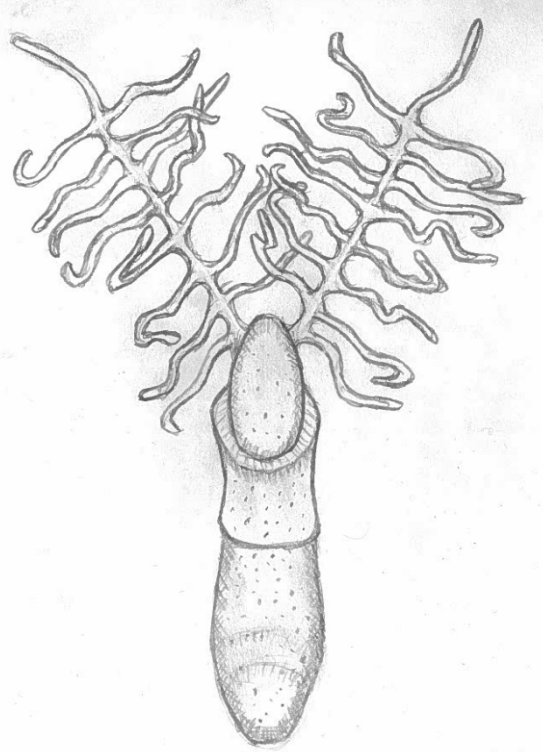
Reproduction in Rhabdopleura occurs in two different ways. One is sexual reproduction, which proceeds through internal fertilization. After fertilization, the female temporarily retains the eggs within the tube until conditions are suitable for their release. The second method is asexual reproduction, achieved through budding, in which new individuals arise directly from the parent colony.

Through the combined strategies of tube construction and budding reproduction, Rhabdopleura and its relatives once flourished in ancient oceans. Their distant relatives are better known under another name: the graptolites. Together they belong to the class Pterobranchia and the clade Graptolithina. During their evolutionary history, graptolites evolved buoyant colonial structures that allowed them to float in the open ocean as planktonic filter feeders. In contrast, Rhabdopleura retained the ancestral lifestyle of fixed, benthic filter feeding on the seafloor.
During the Ordovician and Silurian periods, graptolites were extraordinarily abundant, and their fossils occur in sedimentary rocks across much of the world. However, many graptolite lineages disappeared after the Devonian, leaving behind only a few surviving representatives. Today the order Rhabdopleurida contains a single family and a single genus with only a handful of living species. These surviving Rhabdopleura inhabit the seafloor of the world's oceans, continuing the ancient way of life practiced by their ancestors.

This tiny and ancient marine organism, with its unique hemichordate identity and long evolutionary history, quietly tells part of the story of life on Earth. From the flourishing oceans of the Ordovician to the declines of the Devonian, the lineage that includes graptolites once dominated vast marine ecosystems. Rhabdopleura itself persists today as a resilient remnant of that ancient heritage. Such small and easily overlooked creatures reveal how remarkably diverse and enduring life can be. Perhaps in the future, scientists will uncover further insights into the origins and evolution of life by studying these humble survivors of deep time.
Author: Rodrigo
References:
WoRMS Editorial Board (2025). “Rhabdopleura Allman, 1869”. World Register of Marine Species.
Gordon, D.P., Quek, Z.B.R., Orr, R.J.S. et al. (2023). Morphological diversity and a ribosomal phylogeny of Rhabdopleura (Hemichordata: Graptolithina) from the Western Pacific (Singapore and New Zealand), with implications for a re-evaluation of rhabdopleurid species diversity. Mar. Biodivers.


Comments