
Armadillo Girdled Lizard

Updated: Apr 10

The armadillo girdled lizard (Ouroborus cataphractus) is a member of the family Cordylidae, restricted to the arid regions along the western coast of South Africa, particularly within the succulent Karoo ecosystems of the Northern Cape and Western Cape. This small reptile typically reaches a total length of 16 to 20 cm. Its body is covered with thick, rectangular, heavily armored scales, while the tail is lined with sharp spines, forming a robust protective shield. In contrast, the ventral surface is relatively soft, yellowish in color with darker markings, creating a clear contrast with the varying brown tones of the dorsal side. This coloration provides effective camouflage among rock crevices and serves as a critical survival adaptation in the wild.
In natural habitats, these lizards are commonly found on sandstone slopes or exposed rocky outcrops. They are diurnal, remaining active during the day and retreating into crevices at night. Unlike many solitary lizard species, they display social behavior. A group may consist of 3 to 5 individuals, or even dozens sharing the same rocky habitat. Within these groups, males are strongly territorial, defending both their shelter and associated females, while females and juveniles may move between groups more freely. Although conflicts occur among males, interactions within established groups tend to be relatively stable compared to encounters with outsiders.
In terms of diet, the armadillo girdled lizard primarily feeds on small invertebrates, especially termites. Studies indicate that their most common prey includes Microhodotermes viator and Hodotermes mossambicus. Because termite populations fluctuate with rainfall and climatic conditions, food availability can be unpredictable. To cope with such variability, individuals may reduce activity and food intake during periods of scarcity, thereby lowering competition within the group. In addition to insects and spiders, they may occasionally consume small amounts of plant material.
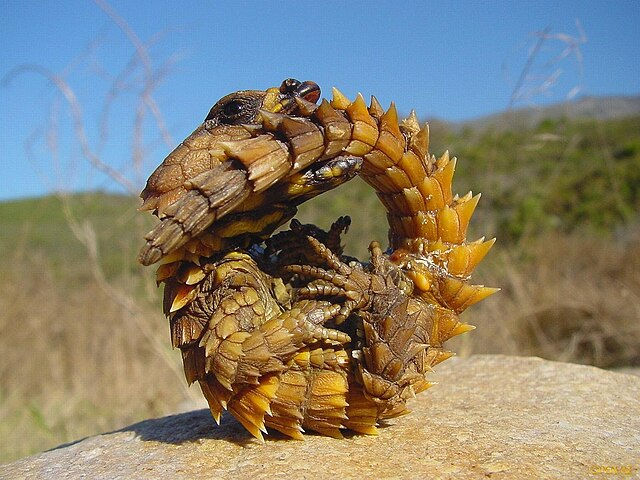
Their most iconic behavior is their defensive posture. When threatened, the lizard grasps its own tail in its mouth and curls into a tight ball, fully protecting its vulnerable underside while exposing only its heavily armored, spiny exterior. This makes it extremely difficult for predators to attack. In some cases, this posture even allows the animal to roll down slopes to escape. The appearance closely resembles both the mythological ouroboros and the mammalian armadillo, which is the origin of its common name.
Reproductively, this species is ovoviviparous. Females do not lay eggs but instead give birth to 1 to 2 live young. Reproductive frequency is relatively low, sometimes occurring only once per year. Remarkably, females may occasionally provide food to their offspring, a rare form of parental care among lizards. Their lifespan can exceed 10 years, with even longer records under captive conditions.
Housing Requirements in Captivity
To keep the armadillo girdled lizard as a pet, it is essential to replicate its natural habitat. As a species adapted to arid rocky environments, it should be housed in a horizontally oriented glass or wooden terrarium. A small group can be accommodated in an enclosure measuring approximately 90 cm in length, 50 cm in width, and 50 cm in height. The substrate is best composed of a 2 to 3 cm layer of compacted clay, which mimics natural ground conditions and is easy to maintain.
The enclosure should include numerous hiding places and crevices. Flat stones can be stacked to create tight shelters, ensuring stability to prevent collapse and injury. These stones also function as basking platforms, providing necessary heat during the day.
Temperature regulation is critical. Daytime ambient temperatures should be maintained at 26 to 28°C, with nighttime temperatures dropping to 22 to 24°C. A basking spot should reach 35 to 38°C, allowing the lizards to thermoregulate by moving between temperature zones. Because they are sensitive to overheating, the basking area should be positioned on one side of the enclosure, leaving a cooler shaded area on the other to establish a thermal gradient.
During the breeding season, photoperiod can be extended to 14 hours. UVB lighting combined with full-spectrum daylight lamps is necessary to support vitamin D3 synthesis and prevent metabolic bone disease. Humidity should be maintained at 50% to 60%, achievable through light misting in the morning and evening.
When housing multiple individuals, compatibility must be monitored closely. Although the species is social, not all individuals coexist peacefully. Subordinate individuals may be excluded or prevented from feeding. Any animal showing signs of persistent stress or exclusion should be separated and housed individually.
Feeding Conditions
In captivity, feeding should reflect their natural diet. The primary food consists of insects such as crickets, Dubia roaches (Blaptica dubia), and Turkestan roaches (Shelfordella lateralis). Mealworms, silkworm larvae, or superworms may be offered occasionally but should not be overused to avoid obesity.
All feeder insects should be gut-loaded with nutritious vegetables or commercial diets before being offered, enhancing their nutritional value. Additionally, insects should be dusted with calcium and vitamin D3 supplements, especially when UVB exposure is insufficient.
Plant material can also be included in the diet. From spring to autumn, suitable greens include dandelion leaves, alfalfa, plantain, and nettle. Edible flowers such as rose, hibiscus, and mulberry blossoms may also be provided. Vegetables such as shredded carrot, lettuce, celery leaves, spinach, and small amounts of broccoli are appropriate, but should be finely chopped to facilitate feeding.
Uneaten food should be removed daily to prevent spoilage and bacterial growth. Adult lizards can be fed insects every three days and vegetables every two days, while juveniles, due to higher growth demands, should be fed daily.
During winter brumation, which lasts approximately two and a half months, feeding should be completely halted while maintaining access to clean water. In the two weeks prior to brumation, lighting and heating should be gradually reduced and feeding stopped, allowing the digestive tract to clear and preventing complications at low temperatures.
Breeding Conditions
Reproduction in this species is closely tied to seasonal cycles. Successful breeding in captivity requires a simulated brumation period. After brumation, increased misting and extended daylight hours stimulate mating behavior. Sexual maturity is typically reached at around three years of age. The gestation period lasts approximately 5 to 6 months, with females usually giving birth to 1 to 2 offspring in late spring or autumn.
When a female is gravid, the enclosure should be kept stable and disturbance minimized. Adequate hydration must be ensured. Although newborns are small, they resemble miniature adults and are capable of feeding independently. Small insects and finely chopped vegetables should be provided.
Observation of maternal behavior is recommended, as some females may assist in feeding or protecting their young. Separation of offspring from the mother should not occur prematurely unless aggression or rejection is observed.
Preventing Invasive Spread
Finally, it is essential to emphasize that keeping non-native species carries a responsibility to prevent their establishment as invasive species. The armadillo girdled lizard is endemic to South Africa, and releasing it into non-native environments could pose ecological risks.
Owners must ensure lifelong care of their animals. If circumstances prevent continued care, the animal should be transferred to a qualified rescue facility or an experienced keeper, rather than being released into the wild.
This species is listed under Appendix II of the Convention on International Trade in Endangered Species of Wild Fauna and Flora (CITES) and is protected under South African law. When acquiring individuals, it is crucial to ensure legal sourcing and to avoid supporting illegal wildlife trade or the capture of wild populations.
Author: Shui-Ye You


Comments