
Australian Spotted Jellyfish | Marine Species

Updated: Apr 10
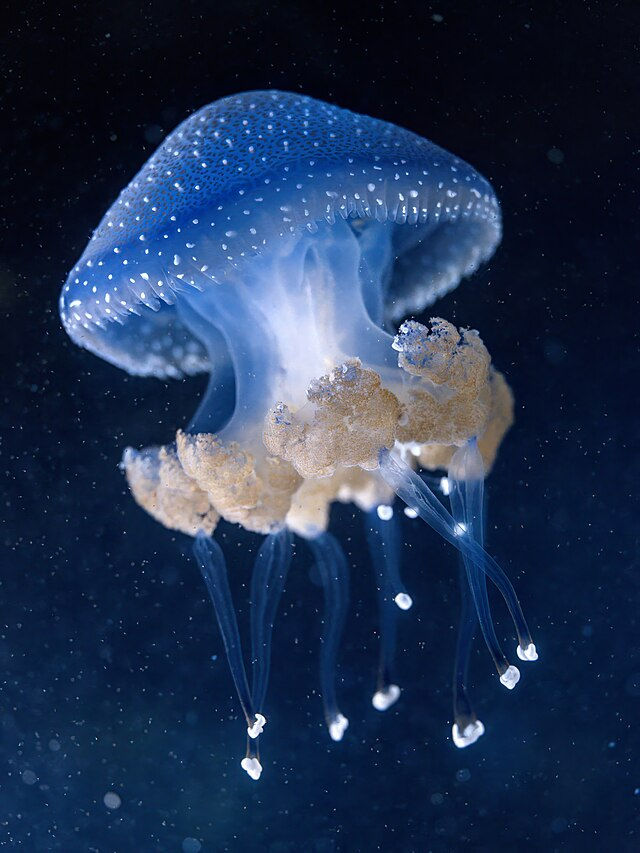
The Australian spotted jellyfish (Phyllorhiza punctata) is a species native to the western Pacific Ocean, with a natural range extending from the northeastern coast of Australia to Japan and Southeast Asia. Within these tropical and subtropical waters, it commonly inhabits estuaries, bays, and warm coastal areas, often drifting in large aggregations. Its bell is semi-transparent and covered with numerous white spots. The bell diameter typically reaches 40–50 cm and may exceed 60 cm under especially favorable environmental conditions, making it one of the more striking jellyfish encountered in marine environments.
Like many jellyfish, the Australian spotted jellyfish possesses a complex life cycle. After fertilization, the eggs develop into free-swimming planula larvae. These larvae eventually settle on a suitable substrate and transform into a sessile polyp stage known as a scyphistoma. The scyphistoma can reproduce asexually by budding. When environmental conditions are suitable, it undergoes transverse segmentation known as strobilation, producing small disc-shaped juvenile jellyfish called ephyrae. As they grow, the ephyrae gradually develop into adult medusae. Adult jellyfish reproduce sexually through external fertilization: males release sperm into the water, which females collect to complete fertilization.
These jellyfish primarily feed by filter feeding, capturing plankton such as fish larvae and crustacean larvae. Because they often occur in dense groups, a large aggregation can filter tens of thousands of liters of seawater per day. Such intense feeding pressure can significantly alter local ecosystems when populations become large. Although the Australian spotted jellyfish is not strongly venomous to humans and its nematocysts usually cause only mild or barely perceptible stings, large populations can still place considerable pressure on fisheries resources and marine ecosystems.
In the wild, the lifespan of this species varies depending on environmental conditions. The polyp stage may persist for several years, while the medusa stage generally lives only one to two years. These jellyfish thrive best in warm seawater with moderate salinity. When salinity becomes too low, the symbiotic algae living within their tissues may be lost, reducing their energy supply and lowering survival rates.


Housing Requirements in Captivity
Keeping Australian spotted jellyfish requires recreating conditions similar to their natural marine environment. A specialized jellyfish aquarium must be used, most commonly a circular Kreisel tank. Unlike standard fish aquaria, jellyfish tanks must maintain gentle, evenly distributed water flow to prevent the animals from being pushed into corners or colliding with the tank walls. Jellyfish lack rigid body structures, so excessive water turbulence can easily damage them. Low to moderate current helps keep them suspended in the water column and allows them to feed effectively.
Water temperature should be maintained between 24 and 28°C, which is the most suitable range for the species. Temperatures outside this range may lead to mortality. Salinity should remain between 30‰ and 35‰. A reliable filtration system is essential to prevent the accumulation of organic waste, as deteriorating water quality can quickly harm jellyfish.
Australian spotted jellyfish also maintain a close symbiotic relationship with algae living within their tissues. Adequate lighting is therefore required to support photosynthesis by these algae. Full-spectrum lighting is recommended, typically providing 8–12 hours of illumination per day. This allows the jellyfish to obtain additional energy from their symbionts. Insufficient light will gradually cause the jellyfish to become more transparent and nutritionally depleted, resulting in declining health. Because adult individuals can grow large, stocking density must remain low to prevent collisions that may damage their form and condition.
Feeding Conditions
Australian spotted jellyfish rely mainly on planktonic prey captured through filter feeding, so small live foods must be provided in captivity. Newly hatched brine shrimp are among the most commonly used foods. These small prey items are abundant and can be effectively captured by the jellyfish's oral arms. During feeding, the food should be evenly distributed throughout the water column rather than concentrated in one location, ensuring that all individuals have an opportunity to feed.
Jellyfish digest food rapidly, typically completing digestion within approximately two hours. For this reason, small amounts of food should be provided multiple times per day. Feeding two to three times daily is generally recommended to maintain adequate energy intake and support normal growth. Uneaten food can die and decompose quickly, polluting the water, so careful control of feeding quantity is essential.
Some aquarists temporarily transfer jellyfish to a separate feeding container during feeding and return them to the main tank afterward. This method reduces the accumulation of waste in the primary aquarium. If jellyfish need to be moved, they should never be handled with a net. Their bodies are extremely delicate and easily damaged. Instead, a container should be used to transfer the jellyfish together with seawater so that the animal remains submerged throughout the process.
Caretakers can monitor the jellyfish's condition through observation. A well-inflated bell and active swimming indicate adequate nutrition, whereas an overly transparent or shrinking bell may signal insufficient feeding or inadequate lighting conditions.
In addition to direct feeding, photosynthesis by the symbiotic algae driven by proper lighting also provides an important source of nutrition. Successful husbandry therefore requires careful management of both feeding and lighting to maintain health and longevity.
Breeding Conditions
Breeding Australian spotted jellyfish in captivity can be relatively complex. Their life cycle includes both the asexual polyp stage and the sexual medusa stage. In aquaria, if polyps successfully attach to a solid substrate, they may repeatedly produce ephyrae through strobilation. These ephyrae gradually develop into small jellyfish and eventually mature into adult medusae.
If signs of reproduction appear in the aquarium, such as the presence of numerous tiny jellyfish or visible polyps, adjustments may be necessary. An increasing population significantly raises food requirements and can quickly lead to overcrowding. Caretakers should therefore prepare additional space or separate tanks in advance. If unexpected reproduction produces more individuals than can be maintained, nearby marine aquarium shops may sometimes accept them. Otherwise, humane euthanasia may be required, such as rapid cooling in a freezing environment. Not all aquarium systems can support the full life cycle, and without appropriate equipment, polyps and juvenile jellyfish often suffer high mortality.
For most hobbyists, maintaining healthy adult jellyfish over the long term is generally more practical than attempting large-scale breeding.
Preventing Invasive Spread
Although the Australian spotted jellyfish is native to the western Pacific Ocean, it has become an invasive species in many parts of the world. Because the polyp stage can easily attach to ship hulls or be transported through ballast water, the species has appeared in regions such as the United States, the Gulf of Mexico, the Caribbean, the Mediterranean Sea, and even Hawaii. In these non-native environments, populations can expand rapidly and consume large quantities of plankton, severely affecting local fisheries and ecosystems. Dense blooms can also clog fishing nets and damage water intake systems on vessels.
Although waters around Taiwan fall within the species' natural distribution, individuals raised in captivity may differ genetically from wild populations after prolonged artificial breeding. Releasing captive individuals could therefore introduce genetic contamination into wild populations. Furthermore, aquarium animals may carry pathogens that could spread to wild jellyfish. For these reasons, aquarists must follow the principle of never abandoning or releasing captive animals into the wild. If an owner can no longer maintain the animals, the responsible approach is to find another suitable caretaker or consult a nearby marine aquarium shop for possible relocation.
Author: Shui-Ye You


Comments