
Blue Iguana

Updated: Apr 10

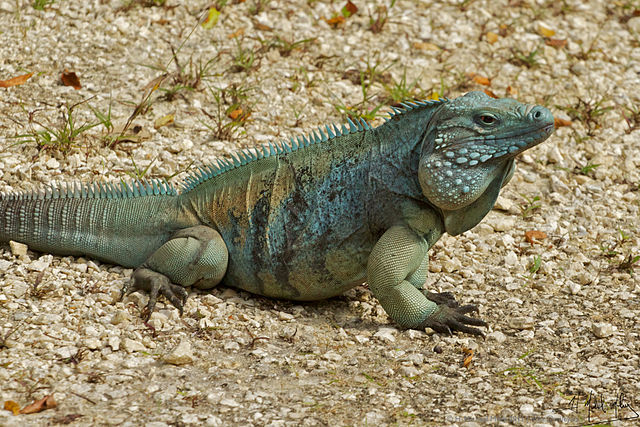
The blue iguana (Cyclura lewisi) is one of the rarest and largest iguanas in the world, and an endemic terrestrial reptile of the Cayman Islands. It was originally regarded as a subspecies of the Cuban iguana (Cyclura nubila) until it was formally recognized as a distinct species in 2004. This species represents a classic case of island gigantism, with adults reaching up to 1.5 meters in length and weighing nearly 14 kilograms, making it the largest land animal on Grand Cayman. Males are noticeably larger than females, possess more developed dorsal spines, and have prominent femoral pores on the inner thighs that secrete pheromones for territorial marking.
The coloration of the blue iguana changes with age and context. Juveniles are typically dark brown or dark green with faint markings, gradually shifting to gray-blue or green-blue as they mature. Adult males develop a vivid blue coloration during the breeding season, serving both as a sexual signal and a territorial display. Females are generally olive green to pale blue. Blue iguanas are typically solitary and highly territorial, communicating and issuing warnings through head-bobbing behavior.
In the wild, they inhabit dry rocky habitats and open forests, using rock crevices, caves, or hollow trees as nighttime shelters. Juveniles are more arboreal to avoid predators, while adults are primarily terrestrial and frequently bask in sunlight during the day to regulate body temperature. Their diet is mainly herbivorous, consisting of leaves, flowers, fruits, and nuts, with occasional consumption of insects, snails, or fungi. They are also important seed dispersers, playing a crucial role in maintaining the native vegetation of the Cayman Islands.
Blue iguanas have exceptionally long lifespans, potentially living for several decades in the wild, with captive individuals recorded to reach up to 69 years. The breeding season occurs roughly from May to June. Males court females through frequent head-bobbing and chasing, while females select suitable sandy areas to dig deep nests for egg-laying. Clutch sizes range from 1 to 21 eggs, with an incubation period of approximately 65 to 90 days. Although females invest considerable effort in concealing and guarding the nest, hatchling survival rates remain low due to predation by snakes, rodents, cats, and dogs.
Due to habitat destruction and pressure from introduced predators, the blue iguana population declined to fewer than 15 individuals in the wild by 2003, placing it on the brink of extinction. Through coordinated local and international conservation efforts, including captive breeding and reintroduction programs, the population has gradually recovered, with several hundred individuals now re-established in protected areas on Grand Cayman. Since then, they have occasionally appeared in the global pet trade. However, the International Union for Conservation of Nature (IUCN) still classifies the species as Endangered.
Housing Requirements in Captivity
When keeping blue iguanas as pets, a spacious enclosure that closely mimics their natural environment is essential. Due to their large size, small glass terrariums are entirely unsuitable. Ideally, they should be housed in large outdoor enclosures or at least in a spacious indoor reptile room. The substrate should consist of soil or sand suitable for digging, combined with rocks, logs, and cave-like structures to replicate their natural use of crevices and shelters.
Blue iguanas require prolonged exposure to sunlight to maintain health. The enclosure must provide high-output UVB lighting or metal halide lamps to enable proper vitamin D3 synthesis and calcium absorption, thereby preventing skeletal disorders. Daytime temperatures should be maintained between 28 and 32°C, with a localized basking area exceeding 35°C. Nighttime temperatures may drop slightly but should not fall below 22°C. Humidity does not need to be high; a well-ventilated, relatively dry environment is sufficient.
Although primarily terrestrial, blue iguanas are capable climbers. The enclosure should include sturdy branches or elevated platforms for observation and resting. Hiding places should also be provided to allow individuals to retreat when stressed or resting. Due to their territorial nature, keeping multiple individuals together requires extremely large spaces; otherwise, aggressive interactions are likely.
Feeding Conditions
Blue iguanas are strictly herbivorous reptiles and should be fed a diet primarily composed of vegetables, fruits, and plant matter. Common food items include leafy greens such as dandelion greens, mustard greens, and kale; root vegetables and gourds such as pumpkin, carrot, and sweet potato; and small amounts of fruit such as papaya, mango, and berries. Food should be cut into appropriately sized pieces to prevent choking. Commercial diets formulated for herbivorous reptiles may also be used as supplements.
Foods high in oxalates, such as spinach and beet greens, should be limited as they can interfere with calcium absorption. Animal-based food is not a dietary requirement. Occasional accidental ingestion of insects or snails is harmless, but regular feeding of animal protein is not recommended, as it may place strain on the kidneys. Calcium and vitamin supplements should be provided regularly to ensure proper skeletal development.
Juveniles should be fed daily, while adults can be fed every 2 to 3 days. Fresh drinking water should always be available. Although blue iguanas obtain much of their moisture from food, they may still drink water under hot or dry conditions. Uneaten food should be removed promptly to prevent spoilage and insect attraction.

Breeding Conditions
If blue iguanas enter the breeding season in captivity, an appropriate nesting environment must be prepared in advance. Gravid females show noticeable abdominal swelling, reduced appetite, and actively search for loose substrate to dig nesting burrows. The enclosure should provide at least 40 to 60 cm of sandy or soil substrate to allow proper nest excavation. Without suitable nesting conditions, females may suffer from egg retention, which can be life-threatening.
Clutch size varies depending on age and body size, ranging from a few eggs up to around 20. Eggs should be carefully removed for artificial incubation at temperatures of approximately 30 to 32°C with moderate humidity. The incubation period typically lasts 2 to 3 months. Hatchlings are highly vulnerable and should be housed separately to prevent attacks from adults.
Breeding blue iguanas is not easily managed by typical keepers, given their long lifespan and demanding environmental requirements. A large number of offspring can quickly create significant housing pressure. Therefore, breeding is generally best left to experienced breeders or conservation organizations to avoid abandonment issues.
Preventing Invasive Spread
Although rare, blue iguanas may pose ecological risks if improperly introduced into non-native regions. While their reproductive rate is relatively low, individuals released into tropical or subtropical environments may survive and impact local vegetation and ecological balance.
Keepers must strictly adhere to a no-release policy. If circumstances prevent continued care, animals should be transferred to legal animal shelters or responsible, experienced keepers rather than being released into the wild.
Furthermore, blue iguanas are listed under the Convention on International Trade in Endangered Species of Wild Fauna and Flora (CITES), and international trade is strictly regulated. Buyers must verify legal sourcing and retain all relevant documentation to avoid legal violations. Keeping such a rare reptile entails significant responsibility and is not suitable for individuals seeking novelty or lacking long-term commitment.
Author: Shui-Ye You


Comments