
Cardinal tetra

Updated: Apr 10

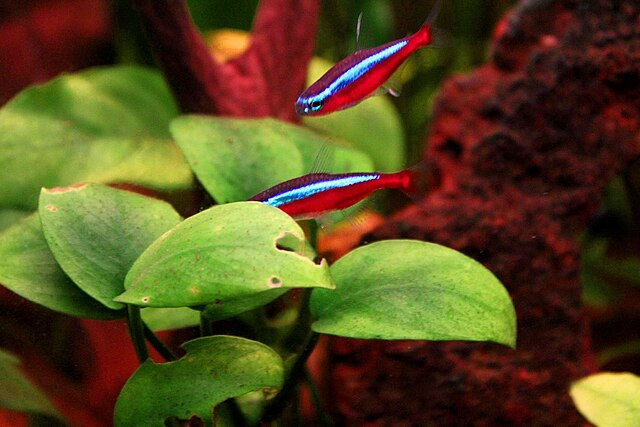
The cardinal tetra (Paracheirodon axelrodi) is a highly popular ornamental fish belonging to the family Characidae within the order Characiformes. Species in the genus Paracheirodon are commonly referred to as “neon tetras.” These fish typically grow to about 2–3 cm in length. Although small, they are strikingly colorful, with a bright iridescent blue stripe running along the side of the body and a vivid red coloration covering the lower half of the body. Their appearance resembles that of the closely related neon tetra (Paracheirodon innesi), but the red stripe of the cardinal tetra extends further along the body, making the two species readily distinguishable. This species was formally described in 1956 by the American ichthyologist Leonard Peter Schultz.
In the wild, the cardinal tetra is mainly distributed in the upper Orinoco River basin of South America and the Rio Negro drainage in Brazil. It inhabits slow-moving waters in forest streams and tributaries. These waterways are typically shaded by dense tropical rainforest canopy, preventing direct sunlight from penetrating the water. The water often appears tea-colored or black due to large amounts of dissolved humic substances, forming what is known as a blackwater environment. The water is extremely soft and acidic, with pH values often below 6, while temperatures remain stable between 25 and 29°C. During the dry season, fish schools gather in the main stream channels or in remaining shallow pools. When water levels rise in the rainy season, they move into flooded forest vegetation to feed and reproduce.
The cardinal tetra is primarily a micro-predator that feeds on small crustaceans, insect larvae, rotifers, and other tiny invertebrates, occasionally consuming algae and organic detritus. These fish exhibit strong schooling behavior and commonly move in groups of dozens or even hundreds. Schooling not only reduces the risk of predation but also facilitates mating during the breeding season. In nature, their lifespan is relatively short, often only about one year. Under captive conditions, however, they can live several years. This difference suggests that captive environments can provide more stable water conditions and a reliable food supply, improving overall health and survival.
Housing Requirements in Captivity
Successfully keeping cardinal tetras requires recreating conditions similar to their natural habitat. Because this species strongly prefers schooling, it is recommended to keep at least ten individuals together and provide an aquarium with a minimum length of 60 cm. Fine sand can be used as the substrate, combined with driftwood and leaf litter to release humic substances that give the water a light brown tint. This not only creates a more natural environment but also releases tannins that help maintain slightly acidic water conditions. Moderate planting of aquatic vegetation or the addition of floating plants can effectively reduce light intensity and provide shelter, giving the fish a greater sense of security.
The recommended water temperature is between 24 and 28°C, with a pH of 6.0–6.5 in soft water conditions. Cardinal tetras are highly sensitive to ammonia and nitrite, so regular water changes are essential. It is advisable to replace about 10–20% of the water each week. Because blackwater environments have relatively low buffering capacity, sudden changes in water chemistry must be avoided. When performing water changes, it is recommended to use treated soft water or reverse osmosis water, supplemented with peat, oak leaves, or Indian almond leaves to help maintain appropriate acidity.
Lighting should be kept subdued, as cardinal tetras naturally prefer dim environments. Floating plants can help filter incoming light and often enhance the intensity of the fish's coloration. Cardinal tetras are peaceful fish and can be kept with other small, gentle species, such as the rummy-nose tetra (Hemigrammus bleheri) or pencilfish species of the genus Nannostomus. If kept in community tanks, large or aggressive fish should be avoided, as they may cause chronic stress in the cardinal tetra.
Feeding Conditions
In the wild, cardinal tetras mainly feed on small crustaceans, insect larvae, and zooplankton. Therefore, a varied diet should be provided under captive conditions. Although they can survive on commercial foods such as high-quality tropical fish flakes or micro pellets designed for tetras, combining these with live foods helps maintain vibrant coloration and active behavior. Common options include newly hatched brine shrimp, water fleas (Daphnia), mosquito larvae, and bloodworms. These protein-rich foods help maintain body condition and may also stimulate reproductive behavior.
Feeding should be carried out in small portions multiple times per day, ideally two to three times daily. Because cardinal tetras have small mouths, food should be finely crushed or selected in appropriately small sizes to prevent uneaten food from sinking and degrading water quality. For aquarists attempting to condition fish for breeding, increasing the proportion of high-protein live foods such as Daphnia or brine shrimp can significantly improve coloration and overall health.
When feeding in a school, cardinal tetras often compete actively for food. This behavior rarely leads to aggression and is generally a sign of a healthy group. As long as food is distributed evenly and weaker individuals are not consistently deprived of food, the school will remain stable. Fry require much smaller foods, such as infusoria or rotifers, and can gradually transition to larger foods as they grow.
Breeding Conditions
In nature, cardinal tetras typically reproduce during the rainy season. When rivers overflow and provide abundant shelter and food resources, schools gather in densely vegetated areas for group spawning. Fertilization occurs externally. A female may release several hundred tiny, transparent eggs at a time, which are simultaneously fertilized by the male. The eggs hatch within one to two days, and the fry begin free swimming three to four days later. However, breeding in captivity is relatively difficult because the species requires very specific water conditions.
To attempt breeding, it is recommended to prepare a separate breeding tank with extremely soft and slightly acidic water. The pH should be around 6.0, hardness close to 0–5 dGH, and the temperature maintained between 27 and 29°C. The tank should be dimly lit and contain fine-leaved aquatic plants that provide surfaces for egg deposition. After spawning and fertilization occur, the adult fish should be removed and returned to the main aquarium while the eggs remain in the breeding tank to develop.
Fertilized eggs typically hatch within 24–36 hours. The larvae are extremely sensitive to light, so the tank should remain shaded. During the earliest stages, they can be fed infusoria or commercially available liquid fry foods, gradually transitioning to newly hatched brine shrimp after several days. Throughout this process, maintaining stable water quality is essential, as the fry have extremely low tolerance for pollution or sudden changes in water chemistry. Although breeding cardinal tetras is challenging, successful reproduction can be highly rewarding. Because females produce large numbers of eggs, aquarists should plan in advance for adequate space and proper care for the growing juveniles.
Preventing Invasive Spread
The cardinal tetra is native to South America. Because it is small in size and capable of reproducing efficiently, releasing unwanted individuals into non-native waterways could create competition with local fish species and potentially cause irreversible ecological impacts.
Aquarists should therefore follow the principle of never releasing or abandoning aquarium animals in the wild. If it becomes impossible to continue keeping the fish, they can be rehomed to other aquarists or returned to a nearby aquarium shop that may accept them. Under no circumstances should excess fish be disposed of by flushing them down toilets or pouring them into sinks. Respect for life and respect for ecological balance are essential responsibilities of all pet owners.
Author: Shui-Ye You


Comments