
Cretaceous Ichthyosaur Skin Fossil: Rare Soft-Tissue Preservation Discovered in Colombia

During the Early Cretaceous, numerous exceptionally preserved fossil localities formed around the world. In addition to skeletal remains, these deposits preserve soft tissues such as skin and muscles, providing valuable evidence for reconstructing the appearance and ecology of ancient organisms. However, most exceptionally preserved fossil sites are located in temperate or subtropical regions. Comparable records from low-latitude regions, particularly northern South America, remain relatively scarce.
In addition, the fossil record of Early Cretaceous marine vertebrates contains a comparatively poorly documented interval. The discovery of exceptionally preserved marine vertebrate fossils from this period could therefore help fill important gaps in our understanding of their evolutionary history. Among marine reptiles, ichthyosaurs are especially valuable because their fossils frequently preserve soft tissues, including skin, muscles, and possibly even internal organs, making them important material for studying soft-tissue preservation.
Most known ichthyosaur fossils preserving soft tissues have been recovered from Jurassic deposits in Europe, while only a few have been reported from Triassic deposits in China and Italy. These fossils not only reveal details of ichthyosaur skin and musculature, but also provide important insights into their physiology and the processes responsible for soft-tissue preservation.

Compared with the well-studied Jurassic deposits, the Lower Cretaceous Paja Formation of Colombia is also rich in marine vertebrate fossils. However, its potential for preserving soft tissues has only begun to receive attention in recent years. Several fossils, including turtles, fishes, and ichthyosaurs, have been reported to preserve possible soft tissues. In this study, researchers conducted multiple analyses on an ichthyosaur specimen from the Paja Formation to determine whether soft tissues were preserved, to investigate the mechanisms responsible for their preservation, and to better understand how a low-latitude Cretaceous Konservat-Lagerstätte formed.
The specimen examined in this study, catalogued as CIP-0107, was discovered during fieldwork in 2018 from the Paja Formation in Colombia. The fossil dates to the Barremian–Aptian stages of the Early Cretaceous. During preparation, preparators noticed a wax-like substance covering the area behind the skull that appeared to represent preserved soft tissue. To minimize disturbance, the area was left largely untouched and the specimen was stored separately in a dry, light-protected cabinet to preserve its integrity prior to analysis.
Preliminary taxonomic identification assigned the specimen to the family Brachypterygiidae and the genus Muiscasaurus. Based on its relatively slender snout, it was further considered likely to represent Muiscasaurus catheti.

A portion of the suspected soft tissue was divided into samples for demineralization and thin-section preparation prior to analysis. The thin sections were examined using scanning electron microscopy (SEM) and elemental analysis, which indicated that the material was likely skin tissue. The samples were rich in carbon and oxygen but contained very little calcium, whereas the surrounding sediment was calcium-rich. Meanwhile, demineralization yielded a flexible, skin-like membrane approximately 5 mm long. Elemental analysis showed that it consisted almost entirely of carbon and oxygen, consistent with fossilized organic material and further supporting the interpretation that this skin-like structure represents preserved soft tissue.
The samples exhibited a reticulate microstructure composed of regularly arranged features with well-defined boundaries and uniform thickness. These structures differed markedly from those produced by microbial mats or algae. Instead, their morphology closely resembled the keratinized squamous epithelial cells found in the epidermis of modern cetaceans and was also similar to epidermal structures previously reported in other ichthyosaur and plesiosaur fossils preserving soft tissues. In addition, microscopic examination revealed two star-shaped structures that were interpreted as possible melanophores.

The researchers then compared the suspected soft tissues of CIP-0107 with previously reported soft-tissue preservation in European ichthyosaurs. They found that the folds and undulating patterns preserved along the side of the skull closely resembled those observed in other ichthyosaur specimens with confirmed skin preservation. These features were interpreted as deformation of the skin caused by decay and the loss of structural support after death.
Taken together, these observations indicate that CIP-0107 preserves not only the external morphology of the skin but possibly also portions of its epidermal microstructure, making it one of the few known examples of soft-tissue preservation in a Cretaceous ichthyosaur.
The researchers propose that the exceptional preservation of soft tissues in CIP-0107 is closely related to the depositional environment of the Paja Formation. During the Early Cretaceous, this region is thought to have been a marine environment approximately 60–130 m deep, where persistently low oxygen levels and a calm depositional setting allowed the carcass to be buried rapidly after death, reducing the likelihood of scavenging and disarticulation.
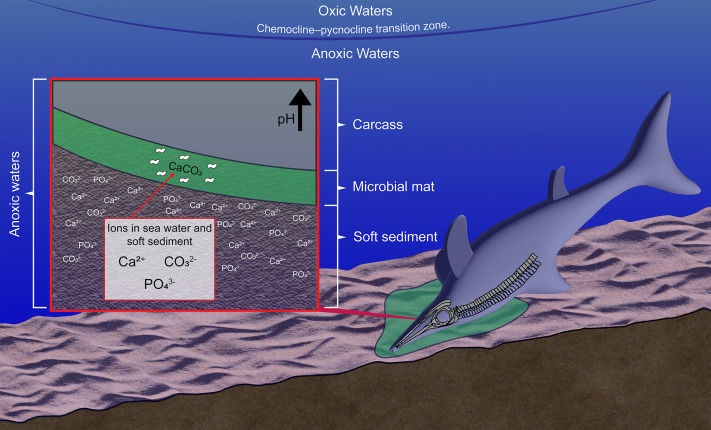
In addition to rapid burial, anaerobic microorganisms may also have played a crucial role in the preservation process. These microbes are thought to have formed biofilms around the carcass while simultaneously promoting the precipitation of calcium carbonate, eventually producing concretions that enclosed the fossil and protected it from external disturbance and degradation.
This preservation pathway suggests that the fossilization mechanism of the Paja Formation differs from that of many other marine Konservat-Lagerstätten. Rather than relying primarily on the processes commonly associated with other fossil deposits, soft-tissue preservation in the Paja Formation appears to have depended largely on microbially mediated mineralization.
The discovery of CIP-0107 therefore provides important new evidence for understanding how soft tissues can be preserved in low-latitude Cretaceous marine environments. It also highlights the potential of the Paja Formation as an important Konservat-Lagerstätte and expands our knowledge of soft-tissue preservation in Cretaceous marine vertebrates.
(Author: Bai Leng)
Reference:
Martinez-Motta, M. F., Cortés, D., Maxwell, E. E., Noè, L. F., Alfonso-Rojas, A., Parra-Ruge, F. H., Cadena, E.-A. (2026). Soft-tissue preservation in an ichthyosaur from the Lower Cretaceous (Barremian - Aptian) of Colombia. Cretaceous Research.


Comments