
Elephants Can Actually Use Hoses to Shower Themselves

As more and more studies and observations have been conducted, scientists have discovered that many animals possess cognitive abilities far beyond what people once believed. Among the most remarkable examples are elephants. Not only do they possess complex social structures, but they also display many unusual behaviors. Asian elephants (Elephas maximus), for instance, have even been observed burying and mourning dead calves.
These findings have led scientists to wonder what other abilities Asian elephants might possess, prompting further research. One such study was conducted at the Berlin Zoo and focused on three female Asian elephants: Mary, Anchali, and Pang Pha. Researchers provided the elephants with flexible plastic water hoses with running water flowing through them in order to observe their behavior. To their surprise, Mary began using her trunk to pick up the hose and shower herself, while Anchali manipulated the hose in various ways that interrupted the water flow during Mary’s showering sessions.

So, what exactly did the researchers observe?
First, there was Mary. Whenever she wanted to shower, she could grasp the hose with her trunk and begin showering herself within five seconds. On average, her showers lasted around seven minutes. If the water was turned off, Mary would immediately discard the hose and stop using it.
Although elephants naturally spray themselves with water or mud using their trunks, Mary’s hose-showering behavior differed significantly from ordinary trunk spraying. Her actions were noticeably more organized and methodical. When showering different parts of her body, she used different grips and holding positions to make the process more efficient. For example, when showering the sides of her body, Mary held the hose close to the nozzle and directly controlled the direction of the spray. However, when showering her back, she held the hose farther away from the nozzle and swung the hose onto her back instead.
It remains unclear how Mary learned this skill. According to the zoo keepers, she had never received any related training. However, it is possible that Mary had previously observed similar behavior in other elephants before arriving at the Berlin Zoo.
Researchers also discovered an interesting phenomenon: Mary showed completely different lateral preferences when showering with a hose versus showering with her trunk. When using her trunk normally, Mary preferred spraying the right side of her body. In contrast, when using the hose, she spent more time showering the left side. Researchers suggested that this may be somewhat comparable to human handedness. Previous studies have shown that tool use often enhances lateralized behavior in animals, so Mary may effectively be “left-handed.” However, Mary’s preferred direction during ordinary trunk showering did not match her trunkedness, making this case particularly unusual, and there is currently no clear explanation for it.

The researchers later provided Mary with three hoses of different sizes to see whether she would alter her showering strategy depending on the tool. The results showed that when given a thick hose with a diameter of 32 millimeters, Mary preferred using her trunk rather than the hose for showering. When given the standard 24-millimeter hose, she preferred hose showering. Meanwhile, when presented with the thinnest hose, measuring 13 millimeters in diameter, Mary often chose not to shower at all. These results demonstrate that Mary adjusted her behavior according to the properties of the tool being used.
Next came Anchali, the younger elephant. Researchers observed that Anchali displayed complex hose-manipulation behaviors. She would lift, bend, kink, and squeeze the hose, causing interruptions in the water flow.
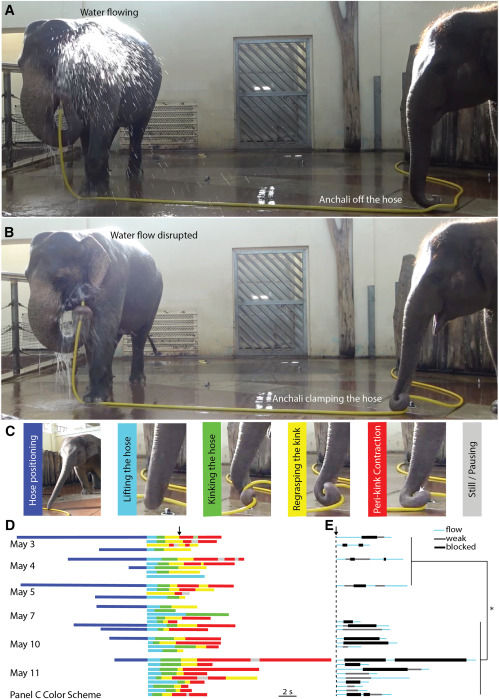
But was Anchali intentionally interfering with Mary’s showering, or were these merely playful side effects?
Because Mary occasionally displayed aggression toward Anchali, Anchali certainly had a possible motive for disrupting Mary’s showering behavior. Furthermore, over time, Anchali’s ability to interrupt the water flow improved, and the duration of the interruptions increased, suggesting the possibility of intentional behavior. However, when researchers provided Anchali with two hoses — one being used by Mary and another lying unused — Anchali showed no particular preference for interfering with Mary’s hose. Instead, she generally chose whichever hose was physically closer to her. As a result, the study could not conclusively determine whether Anchali’s actions were truly intended to disrupt Mary’s showering. In addition, because the experiments were limited by the zoo environment, both the scale and number of observations remained relatively small. More data will therefore be needed in future studies, especially regarding whether Anchali could visually distinguish which hose led to Mary.
Finally, let’s talk about Pang Pha. Although she played a relatively minor role in this study, Pang Pha is also a very special elephant. She peels bananas before eating them — especially when the bananas are very ripe. One could say that Pang Pha is quite particular about her food.
Overall, this study provides important insights into elephants’ abilities in tool use, learning, and behavioral complexity.
(Author: Bai Leng)
Reference:
Urban, L., Becker, R., Ochs, A., Sicks, F., Brecht, M., Kaufmann, L. V. (2024). Water-hose tool use and showering behavior by Asian elephants. Current Biology.


Comments