
How Did Dinosaurs Curl Up Before Hatching? An Oviraptorid Embryo Preserves a Bird-like Prehatching Posture

During the later stages of development, bird embryos gradually change their body posture, repositioning the head, neck, wings, and limbs in preparation for hatching. This tucking behavior is controlled by the nervous system and is critical for successful hatching. Whether the non-avian dinosaur ancestors of birds exhibited similar behavior has long been unclear, but a fossil from the Late Cretaceous Hekou Formation of Ganzhou, Jiangxi Province, China, provides an important clue.
The specimen, YLSNHM01266, is preserved inside an egg measuring 16.7 cm long and 7.6 cm at its widest point. The eggshell structure and surface ornamentation are characteristic of Elongatoolithidae, an oofamily used in the classification of fossil eggs. Inside the egg is a nearly complete, largely articulated theropod dinosaur embryo. Based on its edentulous skull, short and highly arched dentary, and other cranial features, together with phylogenetic analysis, the embryo was assigned to Oviraptoridae, although it cannot be identified to species.

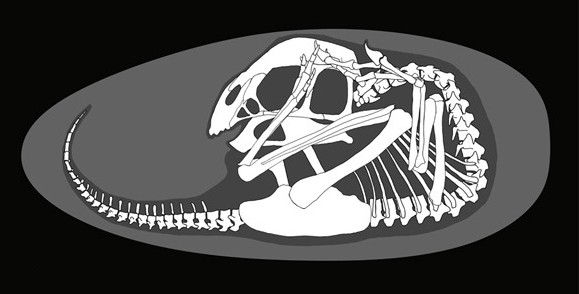
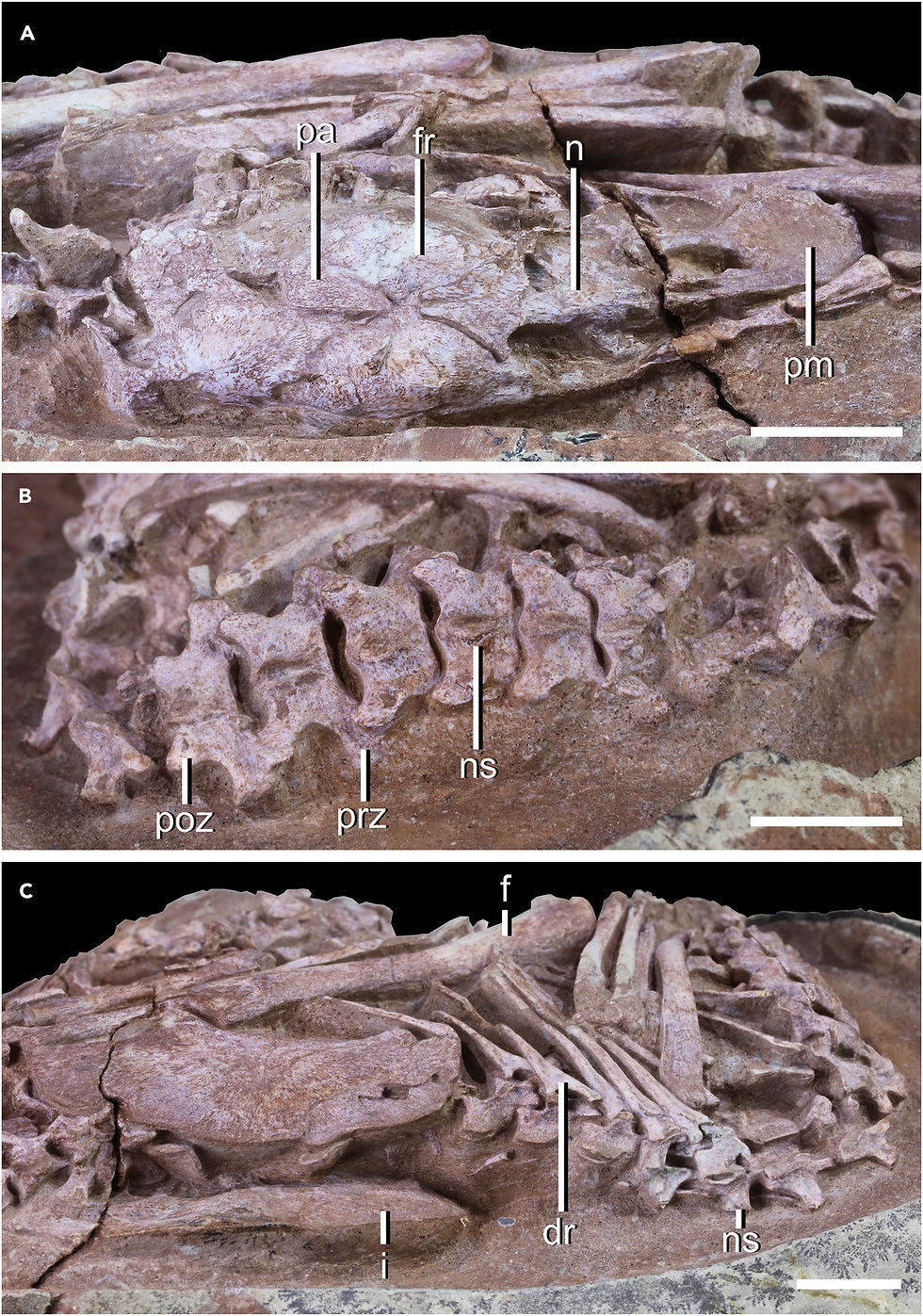
If the curled body were straightened out, the skeleton would measure approximately 23.5 cm from the anterior tip of the skull to the last preserved caudal vertebra. The head lies ventral to the body near the pelvic region, while both hindlimbs are strongly flexed, with a foot positioned on either side of the skull. The vertebral column is also strongly bent, placing the back toward the blunt pole of the egg. Because the skeleton is well ossified and the embryo occupies nearly all of the available space inside the egg, the researchers interpreted it as most likely representing a late-stage embryo.
A space approximately 1.9 cm wide remains between the embryo's back and the blunt pole of the egg. In modern bird eggs, the air cell is generally located at the blunt pole, and the back of the embryo lies adjacent to this region shortly before hatching. The researchers therefore proposed that this space may represent the original air cell. Because an empty gas-filled space cannot itself be directly preserved in the fossil, however, this interpretation remains tentative.
The posture of YLSNHM01266 closely resembles that of modern bird embryos. In domestic chickens, for example, embryos undergo a series of postural changes late in development. Before the head is tucked beneath the wing, the embryo first enters a pre-tucking phase. During this stage, the back curls toward the blunt pole of the egg, the head moves ventral to the body and approaches the hindlimbs, and the beak points toward the pointed pole. The posture preserved in YLSNHM01266 is strikingly similar to this stage.
Bird embryos subsequently rotate the head farther inward toward the body before tucking it beneath the right wing. This position helps stabilize the head and orient the beak so that it can function effectively during membrane penetration and pipping of the eggshell. In living birds, abnormal embryonic positioning can substantially increase mortality and reduce hatching success, showing that tucking is a coordinated component of the hatching process.
The researchers also compared YLSNHM01266 with two other late-stage oviraptorid embryos. In the Mongolian specimen MPC 100/971, the skull lies farther forward relative to the body, and the hindlimbs are not positioned as closely around the skull, suggesting a less tightly curled posture. In IVPP V20183 from Ganzhou, Jiangxi Province, the skull is directed farther inward toward the body and may represent a later position than that seen in YLSNHM01266. The researchers proposed that these fossils may preserve different stages of the postural changes that occurred before hatching.

Other dinosaur embryos provide additional points of comparison. In one embryo of Troodon formosus, the skull is likewise closely associated with the flexed hindlimbs, producing an overall posture similar to that observed in the oviraptorid embryo described here. Embryonic fossils of Cretaceous enantiornithine birds have also been found with the head in a tucked position. By contrast, embryos of the early-diverging sauropodomorph Massospondylus show a distinctly different posture: the skull lies near one pole of the egg, and the neck curls dorsally rather than ventrally. Living crocodilians also generally retain a sitting posture until hatching, with the head bent toward the chest, and do not show the same bird-like tucking sequence.
These findings suggest that the way theropod dinosaur embryos positioned their bodies inside the egg may have deeper evolutionary roots than previously recognized. At least some oviraptorids appear to have adopted prehatching postures remarkably similar to those of late-stage embryos in modern birds. The elaborate sequence of movements that birds perform inside the egg today may therefore have begun evolving among non-avian theropod dinosaurs before the origin of birds themselves.
Author: Shui-Ye You
Reference:
Xing L et al. (2022). An exquisitely preserved in-ovo theropod dinosaur embryo sheds light on avian-like prehatching postures. iScience.


Comments