
How Do Animals in the Namib Desert Survive on Fog?

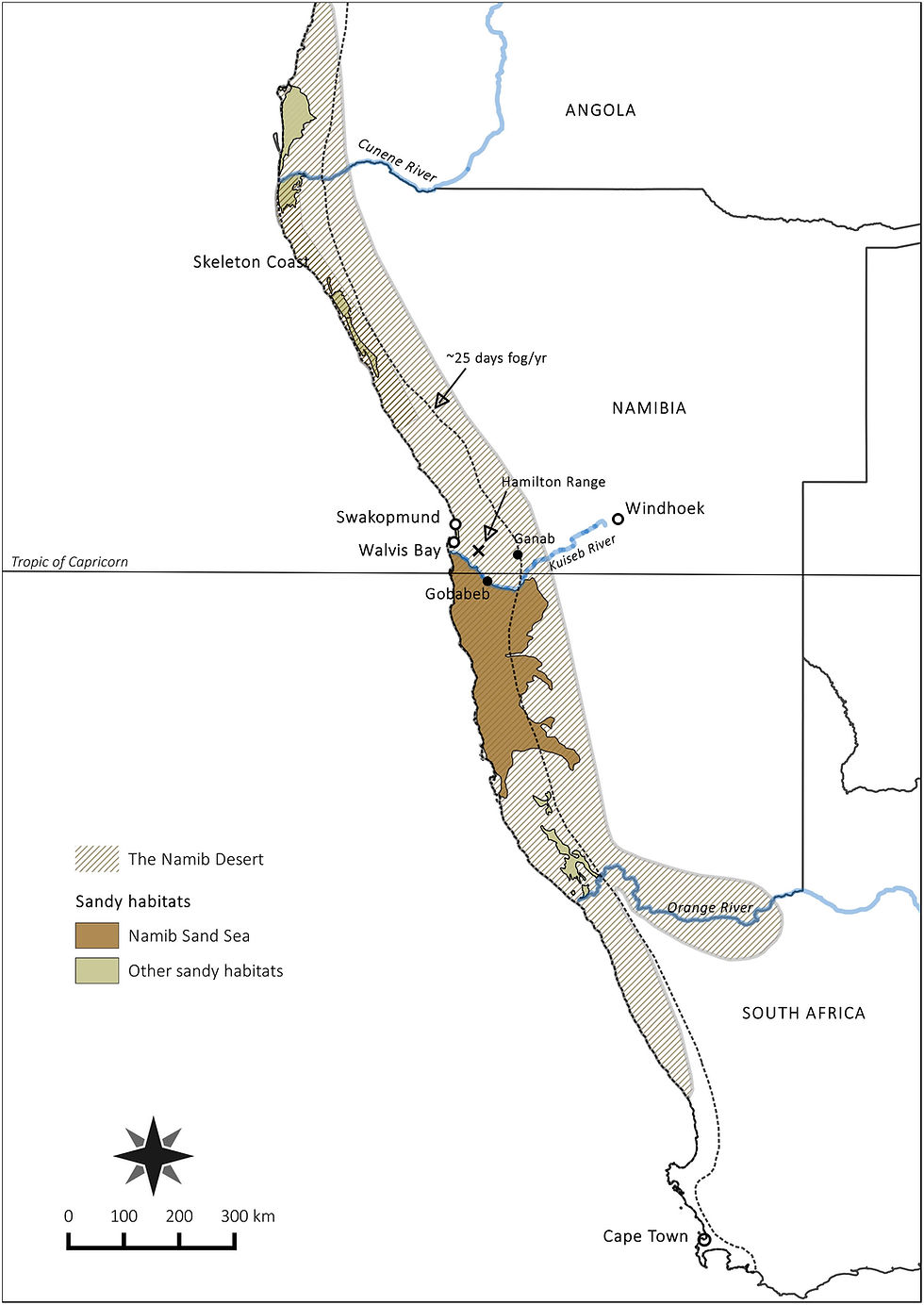
The Namib Desert is a long, narrow coastal desert in southwestern Africa, stretching from southern Angola to just north of Cape Town in South Africa. At its center lies the Namib Sand Sea, one of the world's most iconic dune landscapes. The paradox is obvious: this desert borders the ocean, yet rain is exceedingly scarce. Under the persistent influence of the subtropical high-pressure system, descending air suppresses the growth of thick rain clouds, leaving the region dry enough to become a desert. Even in periods when total rainfall increases, the number of rainy days may decline, because rain becomes concentrated into fewer events. For the animals that live here, the central challenge is not simply how much water falls in a year, but how long they must endure between one chance to obtain water and the next. Fortunately, moisture from the Atlantic Ocean is cooled by the coastal Benguela Current and associated upwelling. As this moisture condenses into fog or low cloud and moves inland, it creates the famous fog-dependent ecosystem of the Namib. Fog is not perfectly regular, but it is more predictable than rain, making it the most important water source for many organisms in the desert.
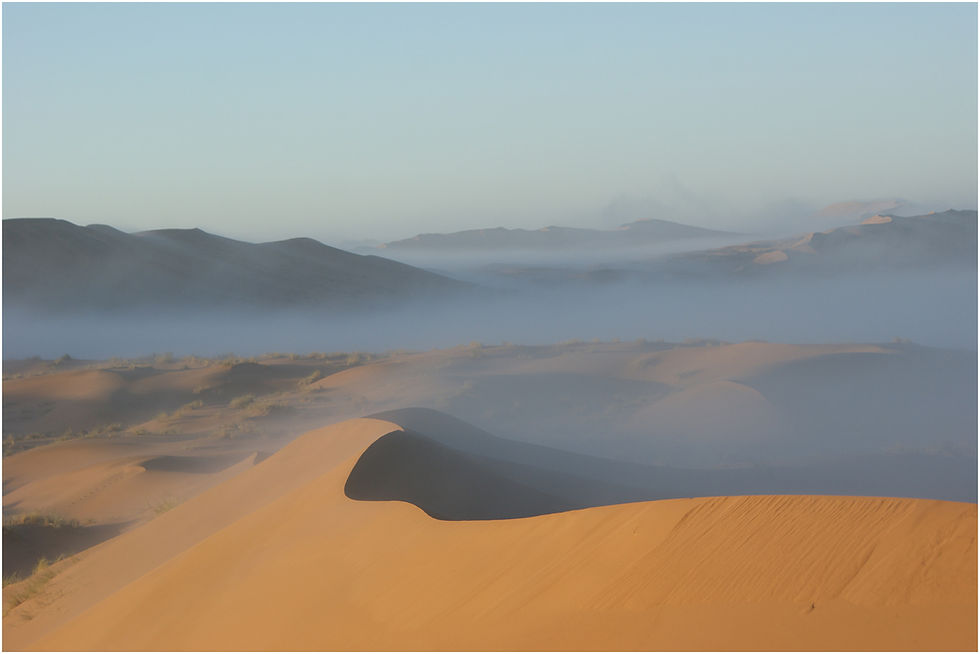
Animals obtain water in three main ways: metabolic water, produced during the oxidation of fats, carbohydrates, or proteins; pre-formed water, already present in food; and free water, taken directly from the external environment as liquid or vapor. In the Namib, all three pathways are ultimately tied to fog. Fog sustains vegetation, which forms the base of food chains and provides fuel for metabolic water production. It also wets plants and detritus, giving herbivores and detritivores access to more pre-formed water. When fog droplets deposit on sand, rock, plants, or the bodies of animals themselves, they also become a direct source of free water.

Most animals in the Namib do not actively seek out fog. They use it opportunistically, drinking deposited fog when they happen to encounter it. Some insects, spiders, scorpions, snails, snakes, lizards, and mammals may obtain fog water in this way. Yet drinking from droplets is not possible for every animal. To access water from droplets, an animal must be large or strong enough to overcome water's surface tension. In general, animals need to weigh roughly 100 milligrams or more to drink safely from droplets. Smaller animals may become trapped in the water film and fail to extract water at all. The Namib termite Psammotermes allocerus, for example, cannot handle droplets directly; it depends instead on capillary water in the soil or water in the vapor phase.

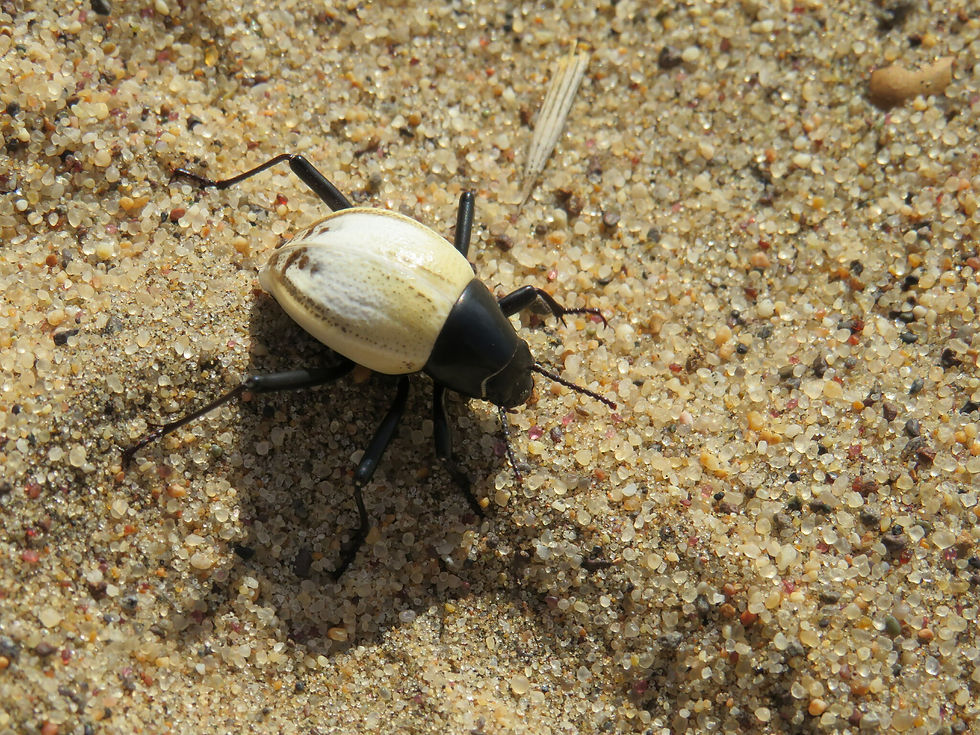
The most famous insects of the Namib are the fog-basking beetles Onymacris unguicularis and Onymacris bicolor, both tenebrionid beetles. Before fog arrives, they emerge from the sand and climb toward the dune crest. There, they assume a head-down, abdomen-up posture, facing their elytra into the fog-bearing wind. Droplets deposit on their hydrophobic, grooved carapace, then run downward under gravity toward the mouthparts. This fog-basking behavior takes place on cold nights or in the early morning, outside the beetles' normal activity period. These beetles are otherwise thermophilic insects that prefer daytime heat, so this is a highly specialized behavior. They even appear before visible fog droplets form, as though they can anticipate an incoming fog event. How they detect fog is still unclear. Humidity alone may not be a reliable cue, because the Namib can be highly humid even on fogless nights, and the beetles usually remain buried more than ten centimeters below the sand. Wind direction, wind speed, turbulence, or vibrations caused by wind-blown sand may be more plausible signals.

Another group of active fog-harvesting tenebrionid beetles belongs to the genus Lepidochora. These beetles do not collect fog by standing in a stereotyped posture. Instead, they bulldoze trenches into the sand surface. As they dig, raised ridges form along the sides of the trench. When fog arrives, these ridges trap more water than a flat sand surface, making the sand around them wetter. The beetles then obtain water from the moist sand grains or from the wet ridge zone. They may even emerge on nights with non-depositing fog, suggesting that they may be able to use water from humid air or damp sand, not only visible deposited droplets.

Fog use is not limited to insects. The sidewinding adder Bitis peringueyi allows fog droplets to collect on its body, then uses dorsoventral flattening to form channels that convey water toward the mouth. The shovel-snouted lizard Meroles anchietae can store water in its bladder, retaining some of it for at least eight weeks after drinking, although it may also obtain enough water from water-rich prey or moist plant tissues. The desert rain frog Breviceps macrops is even more clearly tied to fog. It inhabits a narrow strip of beach and white coastal dunes in the southern Namib, occurring only where fog is present on at least about 75 days per year. When it is not active at night, it lives in burrows in visibly moist sand, and that moisture comes mainly from fog.


Small animals may be unable to drink directly from droplets, but the high humidity associated with fog can itself become a water source. The larvae of Onymacris plana and Onymacris marginipennis probably possess a hygroscopic surface in the lower intestinal tract, likely in the rectal or cryptonephridial complex. When ambient humidity is high enough, this surface can bind water molecules from the air, allowing water to accumulate on the rectal lining and then be absorbed into the body. The zygentoman Ctenolepisma terebrans uses a similar principle, absorbing water vapor through a hygroscopic surface in the lower alimentary tract.


Fog, however, does not arrive on a simple schedule. Animals may have to survive for weeks or even months between fog events. They therefore need physiological mechanisms that prevent excessive concentration of body fluids during dehydration, while also avoiding rapid dilution when they suddenly ingest large volumes of low-osmolality fog water. This makes fog harvesting not only a behavioral problem, but also a problem of storage and osmoregulation. Many fog-dependent animals must balance the need to conserve water with the need to control salts and other osmolytes in their body fluids.
The future of this system is uncertain. Records from many parts of the world show declines in fog over land, and climate models suggest that southwestern Africa may become hotter and drier. Fog in the inland Namib may also decline. If that happens, the most vulnerable species will be those that cannot maintain their water budgets from metabolic water and pre-formed water alone. Species that depend on active fog harvesting, especially those living on sparsely vegetated dunes, may face the greatest risk. The Namib Desert shows that a desert is not simply a place without water. It is a place where water may arrive in subtle, irregular, and easily overlooked forms—and where entire animal communities have evolved around the brief appearance of fog.
Author: Shui-Ye You
Reference:
Mitchell D et al. (2020). Fog and fauna of the Namib Desert: past and future. Ecosphere.


Comments