
How Do Electric Eels Generate an Electric Field?

Updated: Apr 10

The electric eel (Electrophorus electricus) is a fish that inhabits the murky and slow-moving waters of the lower Amazon River and the Orinoco River basin in South America. It belongs to the order Gymnotiformes. Despite its common name, the electric eel is not closely related to true eels of the order Anguilliformes; instead, it is more closely related to catfishes in the order Siluriformes. Adult electric eels can reach about 2 meters in length and weigh roughly 20 kilograms.
Electric eels are widely known for their ability to discharge electricity to hunt prey and defend themselves. An adult electric eel can produce approximately 500 volts of electrical potential and about 1 ampere of current. Even juvenile individuals measuring only 7 to 10 centimeters in length are capable of generating around 100 volts. Inside their bodies are three specialized electric organs: the main organ, Hunter's organ (named after John Hunter), and Sachs' organ (named after Carl Sachs). The main organ and Hunter's organ work together to produce high-voltage discharges used for hunting or deterring predators. In contrast, Sachs' organ generates a low voltage of roughly 10 volts that is used for electrolocation, allowing the eel to sense its surroundings and communicate with other electric eels. Because the waters in which they live are often dark and turbid, vision is not an effective primary sensory system.

These electric organs evolved from skeletal muscle tissue. In humans and other vertebrates, when muscles contract the brain sends electrical and chemical signals to muscle fibers through motor neurons, triggering contraction. Electric eels have modified this biological principle into a system for generating electricity. Their electrocytes have lost the ability to contract and instead specialize in producing electrical potentials by maintaining ion gradients through sodium–potassium pumps.
In ordinary muscle cells, when a chemical signal arrives at the synapse, the resulting action potential produces only a very small voltage difference. Electric eel electrocytes, however, are arranged in such a way that each cell receives neural input and fires almost simultaneously. Because thousands of electrocytes are stacked in series, their individual voltage differences add together, creating a powerful electrical discharge. The combined effect allows the eel to deliver a shock strong enough to affect other organisms within a range of roughly two meters.

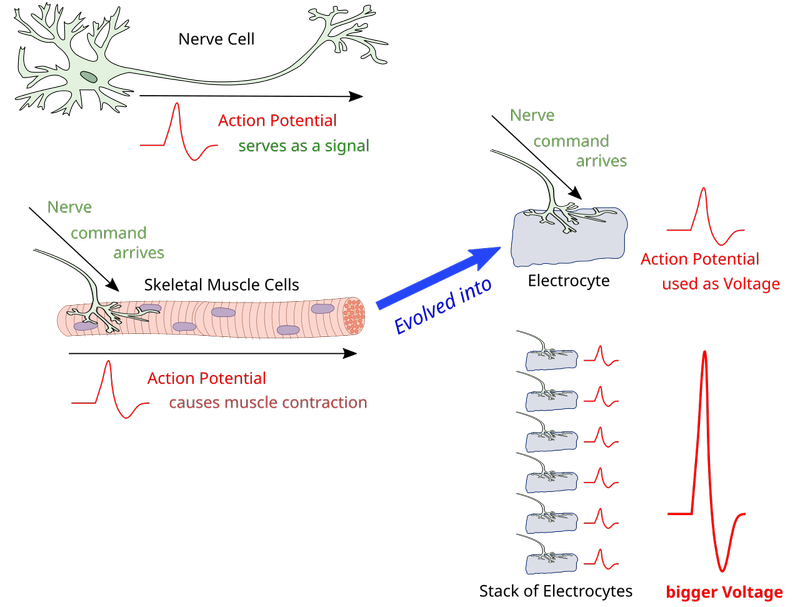
Author: Shui-Ye You
Reference:
Xu J and LaVan DA. (2008). Designing artificial cells to harness the biological ion concentration gradient. Nature Nanotechnology.


Comments