
Lau Banded Iguana

Updated: Apr 10

The Lau banded iguana (Brachylophus fasciatus) is an arboreal lizard native to the Lau Islands of Fiji in the South Pacific. This species is particularly remarkable because most iguanas are distributed across the Americas, yet it exists in isolation on remote Pacific islands, making it one of the most geographically isolated iguanas. Its presence is often attributed to ancient rafting events, with some researchers proposing that its ancestors drifted across the ocean on floating vegetation from the Americas. Regardless of its origin, this population has become a distinctive symbol of the Fijian islands, regarded as a national treasure and even depicted on stamps and currency.
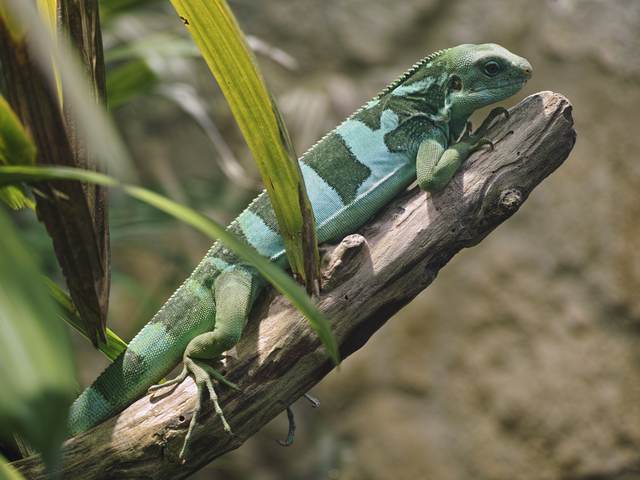
The Lau banded iguana is diurnal, spending daylight hours moving among trees to forage, bask, and defend its territory, while retreating to elevated perches at night. Males are vividly colored, displaying a bright green body marked with two to three pale blue or white transverse bands, often accompanied by spots or striping along the neck. Females are generally solid green, occasionally bearing faint spots or incomplete banding. Both sexes possess a yellow ventral surface and yellow-edged nostrils. Adults reach a total length of approximately 60 cm and can weigh up to 200 grams. Under captive conditions, their lifespan can exceed 25 years. Their skin is highly responsive to light, allowing rapid color adjustments for camouflage, and captive individuals have even been observed mimicking the shadow patterns of enclosure mesh.
In the wild, these lizards primarily consume plant material, including leaves, flowers, and fruits. They show a strong preference for hibiscus flowers and tropical fruits such as bananas and papayas. Juveniles may occasionally consume insects, but adults are almost entirely herbivorous. The breeding season begins in November. Males court females through rapid head bobbing, licking, and body color displays. Females lay three to six eggs in the soil and actively guard the nest, a behavior that is relatively uncommon among iguanas. The incubation period is long, lasting approximately 160 to 170 days. Hatchlings typically emerge during the rainy season and obtain water by licking moisture from leaves.
Wild populations face significant threats. Habitat destruction, introduced predators such as cats, rats, and mongooses, as well as human hunting and illegal pet trade, have caused rapid population declines. It is estimated that only a few thousand individuals remain in the wild. As a result, the species is classified as endangered and is protected under Appendix I of the Convention on International Trade in Endangered Species of Wild Fauna and Flora (CITES).
Housing Requirements in Captivity
In captivity, the goal is to replicate their natural environment as closely as possible. The Lau banded iguana is highly arboreal, so enclosures must provide ample vertical space and climbing opportunities. A single adult should be housed in an enclosure at least 100 cm in length, 100 cm in width, and 120 cm in height. A pair requires an even larger enclosure. The interior should include a variety of branches and rough bark surfaces to allow climbing and selection of perching sites. Live plants not only provide cover but also help maintain humidity. A bioactive substrate can be used, such as a mix of half forest soil and half compost, supplemented with small invertebrates like isopods and springtails to establish a self-sustaining ecosystem. This also provides suitable conditions for egg-laying females.
Daytime temperatures should be maintained at around 28°C, with a localized basking area of 38 to 40°C. At night, temperatures can drop to 20 to 23°C to simulate natural diurnal cycles. Lighting is critical for their health, and full-spectrum UVB lighting must be provided to support calcium metabolism and prevent metabolic bone disease. Photoperiod should be maintained at approximately 11 to 12 hours, with gradual transitions simulating dawn and dusk. Humidity should be kept between 70% and 80%, achieved through regular misting and moisture-retentive substrates. A water dish is not essential, as these lizards typically drink from water droplets on leaves, so daily misting is recommended.
For hygiene, bioactive setups require only routine removal of feces, though periodic checks are necessary to prevent pathogen buildup. Insufficient humidity may result in incomplete shedding; in such cases, light misting can assist the process without the need for forced soaking, which may cause stress.
Feeding Conditions
In captivity, their diet should reflect their natural herbivorous habits. A variety of leafy greens should form the foundation, including dandelion greens, mulberry leaves, Chinese kale, cabbage, and watercress, supplemented with flowers such as hibiscus. Meals should ideally include several different plant types each day to ensure balanced nutrition. Vegetables should be finely chopped or shredded to facilitate feeding. Fruits such as mango, papaya, banana, and berries can be offered occasionally, but due to their high sugar content, they should be limited.
Juveniles and females that have recently laid eggs may receive small amounts of insects such as crickets or cockroaches to provide additional protein. Adult individuals generally do not require frequent insect supplementation, as excessive protein intake may lead to obesity or nutritional imbalance. Food should be dusted with calcium and vitamin supplements prior to feeding, particularly those containing vitamin D3, to complement UVB exposure.
Feeding is best conducted in the morning, aligning with their diurnal activity pattern and allowing digestion under warmth and light. Food should be replaced daily to prevent spoilage. Many keepers provide slightly more food than necessary to allow choice, but uneaten food should not be left for extended periods to avoid bacterial growth.
Breeding Conditions
When a male and female are housed together, breeding may occur naturally under suitable conditions. Keepers should carefully consider whether they are prepared to manage and care for offspring before allowing breeding. Males court females through darkening body coloration, head bobbing, and licking the female's back and limbs. After mating, the female seeks moist soil for egg deposition, so the enclosure must include a suitable nesting area or a dedicated laying box. The substrate should remain moist but not waterlogged, allowing proper excavation.
The incubation period is long, typically around 160 days or more. For artificial incubation, eggs should be placed in a moisture-retentive medium such as vermiculite or a specialized incubation substrate and maintained at a constant temperature of approximately 29°C. Hatchlings measure about 10 cm in length and begin feeding independently within a few days. They can be raised in environments similar to adults but should be housed separately and kept in clean conditions due to their relatively weaker immune systems.
Breeding should not be regarded as a casual or incidental outcome. Responsible planning for offspring care is essential, and if proper arrangements cannot be ensured, breeding should be avoided.
Preventing Invasive Spread
Although the Lau banded iguana is already rare in its native habitat, its striking appearance and manageable size make it highly desirable in the pet trade, including illegal markets. If released or abandoned outside its native range, it may establish invasive populations and threaten local ecosystems. Evidence suggests that populations found in the Tonga Islands were introduced by human activity and subsequently established in the wild. Such cases illustrate that releasing animals is not an act of kindness, but one that can disrupt entire ecological systems.
Keepers must be fully prepared for long-term care. If personal circumstances prevent continued ownership, animals should be rehomed through legal and reliable channels or transferred to appropriate caretakers. Under no circumstances should they be released into the wild.
Author: Shui-Ye You


Comments