
Leopard Tortoise

Updated: Apr 10
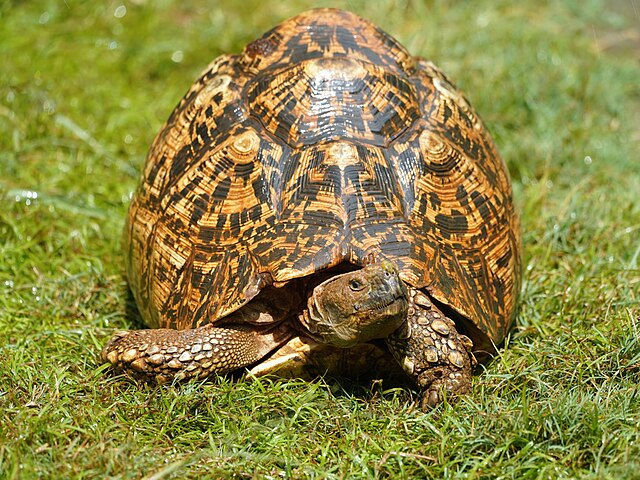
The leopard tortoise (Stigmochelys pardalis) is one of the most iconic tortoise species on the African continent. It is widely distributed across the dry grasslands and savannas of eastern and southern Africa, ranging from Sudan and Ethiopia down to Namibia and the Cape region of South Africa. Its name originates from the distinctive pattern on its carapace: a yellowish-brown shell marked with dark blotches resembling the spots of a leopard. Adult individuals are large, typically reaching 40 cm and in some cases up to 70 cm in length, with body weights ranging from 13 to 40 kilograms, making it the fourth largest tortoise species in the world.
In the wild, leopard tortoises inhabit semi-arid to grassland environments, most commonly found in open savannas and low shrublands. They do not actively dig their own burrows; instead, they rely on abandoned burrows created by animals such as foxes, jackals, or aardvarks to escape extreme temperatures. As herbivores, their diet mainly consists of grasses, succulents, and plants from the Asteraceae family. Occasionally, they gnaw on bones or ash to supplement calcium intake. Ecologically, leopard tortoises serve as important seed dispersers, as many plant seeds pass through their digestive system intact and are subsequently spread across the grassland.
Leopard tortoises are exceptionally long-lived, with lifespans reaching 80 to 100 years in the wild. They typically reach sexual maturity between 12 and 15 years of age. During the breeding season, males engage in ramming behavior to compete for females and produce low, guttural vocalizations during courtship. Females lay eggs between May and October, producing approximately 5 to 30 eggs per clutch, and may lay multiple clutches within a single season. The incubation period ranges from 8 to 15 months, depending on temperature. Hatchlings are independent immediately after emergence but are highly vulnerable to predation, with monitor lizards, snakes, jackals, and corvid birds among their main predators. In contrast, adult tortoises are well protected by their thick shells, with only large predators such as lions or hyenas occasionally able to prey upon them.
Although still relatively common in their native range, leopard tortoises face increasing pressure from habitat destruction, agricultural burning, and the pet trade. Since 1975, they have been listed in Appendix II of the Convention on International Trade in Endangered Species of Wild Fauna and Flora (CITES), which regulates international trade.

Housing Requirements in Captivity
In captivity, leopard tortoises require an environment that closely replicates their natural habitat. Due to their large size and active nature, the enclosure must be spacious. For adult individuals, an outdoor yard-style enclosure is ideal. The enclosure should be securely fenced to prevent escape and to protect against dogs or other potential predators. The habitat should include areas of exposed soil for egg-laying, as well as grass or low vegetation for feeding and shelter. Outdoor enclosures must provide both sunlit and shaded areas, allowing the tortoises to regulate their body temperature naturally.
In colder climates, year-round outdoor housing is not feasible, and a large indoor enclosure is necessary. For adult tortoises, a minimum space of at least 3 meters in both length and width is recommended. The substrate should consist of dry grass, clean soil, or a sand-soil mixture, avoiding excessive moisture. A proper thermal gradient must be established indoors, with daytime temperatures maintained between 24 and 32°C, a basking area reaching up to 35°C, and nighttime temperatures not dropping below 20°C. Heat lamps or ceramic heaters can be used to achieve these conditions.
Ultraviolet (UVB) lighting is essential and should be provided for 10 to 12 hours daily to support calcium absorption and prevent metabolic bone disease. Leopard tortoises are not strictly adapted to extremely dry environments; daytime relative humidity should be maintained between 40% and 60%, increasing to 70%–80% at night. This can be achieved through misting or the use of slightly moist hay. A shallow, stable water dish must always be available, allowing both drinking and occasional soaking.
Feeding Conditions
The diet of leopard tortoises should be based on high-fiber plant material, closely resembling their natural feeding habits. Daily feeding should include fresh grasses, natural weeds, and dark leafy greens such as dandelion leaves, Chinese kale, mustard greens, plantain, and clover. Small amounts of vegetables such as carrots or watercress may be added, but high-oxalate plants like spinach and beet greens should be avoided, as they interfere with calcium absorption.
Fruits should only be offered occasionally, such as figs, berries, or papaya, due to their high sugar content, which can disrupt gut balance. Animal protein must never be provided, including dog food, cat food, or meat, as it places excessive strain on the kidneys and liver. Commercial tortoise diets may be used as supplements, but only high-fiber, low-protein formulations should be selected and combined with fresh plant matter.
To ensure adequate calcium intake, cuttlebone or calcium powder can be provided several times per week, sprinkled over food. This must be paired with proper UVB exposure to facilitate vitamin D3 synthesis. Feeding should be scattered throughout the enclosure to encourage natural foraging behavior, promote physical activity, and reduce boredom and obesity. Hatchlings require daily access to fresh food due to rapid growth, while adults can be fed once daily. Fresh water should be replaced daily.
Breeding Conditions
Breeding leopard tortoises in captivity can be challenging. During the breeding season, males become more aggressive, chasing and ramming females. In confined spaces, this behavior can cause stress or injury, so careful monitoring is required, and individuals should be separated if necessary.
Gravid females will search for suitable soil to lay eggs, so the enclosure must provide loose, dry substrate for nesting. Each clutch typically contains 5 to 30 eggs, and multiple clutches may be produced within a single season. Eggs should be incubated at a constant temperature, usually between 27 and 32°C. Leopard tortoises exhibit temperature-dependent sex determination: incubation temperatures above 30°C tend to produce more females, while temperatures below 30°C result in a higher proportion of males. During artificial incubation, temperature should be adjusted accordingly, and the substrate must remain moderately moist to prevent egg desiccation.
Hatchlings are small and fragile and require a high-humidity, secure enclosure to protect them from predators such as dogs, cats, or birds. Their diet should consist of fresh, tender plant material to support digestion and growth. Due to the high mortality rate at this stage, maintaining stable environmental conditions is critical.
Preventing Invasive Spread
Although native to Africa, the leopard tortoise has become a popular pet worldwide due to its attractive appearance and relatively docile nature. However, releasing or abandoning these animals into the wild can lead to invasive species problems. Their long lifespan, broad diet, and ability to adapt to semi-arid and grassland environments allow them to establish populations outside their native range, potentially impacting local plant communities and competing with native tortoise species.
In the United States, the importation of wild-caught leopard tortoises was banned in 2000 due to the risk of introducing ticks carrying heartwater disease, which poses a threat to livestock. This highlights the potential agricultural and ecological consequences of introducing non-native species.
Therefore, owners must adhere to the principle of not abandoning or releasing pets into the wild. If they are unable to continue caring for the animal, they should contact licensed animal shelters or responsible keepers for rehoming. Prospective owners should carefully evaluate their ability to provide long-term care before acquiring a leopard tortoise, as adult individuals require substantial space. Acquiring a hatchling without considering its future needs and later abandoning it due to size constraints is highly irresponsible.
Author: Shui-Ye You


Comments