
Red-bellied short-necked turtle

Updated: Apr 10
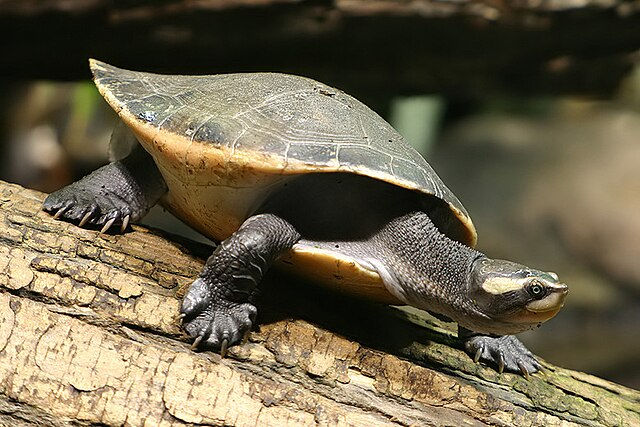
The red-bellied short-necked turtle (Emydura subglobosa) is a freshwater turtle native to Australia and New Guinea. It belongs to the family Chelidae, commonly known as side-necked turtles. Members of this family possess a distinctive anatomical trait: when retracting the head, they do not pull it straight back into the shell. Instead, they bend the neck sideways and tuck the head along the side of the carapace. This unusual mechanism is the defining characteristic of side-necked turtles.
The red-bellied short-necked turtle is widely appreciated among reptile keepers for both its calm temperament and its striking coloration. The head is typically olive-colored, with a pale yellow or whitish stripe extending behind the eye. The throat and plastron display vivid red or pink-orange hues. Although these colors may fade slightly as the turtle ages, the species retains its distinctive appearance throughout life. Adult individuals generally reach a carapace length of about 25 to 30 cm.
In the wild, this species inhabits northern Queensland in Australia, southern Papua New Guinea, and nearby islands and lowland wetlands. It favors slow-moving rivers, lakes, and swamps, and may also occupy seasonally flooded wetlands. These turtles spend most of their time swimming and foraging in the water, but they regularly climb onto floating logs or riverbanks to bask in the sun for thermoregulation. During periods of drought, they are capable of moving to other water bodies in order to survive.
The red-bellied short-necked turtle is omnivorous. In nature it consumes algae, aquatic plants, and seeds, while also capturing fish, insects, snails, crustaceans, and other aquatic invertebrates. Its powerful jaws allow it to crush hard-shelled prey efficiently. Within aquatic ecosystems, these turtles play an important role in maintaining the balance of aquatic vegetation and invertebrate populations. At the same time, they serve as prey for crocodiles, large monitor lizards, rodents, and occasionally humans. Their nesting behavior, which involves digging into soil to lay eggs, also contributes to soil aeration and nutrient cycling.
This species matures relatively slowly. Females usually require about 9 to 10 years to reach sexual maturity, while males may take approximately 10 to 12 years. Their lifespan generally ranges from 20 to 30 years. Breeding typically occurs toward the end of the dry season. Females come ashore to search for soft soil in which to dig a nesting chamber, depositing roughly 7 to 14 eggs per clutch. The female does not guard the nest. After hatching, the young turtles must make their way to water on their own, resulting in a relatively high mortality rate among hatchlings.

Housing Requirements in Captivity
In captivity, red-bellied short-necked turtles require an aquatic-terrestrial environment that accommodates their natural behavior. Adult individuals should be housed in an aquarium with a minimum capacity of about 300 liters, though larger enclosures provide better conditions for maintaining health and activity. The water depth should exceed twice the width of the turtle's shell, allowing sufficient space for swimming. Outdoor ponds or large plastic tubs can also serve as suitable enclosures, provided that precautions are taken to prevent escape.
Maintaining water quality is crucial for their health. Because turtles excrete waste in the water, deteriorating water conditions can easily lead to skin disease, shell rot, or ear infections. A powerful filtration system combined with regular partial water changes is recommended to keep the water clean. If the water supply contains chlorine, it should be treated with a dechlorinating agent to avoid physiological stress.
Although this species is highly aquatic, a basking platform is still essential. A dry basking area can be constructed using wood, stones, or floating platforms. A heat lamp and a UVB lamp should be installed above the basking site. The temperature of the basking area should remain between 30 and 34°C, while the water temperature should ideally range from 24 to 28°C. At night, the temperature may drop slightly to around 20°C, simulating natural environmental fluctuations. UVB lighting should be provided for 10 to 12 hours daily and replaced periodically, as UV output decreases over time and may lead to metabolic problems if not maintained.
For enclosure design, fine sand or smooth gravel can be used as substrate, and driftwood, plants, or rocks may be added to provide hiding places and resting areas. Decorations that are sharp or could trap the turtle should be avoided. If the turtles are kept outdoors, appropriate protective measures should be taken to prevent predation or accidental escape.
Feeding Conditions
The red-bellied short-necked turtle is omnivorous and requires a balanced diet containing both animal and plant matter in captivity. Juveniles grow rapidly and therefore require a higher proportion of protein. They can be fed daily with small fish, shrimp, insects, earthworms, or high-quality commercial turtle pellets. Adult turtles, however, should typically be fed every two to three days, with a gradual increase in plant-based foods such as aquatic plants, leafy greens (including romaine lettuce, dandelion leaves, and water spinach), and sliced zucchini.
Animal-based foods may include small freshwater fish or frozen fish fillets, though excessively fatty fish should be avoided because long-term consumption may lead to liver problems. Chicken hearts, chicken liver, or other organ meats may occasionally be offered as supplements, but they must be thoroughly cleaned and given in limited quantities. Commercial turtle diets such as Mazuri or ReptoMin provide nutritionally balanced formulations and serve as a reliable staple food.
Food items should be cut into small pieces before feeding to facilitate swallowing. Because feeding can quickly pollute the water, some keepers prepare a separate feeding container and return the turtle to the main tank afterward. This practice helps slow the deterioration of water quality. Feeding times should ideally be consistent. If food is provided directly in the main tank, uneaten leftovers must be removed promptly to prevent water contamination.
To reduce the risk of calcium deficiency, calcium blocks may be placed in the water, or small amounts of calcium powder and vitamin D3 supplements can be dusted onto food. This is particularly important for growing juveniles and females preparing for reproduction.
Overfeeding should be avoided even if the turtle appears eager to eat. Excessive feeding can result in obesity and shell deformities. Regular observation of body condition is recommended, ensuring that the carapace remains smooth and the body maintains a firm, healthy shape.
Breeding Conditions
Once red-bellied short-necked turtles reach maturity, reproductive behavior may occur. Males typically court females through behaviors such as head bobbing, gentle contact, and blowing small bursts of air from the nostrils. If the female accepts the male, mating takes place in the water.
During the breeding season, females seek terrestrial areas in which to dig nesting holes. In captive conditions, it is essential to provide a moist and loose substrate such as sand or soil for nesting. Without a suitable laying site, females may retain eggs inside the body for extended periods, which can lead to fatal egg retention.
Each clutch usually contains approximately 7 to 14 eggs. The eggs are hard-shelled and oval in shape. If artificial incubation is desired, the eggs can be carefully excavated and placed in moist vermiculite within an incubator maintained at 27 to 29°C. The incubation period generally ranges from 40 to 60 days, depending on temperature. During incubation, the eggs must never be rotated, as turning them can damage the developing embryo.
After hatching, the young turtles usually remain within the eggshell while absorbing the remaining yolk sac. Only after regaining strength do they begin active movement. At this stage, they should be provided with shallow water and safe hiding places. Feeding can begin with small insects or finely chopped fish, gradually transitioning to the diet of adult turtles.
Although breeding offers an opportunity to observe the continuation of life, it also requires additional resources and responsibility from the keeper. If raising hatchlings is not planned, the availability of space, food, and potential adoption arrangements should be evaluated beforehand to prevent abandonment due to excessive reproduction.
Preventing Invasive Spread
The red-bellied short-necked turtle is native to Australia and New Guinea, but because it is traded internationally in the pet market, abandoned or released individuals can pose ecological risks in non-native regions. Introduced turtles may compete with native species for food and habitat, and they may also transmit diseases, causing irreversible damage to local ecosystems.
For this reason, keepers must strictly follow the principle of responsible ownership: never abandon pets and never release them into the wild. If a keeper can no longer provide care, the turtle should be transferred to a legitimate animal rescue organization or another responsible owner rather than being released into public ponds or natural habitats where it could harm native wildlife.
Author: Shui-Ye You


Comments