
Shortfin Bichir

Updated: Apr 10
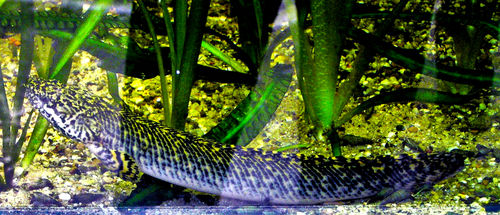
The shortfin bichir (Polypterus palmas) is a member of the family Polypteridae within the class Actinopterygii. It is a predatory fish commonly encountered in the aquarium trade. Because of its primitive appearance and anatomical features that differ markedly from those of most modern bony fishes, it is widely referred to in the aquarium hobby as a "dinosaur fish." In Chinese-speaking markets it is often called the green dinosaur bichir, while in English-speaking markets it is commonly known as Palmas bichir, shortfin bichir, or marbled bichir.
Morphology
Morphologically, the shortfin bichir displays one of the defining traits of the family Polypteridae: a series of separate dorsal finlets along the back. These small, individual dorsal spines are among the most important diagnostic features used to identify bichirs. In this species, the number of dorsal finlets usually ranges from seven to nine. The anal fin typically contains 12–14 soft rays, the upper jaw is usually slightly longer than the lower jaw, and the lateral line contains approximately 55–58 scales. These characters are important for distinguishing species within the genus.
Compared with most ray-finned fishes, bichirs retain many traits associated with early actinopterygian lineages. One notable example is the presence of ganoid scales. These scales consist of a highly mineralized outer layer called ganoine, a dentine-like cosmine layer beneath it, a vascular layer containing a medullary cavity, and an inner basal layer composed of parallel bony plates known as isopedine.
Because their natural habitats are dense swamp environments filled with vegetation, bichirs have evolved a cylindrical body and a flattened head that allow them to maneuver effectively along complex bottom substrates. In addition, in order to survive in wetlands and lakes where seasonal droughts are common, these fishes have convergently evolved respiratory spiracles and a modified swim bladder that functions in air breathing, somewhat similar to the respiratory structures found in lobe-finned fishes. This adaptation allows them to temporarily leave shrinking pools during the dry season and move to more suitable bodies of water.
In terms of coloration, adult shortfin bichirs typically have a gray dorsal surface and a dark gray to grayish-white underside. The fleshy bases of the pectoral fins bear small spots, and the dorsal finlets also display spotted markings. The pelvic and anal fins lack dark patterns. In body size, the shortfin bichir is considered a medium-sized predatory fish, usually reaching a length of approximately 30–33 centimeters.

During early development, members of the family Polypteridae differ markedly from most other fishes. Juveniles possess prominent external gills that resemble those seen in amphibian larvae. The evolutionary reason for this unusual feature remains unclear. What is known, however, is that these external gills gradually regress and disappear as the fish grows.
Native Range and Habitat
The shortfin bichir is distributed in freshwater drainage systems of Ivory Coast and Liberia in West Africa. It inhabits streams, swamps, and slow-moving waters with dense vegetation. Most individuals are found in freshwater rivers or areas with gentle current.
As an ambush predator, the bichir prefers habitats with slow water flow, shallow areas, abundant aquatic vegetation, and muddy or sandy substrates. When dissolved oxygen levels decline, the fish can supplement oxygen intake by breathing atmospheric air using its air-breathing organs.
Aquarium Conditions
The shortfin bichir is a medium-sized predatory fish and is generally recommended to be kept as a single individual. It is not suitable for housing with small fish or aggressive large predators. If mixed-species housing is attempted, it should be limited to large, relatively peaceful fish.
Aquarium size should be determined based on the adult body length. A single individual requires a tank volume of at least 300–500 liters, with a minimum length of approximately 120 centimeters to provide sufficient turning space. If multiple individuals are housed together, a significantly larger aquarium is required.
Bichirs are extremely capable jumpers. When designing an aquarium for them, it is essential to install a tightly fitting but ventilated lid to prevent individuals from escaping the tank during stress or while surfacing to breathe.
In terms of tank layout, bichirs are classic ambush predators that prefer dark or sheltered areas. The aquarium should therefore include driftwood, caves, dense vegetation, or floating plants to provide cover. The substrate is best composed of sand or fine gravel. Strong lighting should be avoided, as intense illumination may cause stress.

Water parameters should generally be maintained between 24–28°C, with neutral to slightly alkaline conditions (approximately pH 6.5–7.8). Water flow should be gentle, and strong currents should be avoided. Because bichirs are bottom-dwelling carnivores that produce considerable uneaten food and organic waste, frequent water changes are necessary. A typical maintenance schedule might involve replacing 20–30 percent of the water each week, or adjusting based on water quality. Filtration should be robust, ideally combining biological filtration with mechanical filtration.
Feeding Conditions
Shortfin bichirs are bottom-dwelling carnivores. In the wild they feed primarily on small fish, crustaceans, worms, insects, and aquatic invertebrates. In captivity they readily accept sinking carnivore pellets and frozen foods such as bloodworms, shrimp, or pieces of fish. A varied diet is recommended to maintain balanced nutrition.
Adult individuals are typically fed once per day or once every other day, depending on activity level and appetite. Juveniles require more frequent feeding, usually once or twice daily. Feeding is best performed under dim lighting or during evening and nighttime hours, since bichirs are largely nocturnal and feed more actively under low-light conditions.
Breeding Conditions
The shortfin bichir (Polypterus palmas) is an egg-laying species that releases adhesive eggs, which attach to aquatic plants or other surfaces. A single spawning event may produce anywhere from several dozen to several hundred eggs, although the exact number varies among species.
Fertilization occurs externally. During spawning, the male wraps around the female and assists in releasing sperm. The incubation period typically lasts about three to seven days, depending on water temperature.
Newly hatched larvae initially feed on planktonic organisms or very small benthic prey. Early-stage larvae may possess external gills similar to those observed in other bichirs.
Artificial breeding of the shortfin bichir (Polypterus palmas) has been recorded but is not considered easy. When attempting captive breeding, it is recommended to provide abundant plants or spawning mops, maintain stable water conditions, and simulate seasonal environmental changes such as shifts in temperature or water level to trigger spawning. During incubation, antifungal treatments such as low concentrations of methylene blue may help protect the eggs. Newly hatched larvae should be provided with microscopic live foods such as protozoans, rotifers, or newly hatched brine shrimp.
Preventing Invasive Spread
The shortfin bichir (Polypterus palmas) originates from Africa and is a highly adaptable carnivorous fish. If released into non-native environments, it may become an invasive species capable of disrupting local ecosystems. These fish can prey on the eggs and juveniles of native fish and compete with indigenous species for food resources, potentially affecting the survival of native fish populations.
For this reason, aquarium keepers must follow the principle of responsible ownership: never abandon or release captive animals into the wild. Under no circumstances should shortfin bichirs be released into natural waters. If an owner can no longer care for the fish, it is preferable to transfer it to another aquarist or donate it to an aquarium facility willing to house it.
Author: Rodrigo
References:
Lalèyè, P.; Olaosebikan, B.D. (2020). "Polypterus palmas". IUCN Red List of Threatened Species. 2020: e.T182701A135027184. doi:10.2305/IUCN.UK.2020-2.RLTS.T182701A135027184.en. Retrieved 20 November 2021.
Froese, R., & Pauly, D. (Eds.). (n.d.). Polypterus palmas summary. FishBase.
SeriouslyFish. (n.d.). Polypterus palmas palmas (Marbled/Shortfin bichir) — species profile.
Polypterus.info. (n.d.). Keeping Polypterus — care & breeding notes.
Aquarium Glaser GmbH. (n.d.). Polypterus palmas — species notes & photos.
QualityMarine. (2023). The Palmas Bichir (Polypterus palmas) — care notes.
Biotope Aquarium Project. (n.d.). Polypterus palmas — biotope / distribution notes.


Comments