
Suckermouth Catfish

Updated: Apr 10

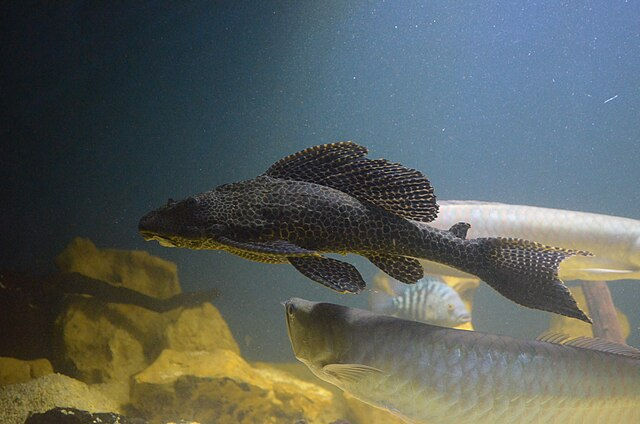
The suckermouth catfish (Hypostomus plecostomus), commonly referred to as a “janitor fish” or “algae-eater”, belongs to the family Loricariidae. A defining feature of this species is the presence of hard bony plates covering the head and dorsal surface, while the abdomen remains soft and unarmored. In the wild, adults can exceed 50 cm in length and typically live for about 8 years; under captive care, individuals may survive for as long as 15 years.
Its native distribution lies in tropical freshwater rivers of South America, including northeastern Brazil, Guyana, and the islands of Trinidad. The species is highly adaptable and can inhabit fast-flowing rivers, still waters, and even mildly acidic blackwater environments. With its suction-cup mouth, the fish can firmly attach itself to rocks or submerged wood, resisting water currents while scraping algae and organic matter from surfaces. In addition to algae and plant debris, it also feeds on small mollusks and crustaceans. The species possesses another remarkable adaptation: it can gulp air and store it in the stomach, absorbing oxygen from the air to survive in oxygen-poor waters, while regulating buoyancy by controlling the gas volume inside the stomach.
In the wild, suckermouth catfish are mainly active at dusk and during the night, spending the daytime concealed in caves or crevices among rocks. They display a mild degree of territorial behavior, particularly after reaching adulthood, and may chase away other bottom-dwelling fish or conspecifics. However, they are usually more tolerant of fish of similar size or species that occupy the upper layers of the water column. In their native range, people occasionally catch them for food, though they are not considered an important food fish. Instead, their ability to remove algae from aquariums has made them highly sought after in the global ornamental fish trade. Because of this demand, the species has been exported widely and has become an invasive species in many regions.
Housing Requirements in Captivity
In aquarium culture, the suckermouth catfish is often known as a “janitor fish”, yet this nickname can be misleading. It is not simply a cleaning organism but rather a large benthic fish that requires suitable conditions to remain healthy. Juveniles are only a few centimeters long and may appear suitable for small aquariums, but as they grow their body length gradually approaches 30–40 cm. Eventually, a tank of at least 300 liters is required to house them properly. For long-term care of a fully grown adult, an aquarium exceeding 600 liters is considered more appropriate.
In terms of water quality, this species thrives at temperatures between 22 and 30°C, with a pH maintained between 6.5 and 7.5. Because adult individuals are large and produce substantial metabolic waste, they can significantly affect water quality. A powerful filtration system and regular water changes are therefore essential. Generally, replacing 10–20% of the water each week is recommended to prevent nitrate levels from exceeding 50 mg/L. Their high activity level and heavy waste production also require periodic cleaning of the substrate, otherwise water quality may deteriorate rapidly.
For habitat structure, driftwood and rocks provide surfaces for attachment and shelter, and the fibrous structure of driftwood may even contribute minor nutritional value. Artificial caves can also simulate the natural refuges these fish occupy in the wild, helping them feel secure. Lighting should remain relatively dim or include shaded areas because the species is nocturnal; excessively bright lighting may cause the fish to hide constantly and experience stress.
When keeping them with other fish, it is generally advisable to avoid housing multiple suckermouth catfish in the same tank, as adults may engage in strong territorial conflicts. They are more compatible with larger mid- to upper-water fish such as the oscar (Astronotus ocellatus), discus (Symphysodon), or other fish of similar size. Pairing them with small fish should be avoided, as accidental injury may occur during feeding.
Feeding Conditions
Many aquarists assume that suckermouth catfish can survive solely by eating algae, but this assumption is inaccurate. In natural environments their diet is quite diverse, consisting of algae, plant debris, mollusks, insect larvae, and small crustaceans. Therefore, in captivity they should be provided with a balanced omnivorous diet.
Commercial algae wafers, sinking pellets, and spirulina-based feeds can serve as staple foods. These should be supplemented regularly with vegetables such as boiled zucchini, cucumber slices, carrot slices, or chopped spinach leaves, which provide fiber and vitamins. Some individuals also enjoy rasping on driftwood, so including natural wood in the aquarium not only enhances the environment but may also support digestive health. Occasionally adding animal protein—such as bloodworms, brine shrimp, or small pieces of shrimp—can further mimic natural feeding conditions.
Feeding is best scheduled in the evening or at night, when the fish become active. During the daytime they usually remain motionless and resting. Large quantities of food should not be introduced at once, since uneaten food will decay in the aquarium and degrade water quality. A better approach is to feed small portions multiple times, observing whether the fish can finish the food within 15–20 minutes. Any remaining food should be removed promptly.
Breeding Conditions
Breeding suckermouth catfish in home aquariums is extremely difficult, and successful cases are rare. One major reason is their requirement for large territories, combined with the strong territorial behavior of adults, which complicates pairing and cohabitation. In addition, the sexes are difficult to distinguish, as the external differences between males and females are minimal even under professional conditions.
In natural habitats, suckermouth catfish excavate burrows in riverbanks composed of mud or sandy substrate. Females may lay several hundred eggs in a single spawning event. After fertilization, the male guards the burrow and protects the eggs until they hatch. Artificial breeding is usually conducted in large outdoor ponds in Southeast Asia or South America. These ponds often contain sloped banks or cavities designed to mimic natural riverbanks where the fish can dig spawning burrows. Because such systems require extensive space, they are generally impractical for ordinary hobbyists.
If breeding behavior unexpectedly occurs in a home aquarium, maintaining stable water quality becomes crucial. Eggs or larvae may be transferred to a rearing tank if necessary, where they can be fed infusoria, powdered foods, or newly hatched brine shrimp. However, survival rates among fry are typically low, and without specialized facilities and experience, successful rearing is difficult.
Preventing Invasive Spread
Suckermouth catfish and their close relatives possess strong environmental tolerance, broad diets, and high reproductive capacity. As a result, they have become ecologically harmful invasive fish in many parts of the world. Wild populations have been recorded in Florida and Texas in the United States, as well as in Taiwan, Malaysia, India, and the Philippines. In rivers they can reproduce in large numbers, excavate burrows that damage riverbanks, compete with native fish for resources, and even cause economic losses to agriculture and fisheries. Some countries have therefore implemented bans on sale and possession or introduced bounty programs to control their spread.
In Taiwan, the species most commonly encountered in the wild is not Hypostomus plecostomus but rather the Amazon sailfin catfish (Pterygoplichthys pardalis) and the vermiculated sailfin catfish (P. disjunctivus). These fishes are also often called janitor fish or algae-eaters, and both species have established breeding populations in rivers where hybridization between them has been documented. Such situations are widely regarded as consequences of deliberate release or abandonment by aquarium keepers.
For this reason, aquarists must strictly follow the principle of “no abandonment and no release”. When a suckermouth catfish grows too large or becomes difficult to maintain, the responsible approach is to transfer it to another capable aquarist or inquire whether local aquarium stores or public aquariums can accept it. Under no circumstances should the fish be released into natural rivers or lakes. Responsible fishkeeping means caring properly for one's aquarium animals while also recognizing the ecological consequences that careless release can create.
Author: Shui-Ye You


Comments