
The Leviathan of the Southern Ocean — the Colossal Squid
- Rodrigo

- Mar 12
- 4 min read
Updated: Apr 10
Since ancient times, the deep sea has stirred both curiosity and fear. Humanity has long been fascinated by the mysteries hidden beneath the ocean's depths, yet the possibility of enormous creatures lurking in those dark waters has also inspired unease. Among the many organisms inhabiting the deep ocean, cephalopods stand out as particularly striking. These unusual invertebrates are renowned for their intelligence and remarkable flexibility, but their formidable appearance has also earned them a reputation for danger. Giant cephalopods in particular have often been portrayed in legends as monstrous beings capable of dragging ships beneath the waves, much like the mythical Kraken of northern folklore. Yet how much truth lies behind these stories? This article focuses on one of the most enigmatic giants of the deep sea—the colossal squid, Mesonychoteuthis hamiltoni—and explores the biology behind this remarkable animal.

In the current “version” of Earth's living world, cephalopods represent a remarkably diverse group. To date, scientists have identified roughly 786 species, including cuttlefish, octopuses, and squids, though many species living in the deep ocean likely remain undiscovered. Among the giant members of this group, two species are particularly famous: the colossal squid Mesonychoteuthis hamiltoni and the giant squid Architeuthis dux.
The colossal squid belongs to the family Cranchiidae and the genus Mesonychoteuthis. Unlike the squids commonly harvested for food, most species within this family have little economic value and inhabit the dark depths of the ocean. Current research suggests that the colossal squid may reach a total length of approximately 6 to 18 meters and a body mass of up to 750 kilograms, making it even heavier than the giant squid. Its body is thick and muscular, while the head is relatively small. Enormous eyes allow it to function in the extremely dim conditions of the deep sea. Unlike many other squids and octopuses that possess suction cups on their tentacles, the colossal squid's tentacles are armed with sharp rotating hooks, giving the animal a particularly formidable appearance.

Despite its fearsome morphology, the colossal squid does not appear to be a highly aggressive predator. Instead, it is thought to be a relatively slow-moving ambush hunter. Analyses of stomach contents suggest that a 500-kilogram individual requires only about 0.03 kilograms of food per day, indicating a metabolic rate far lower than that of many other marine predators. Its prey likely includes deep-sea fish, sharks, and other cephalopods. The squid may locate prey using its large eyes, or possibly attract animals using bioluminescent signals on its body. Once prey approaches within range, the squid rapidly extends its hook-bearing tentacles and pulls the victim toward its beak. These behavioral interpretations are largely based on the study of wounds found on Antarctic toothfish and the anatomical structure of the squid itself, and many aspects of its feeding strategy remain uncertain.
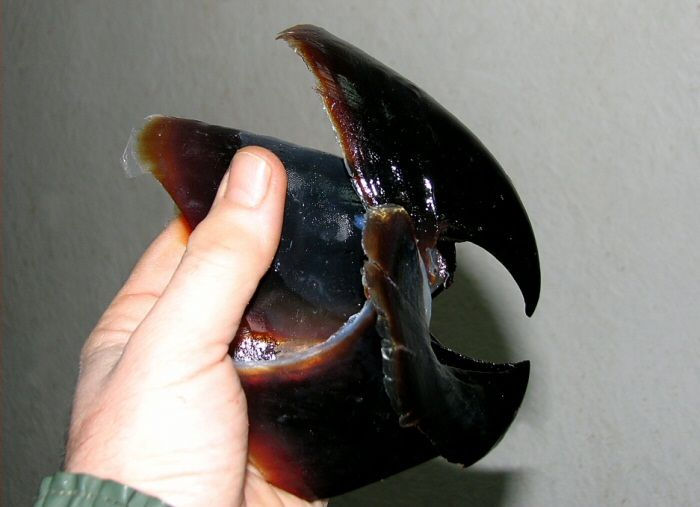
Contrary to the image of an invincible sea monster, the colossal squid faces numerous challenges throughout its life. Newly hatched individuals are extremely small, measuring only about 30 centimeters in length, and are vulnerable to a variety of Antarctic predators. Beaked whales, southern elephant seals, Antarctic sleeper sharks, Antarctic toothfish, albatrosses, and penguins may all prey upon juvenile squids. To reduce the risk of detection, young individuals possess a nearly transparent body. As the squid grows larger, the number of predators capable of attacking it decreases dramatically. Only two major threats remain. One is cannibalism—studies suggest that adult individuals may consume smaller subadults or even other adults. The other is the sperm whale. Analyses of sperm whale stomach contents indicate that roughly fourteen percent of the squid beaks recovered belong to colossal squids. Scars observed on the heads of sperm whales are also believed to have been inflicted by the squid's hooked tentacles.

Compared with the giant squid, the colossal squid remains relatively obscure, partly because it was recognized later by science. The earliest evidence dates back to 1925, when scientists discovered two hooked tentacles inside the stomach of a sperm whale. However, it was not until the 1980s, with advances in deep-sea trawling technology, that researchers began recovering more complete specimens. For decades, most available samples came from dead animals, which greatly limited scientific understanding of their behavior and ecology.
The situation began to change in the twenty-first century with the development of advanced observation technologies. In 2025, the remotely operated vehicle SuBastian, operated by the Schmidt Ocean Institute, captured the first confirmed footage of a living colossal squid at a depth of about 600 meters. This observation significantly expanded our understanding of the species and provided valuable insights into its behavior and habitat.
Even with these advances, many mysteries surrounding the colossal squid remain unresolved. How exactly do they reproduce? How do they defend themselves against sperm whales? Why did they evolve such enormous body size? Each of these questions highlights how much remains unknown about deep-sea ecosystems. The colossal squid is not merely an object of scientific study; it has also become a symbol of the vast and largely unexplored realm beneath the ocean's surface.
Its existence reminds us that Earth's deepest waters still conceal countless secrets. Every expedition into the depths has the potential to reveal new discoveries, gradually strengthening humanity's connection with the ocean. As exploration continues, the deep sea may one day yield answers to questions that have intrigued scientists for generations.
Video of a juvenile Mesonychoteuthis hamiltoni
Video of an adult Mesonychoteuthis hamiltoni being captured
Author: Rodrigo
Reference:
Barratt, I.; Allcock, L. (2014). "Mesonychoteuthis hamiltoni". IUCN Red List of Threatened Species.



Comments