
The Sound of Evolution
Bacitracin
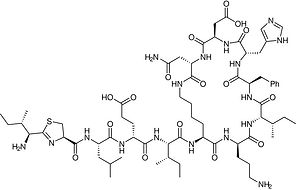
Mechanism of action:
Bacitracin is a polypeptide antibiotic. Bacterial cell wall synthesis requires the transport of peptidoglycan precursors from the cytoplasm to the outer side of the cell membrane, a process that depends on the recycling of the lipid carrier molecule C55-isoprenyl pyrophosphate. During this cycle, C55-isoprenyl pyrophosphate must undergo dephosphorylation before it can be reused. Bacitracin binds to C55-isoprenyl pyrophosphate and prevents its dephosphorylation, thereby blocking the transport of peptidoglycan precursors. As a result, the cell wall cannot be synthesized, and the bacterium eventually undergoes lysis and dies because of osmotic pressure differences.
Reference(s):
1. Tay WM et al. (2010). ¹H NMR, mechanism, and mononuclear oxidative activity of the antibiotic metallopeptide bacitracin: the role of D-Glu-4, interaction with pyrophosphate moiety, DNA binding and cleavage, and bioactivity. J Am Chem Soc.
2. Karala AR et al. (2010). Bacitracin is not a specific inhibitor of protein disulfide isomerase. FEBS J.
3. Toscano WA Jr et al. (1982). Bacitracin. Pharmacol Ther.