
A Brief Look at Tyrannosauroid Dentition

Tyrannosauroidea is a carnivorous clade of theropod dinosaurs that ranged from the Middle Jurassic to the end of the Cretaceous. Its members varied greatly in body size, from animals only about 2 meters long to giants approaching 12 meters, and included Tyrannosaurus rex and its closest relatives. Tyrannosauroids are often recognized by their massive skulls, powerful bodies, and shortened forelimbs, yet their teeth preserve an equally rich record of their biology. Since the mid-nineteenth century, tyrannosauroid teeth have been part of scientific study. Early work focused mainly on the external morphology of the crown, the carinae, and the denticles. Since the 1980s, however, research has expanded into morphometrics, histology, isotope analysis, biomechanics, dental replacement, and wear patterns, making teeth an important source of evidence for understanding tyrannosauroid taxonomy, growth, and paleoecology.
Tyrannosauroid dentition is heterodont, meaning that the teeth differ in form according to their position in the jaws and likely performed different functions. This feature was already recognized in 1860. The mesial teeth at the front of the mouth, including the premaxillary teeth, are relatively small and more conical, somewhat recalling mammalian incisors. They likely helped seize and hold prey. Farther back, the lateral tooth row of the maxilla and dentary carried the main cutting and tearing load. These teeth generally increased in size toward the middle of the jaw, forming the principal biting region, before becoming smaller again toward the rear.

The lateral teeth are usually recurved, and their carinae commonly bear rows of denticles that form cutting edges. Important differences can be seen between basal tyrannosauroids and more derived tyrannosaurids. Early forms such as Proceratosaurus, Dilong, and Guanlong generally had more labiolingually compressed, blade-like lateral teeth. Later forms such as Tyrannosaurus, Daspletosaurus, and Albertosaurus developed taller, labiolingually expanded crowns. These pachydont teeth reflect a shift from a primarily slicing bite toward a bite capable of withstanding enormous stress, allowing these animals to crush bone directly.


Several of the mesial dentary teeth at the front of the lower jaw were also procumbent, leaning forward. This condition is seen in a range of predatory archosaurs, including some crocodylomorphs, pterosaurs, and other theropods. Researchers have generally suggested that such teeth may have helped capture and manipulate prey, making it harder for struggling animals to escape once seized.
Across tyrannosauroid evolution, tooth number tended to decrease. Early taxa such as Guanlong wucaii and Proceratosaurus bradleyi had a relatively high number of teeth, with the total dentition falling roughly in the range of 60 to 70. By contrast, later tyrannosaurids had fewer teeth. Daspletosaurus torosus had about 55 teeth, while Tyrannosaurus rex had approximately 50 to 58. Yet the individual teeth became larger and more robust. This pattern reflects a broader change in feeding mechanics, from repeated cutting bites toward fewer, higher-pressure bites capable of inflicting devastating damage. The long-snouted Alioramus lineage forms an exception, since it had more dentary teeth than other late tyrannosaurines.
Modern studies have moved beyond external shape into the microscopic structure of the teeth. Histological analyses have shown that tyrannosaur teeth had enamel and dentine structures suited to resisting and distributing the stresses generated during biting. This helps explain how these animals could tolerate extremely high bite forces and directly crush bone. Isotope studies have also provided clues about ancient environments and food sources. Analyses of δ¹³C, δ¹⁵N, and δ¹⁸O signals preserved in tyrannosaurid teeth from Late Cretaceous deposits in Asia and North America indicate that tyrannosaurids had elevated δ¹⁵N values compared with many other animals in the same ecosystems. Because δ¹⁵N typically increases with each step up the food chain, this supports the interpretation that tyrannosaurids occupied apex predator positions. δ¹³C data also suggest broad overlap with large herbivores, which has been used to infer that tyrannosaurids often targeted large-bodied prey. At present, however, these studies remain geographically uneven, with much of the available evidence coming from Canada, the United States, and Mongolia.
Wear studies add another layer of information. By examining damage and microscopic scratches on tooth surfaces, researchers can reconstruct aspects of feeding behavior. Different forms of wear have been identified, including spalled surfaces and wear facets. Spalled surfaces may be linked to fractures caused when the crown contacted bone. Wear facets are often elongate and oval, with scratches oriented in a consistent direction, and may have formed through contact between upper and lower teeth. In Tyrannosaurus rex, such wear traces support the idea that these animals were capable of bone-crushing feeding behavior. Together, these approaches turn teeth into powerful clues for reconstructing tyrannosauroid paleoecology.
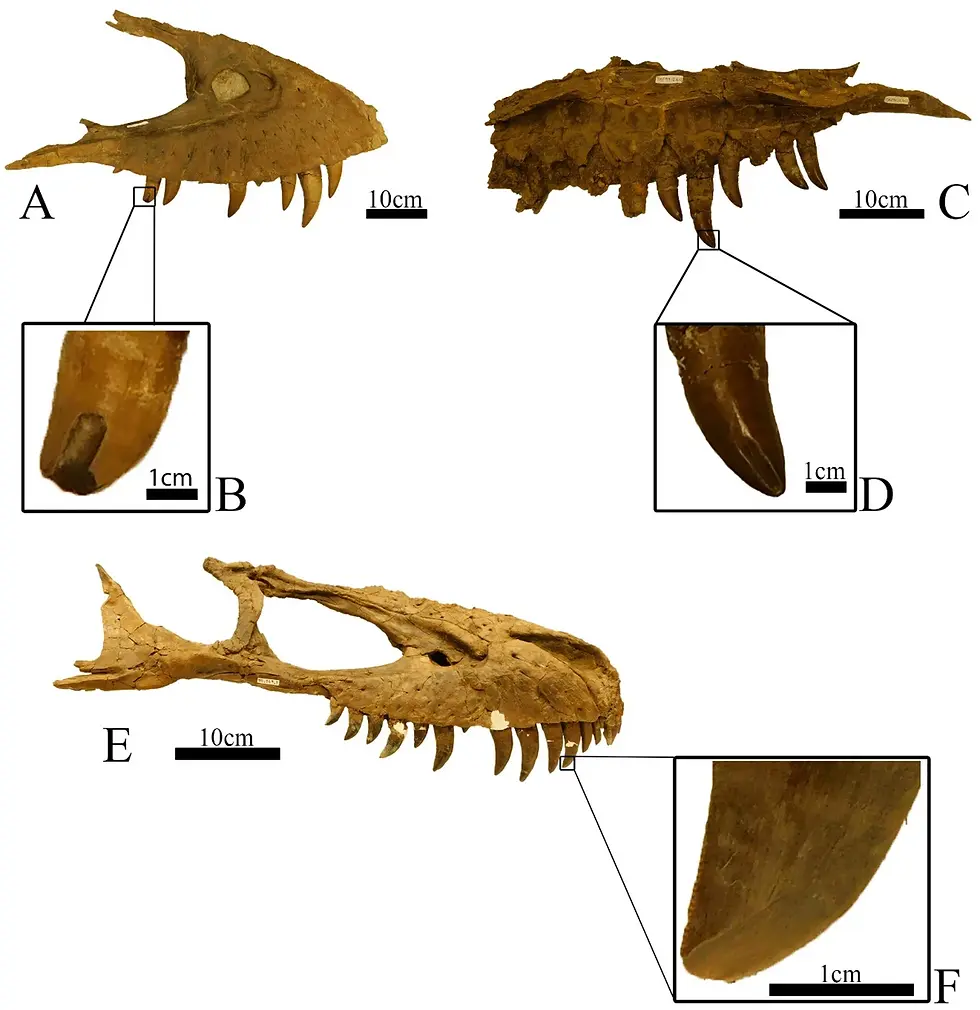
Dental variation also changed through growth. Juvenile individuals often had more slender teeth, resembling those of smaller theropods, and their dental differences may have been less pronounced than in adults. As tyrannosauroids matured, tooth shape changed as well, implying that diet and feeding behavior may also have shifted with age. For this reason, age must be considered carefully when comparing dental morphology or using teeth for taxonomic identification.
Animal teeth contain a remarkable amount of biological information. Their outer contours, microscopic tissues, arrangement in the jaws, and changes through growth all record details of diet, predatory behavior, and position within the food web. In tyrannosauroids, these details help trace how one lineage of theropods became some of the most formidable apex predators of the Mesozoic world.
Author: Shui-Ye You
Reference:
Hernández-Luna CA et al. (2026). The dentition of tyrannosauroid theropods: a review. Discover Geoscience.


Comments