
A Cockroach That Looks Like a Ladybird
- 演化之聲

- Jun 8
- 4 min read
Viewed from above, many species of the cockroach genus Prosoplecta can easily be mistaken for ladybirds, while the more elongate forms may recall buprestid beetles. Yet these insects are not beetles at all. They belong to Blattodea, the order that includes cockroaches. Their tegmina have evolved into hard, glossy, convex structures that cover the abdomen, giving them a strikingly coleopteran appearance.
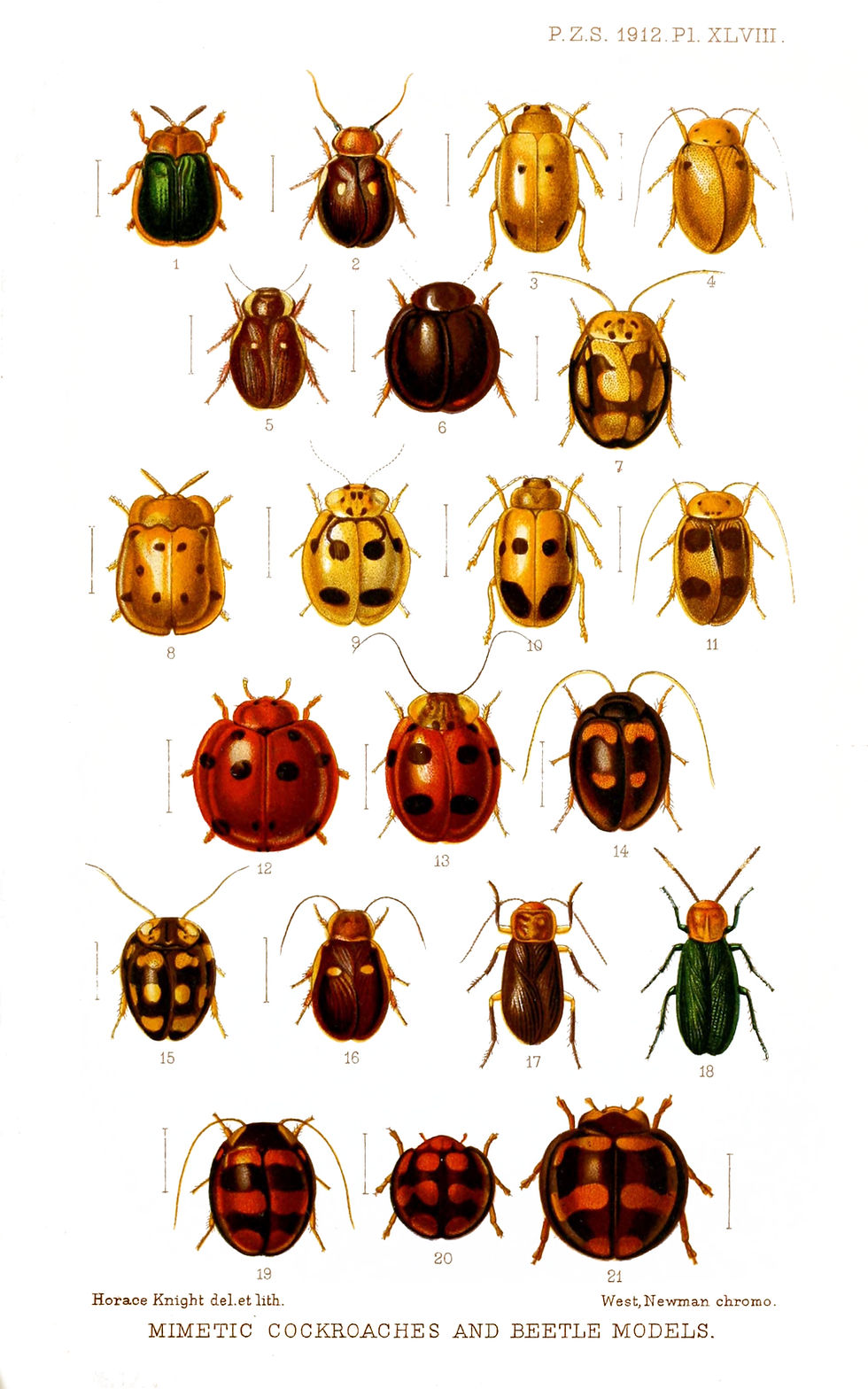
The genus Prosoplecta was established by the Swiss entomologist Henri de Saussure in 1864, with Prosoplecta coccinella as the type species. Early researchers noticed that some species in this group were rounded and coccinellid-like, whereas others were more elongate and buprestid-like. The latter forms were once placed in a separate genus, Areolaria. Later, however, comparisons of the front leg armament, wing venation, male subgenital plate, and male genitalia suggested that the structural differences were not sufficient to maintain two separate genera, and Areolaria was synonymized with Prosoplecta. In 2013, when the Vietnamese species Prosoplecta (Areolaria) vietnamensis was described, a more conservative approach was adopted: Areolaria was treated tentatively as a subgenus of Prosoplecta. The reason was that the two groups still differ in body shape and in details of the male genitalia, while the available material and data remain insufficient to settle the classification completely.

Mimicry often concerns superficial resemblance between unrelated organisms, but in Prosoplecta the transformation goes deeper. To make a cockroach body look beetle-like, the wings themselves have also been reorganized. The hind wings have not become beetle-like elytra; they remain membranous cockroach hind wings with their own venation. However, the large apical folding region of the hind wing curls into a spiral when at rest, allowing the hind wing to be tucked beneath the tegmina. Later phylogenetic studies have also indicated that the apically folded hind-wing did not arise in only one cockroach lineage. Similar structures may have evolved independently several times in Blattodea. A large apical folding membrane can increase the surface area of the hind wing during flight, while still allowing the wing to be folded or rolled away at rest. For this reason, Prosoplecta provides an important reference point for understanding wing evolution and convergent evolution in cockroaches.

In terms of distribution, Prosoplecta species have been recorded mainly from the Philippines, Batjan, Sulawesi, Malacca, and Seram, while Areolaria-like species are known from Malacca, Singapore, and Indonesia. Prosoplecta (Areolaria) vietnamensis was collected in the Kon Chư Răng area of Gia Lai Province in southern Vietnam, at an elevation of about 1,000 to 1,200 meters. This species represents the first confirmed record of the genus from the Indochina Peninsula.
The life history of these insects remains incompletely known. From the logic of their mimicry, however, researchers have suggested that they may reduce predation risk by resembling unpalatable or aposematic beetles. Many species of Coccinellidae and Chrysomelidae produce defensive chemical compounds, teaching predators to avoid small, brightly marked beetles with this general appearance. If Prosoplecta resembles such insects closely enough, it may gain a defensive advantage.
There is at least one reproductive observation from the genus: a female of Prosoplecta bipunctata was recorded carrying an ootheca in the vertical position. This detail reminds us that, despite their beetle-like exterior, their reproductive biology, abdominal structure, and finer morphology remain those of cockroaches. Their legs also retain important cockroach characters, including the front femoral armament, pulvilli, slightly asymmetrical claws, and well-developed arolia.

Differences among species often lie in coloration, pronotal markings, tegminal shape, and the male genitalia. The male genitalia of Prosoplecta coccinella and Prosoplecta bipunctata are quite similar, but the coloration of the head and pronotum can help separate them. In P. coccinella, the head is blackish or dark reddish brown, with paler areas on the vertex and clypeus. In P. bipunctata, the head is paler, and the pronotum lacks a conspicuous black marking. P. (Areolaria) vietnamensis, by contrast, is a small, elongate, reddish-brown species with glossy tegmina bearing large punctures; the legs and abdomen are mostly brownish yellow, with darker distal portions. These details allow taxonomists to distinguish genuine species among beetle-mimicking cockroaches that may look deceptively similar at first glance.


With these characters in mind, the next time one encounters a small insect in Southeast Asia that looks like a ladybird, it may be worth taking a closer look. It might not be a ladybird at all, but one of the remarkable beetle-mimicking cockroaches of the genus Prosoplecta.
Author: Shui-Ye You
References:
Anisyutkin LN. (2013). A description of a new species of the cockroach genus Prosoplecta saussure, 1864 (Dictyoptera, Ectobiidae) from South Vietnam. Entomological Review.
Evangelista DA et al. (2022). Phylogenomics and deep convergence in cockroach hind‑wing morphology. Organisms Diversity & Evolution.
Roth LM. (1994). The beetle-mimicking cockroach genera Prosoplecta and Areolaria, with a description of Tomeisneria furthi gen. n., sp. n. (Blattellidae: Pseudophyllodromiinae). Brill.


Comments