
A Tail Vertebra Overlooked for Forty Years: Traces of Cretaceous Titanosaurs in Antarctica

Aside from Early Jurassic deposits in the Central Transantarctic Mountains, most Cretaceous dinosaur fossils known from Antarctica have come from the James Ross Sub-Basin near the Antarctic Peninsula. Fossils of ankylosaurs, ornithopods, non-avian theropods, and birds have all been discovered there, yet the Antarctic sauropod record remains exceptionally sparse, consisting of only two body fossils. One of them had already been brought back to the British Antarctic Survey in 1985.
On 9 December 1985, Michael R. A. Thomson of the British Antarctic Survey and German palaeontologist Reinhard Förster collected a vertebra on the Ulu Peninsula of northwestern James Ross Island. Catalogued as BAS D.8621.25, the specimen came from a conglomeratic horizon of the Santa Marta Formation and was found alongside osteichthyan scales, invertebrate fossils, and plant remains. Radioisotopic dating of a nearby stratigraphic horizon yielded an age of approximately 82.6 ± 0.5 million years, placing the bone in the early Campanian of the Late Cretaceous.


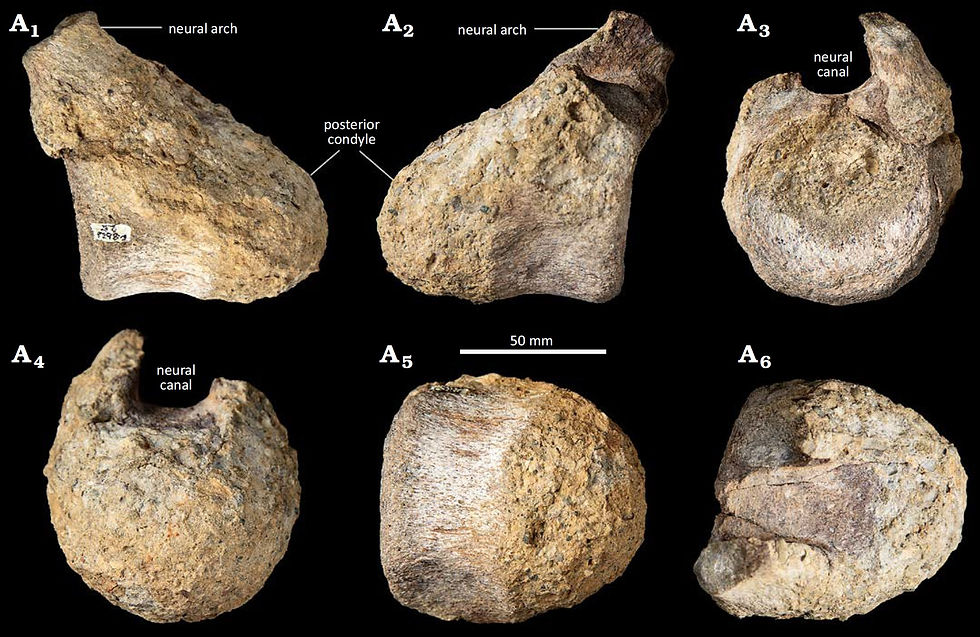
After entering the collection, the specimen received no further description. It was not until 2026, when researchers re-examined this fossil collected more than four decades earlier, that it was identified as belonging to a titanosaurian sauropod dinosaur. The fossil preserves only the centrum of a caudal vertebra and the bases of part of the neural arch, with a total preserved length of approximately 8.9 cm. Its morphology indicates that it probably came from the anterior part of the tail. The anterior articular surface of the centrum is shallowly concave, whereas the posterior surface forms a strongly convex, nearly hemispherical condyle, producing a typical procoelous vertebra. This morphology is taxonomically informative among sauropods, and well-developed procoely in anterior caudal vertebrae is especially characteristic of more derived titanosaurs.
The researchers used computed tomography to examine the internal structure of the bone. Externally, some areas initially appeared to contain numerous small chambers, but the scans showed that these apparent cavities were largely produced by pebbles adhering to the bone surface and by differential erosion. The centrum itself is filled with densely packed trabecular bone and lacks extensive pneumatic spaces. This distinction is important because some highly derived titanosaurs, including saltasaurines, possess caudal vertebrae with a camellate internal bone structure composed of numerous small chambers. BAS D.8621.25 lacks this feature, allowing the researchers to exclude saltasaurine affinities.
The neural arch of the vertebra is positioned on the anterior half of the centrum, with its base projecting anterodorsally. Similar configurations occur in several South American titanosaurs belonging to Rinconsauria and Aeolosaurini. One particularly close comparison is MAU-PV-LL-200, an anterior caudal vertebra from Argentina that was formerly referred to Muyelensaurus pecheni but has recently been reassigned to an indeterminate aeolosaurine. Its anterior centrum margin, centrally positioned posterior condyle, and neural arch configuration closely resemble those of the Antarctic specimen.
Phylogenetic relationships among many titanosaurian groups remain unsettled, and Rinconsauria and Aeolosaurini occupy different positions in different analyses. Combined with the fragmentary nature of the Antarctic fossil, which consists of only a single incomplete caudal vertebra, this uncertainty prevented the researchers from naming a new species or assigning the specimen to a more specific lineage. Their most conservative interpretation is that BAS D.8621.25 represents an indeterminate non-saltasaurid eutitanosaurian.
The dinosaur also appears to have been relatively small. BAS D.8621.25 is only about 60% the size of the corresponding vertebra in the Brazilian titanosaur Baurutitan britoi and roughly 75% the size of that in the comparatively small-bodied Neuquensaurus australis, while being similar in size to the dwarf titanosaur Magyarosaurus dacus. The centrum and neural arch appear to be fully fused, a condition traditionally regarded as an indicator of skeletal maturity. However, the timing of neurocentral fusion varies along the vertebral column, and no consistent pattern has been established for sauropods. Body size and neural arch fusion alone therefore cannot determine whether this individual was an immature animal that had not yet reached full size or an adult member of a genuinely small-bodied titanosaurian species.


The other known Antarctic sauropod fossil is MLP-PV 11-II-20-1, a partial middle caudal vertebral centrum from the upper Campanian Snow Hill Island Formation that was first described in 2012. Re-examination in the new study suggests that the bone had previously been incorrectly oriented. Nevertheless, it still possesses a procoelous centrum and likewise lacks the camellate internal structure characteristic of saltasaurines. The specimen therefore continues to support identification as a non-saltasaurine eutitanosaurian.

Somphospondylan sauropods inhabited both South America and Australia during the Cretaceous, with most well-supported Australian forms belonging to Diamantinasauria. Eutitanosaurs are now documented from Antarctica, and a Campanian caudal vertebra from New Zealand is also likely to represent a member of the same broader lineage. Together, these records indicate that more than one somphospondylan lineage was present in Antarctica during the Cretaceous. They also support the possibility that the Antarctic Peninsula formed part of a dispersal route used by sauropods moving between South America and Zealandia.
Author: Shui-Ye You
Reference:
Barrett PM et al. (2026). A titanosaurian sauropod dinosaur from the Upper Cretaceous of Antarctica. Acta Palaeontologica Polonica.


Comments