
Achoo!!! How Does Sneezing Happen? Why Do Some People Sneeze When They See Sunlight?

Updated: Apr 10
Sneezing appears to be a simple action, yet when the entire process is examined closely it becomes clear that it is a remarkably complex physiological response. Even today, its mechanisms are not fully understood. The nasal cavity is lined with mucous membranes and easily collects external particles such as dust and pollen during breathing. When such irritants are detected, the body expels air outward with explosive force—reaching speeds of up to about 40 meters per second—to clear the nasal passages. This reaction helps reduce potential harm to the respiratory tract, and it can also prevent pathogens from entering the airways, thereby protecting the body from infection. On the other hand, when an infected individual sneezes, studies have shown that a single sneeze may release nearly forty thousand virus-containing droplets into the surrounding air within a radius of seven to eight meters.
To understand the mechanism of sneezing, it helps to begin with a basic overview of nasal anatomy. In the center of the nasal cavity lies the nasal septum, which divides the space into left and right chambers. Along the inner walls of each chamber are three curled structures called the nasal turbinates. From top to bottom these are known as the superior turbinate, middle turbinate, and inferior turbinate.


Most of the surfaces inside the nasal cavity and the paranasal sinuses are covered with ciliated pseudostratified columnar epithelium. This tissue contains various supporting cells, basal cells, submucosal glands, olfactory neurons, and other nerve fibers. The mucus secreted by nasal glands keeps the cavity moist and traps foreign particles before they can be inhaled into the lungs. Olfactory neurons are primarily located near the roof of the nasal cavity. However, the sneezing reflex discussed here is not triggered by the olfactory system. Instead, it is mediated by the trigeminal nerve, which is distributed throughout the turbinates and the upper portion of the nasal septum.

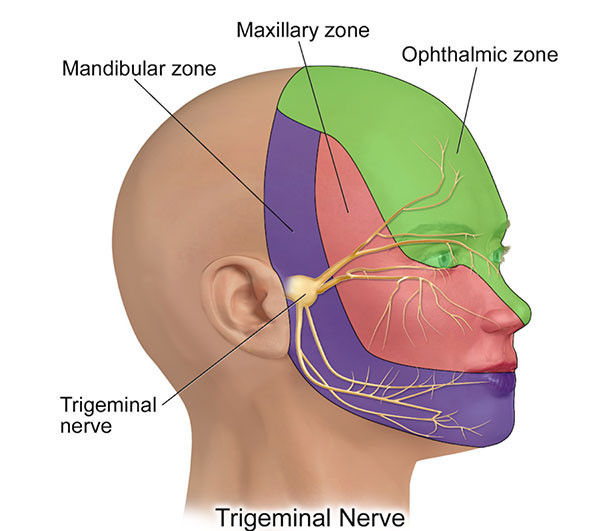
The trigeminal nerve is the fifth cranial nerve and the largest nerve of the face. It is a mixed nerve, meaning it contains multiple types of neurons responsible for both sensory perception and muscle control. Because of this broad role, it extends far beyond the nasal cavity. The name “trigeminal” reflects its three main branches: the ophthalmic nerve, the maxillary nerve, and the mandibular nerve. The maxillary branch includes portions that extend into the nasal cavity and play an essential role in triggering sneezing.

Within the nasal cavity, the trigeminal nerve endings involved in sneezing include Aδ fibers and C fibers, which are associated with sensations such as pain, temperature, and itching. The neurons belonging to these fibers express the TRPV1 cation channel protein and are capable of releasing the neuropeptide Neuromedin B. When the nasal mucosa encounters irritants or mechanical stimulation, these nerve endings become activated. Once the level of stimulation reaches a threshold, electrical signals are transmitted to the trigeminal ganglion, located anterior to the pons, where the neuronal cell bodies reside. At this stage, these neurons release Neuromedin B toward the brainstem's sneeze-triggering center in the pons, specifically within the ventromedial spinal trigeminal nucleus (SpV). Neurons carrying receptors for Neuromedin B then relay the signal further to the caudal ventral respiratory group (cVRG) within the pons.

After receiving these signals, the caudal ventral respiratory group distributes neural commands to several control centers responsible for the physical components of a sneeze. These include the parasympathetic nervous system, which stimulates the secretion of nasal mucus and tears; the facial nerve nucleus in the pons, which directs facial nerve activity controlling eyelid closure and facial expressions; and the nucleus ambiguus in the medulla oblongata, which contains nuclei associated with the glossopharyngeal nerve, vagus nerve, and accessory nerve. Through these pathways, the glossopharyngeal, vagus, and accessory nerves coordinate movements of the tongue, pharynx, and throat.
In addition, the ventral respiratory group (VRG) in the medulla controls accessory respiratory muscles and the internal intercostal muscles, while the dorsal respiratory group (DRG) regulates the external intercostal muscles and the diaphragm. These coordinated actions allow the lungs to rapidly draw in a large volume of air. Then, through synchronized contraction of facial and thoracic muscles, the body forcefully expels the air through the nasal passages, ejecting trapped irritants and releasing droplets from the mouth.

Sneezing Triggered by Allergic Rhinitis
Allergic rhinitis occurs when allergens contact the nasal mucosa and trigger a Type I hypersensitivity reaction mediated by immunoglobulin E (IgE). In the nasal cavity, IgE binds to receptors on mast cells, prompting the release of large amounts of histamine and nerve growth factor. Other immune cells also release cytokines such as interleukin-6 (IL-6), interleukin-1β (IL-1β), and tumor necrosis factor-α (TNF-α). This immune environment strongly stimulates trigeminal nerve endings in the nasal cavity, making it easier for their action potentials to reach the threshold required to trigger sneezing.
The Photic Sneezing Reflex
This condition is also known as ACHOO syndrome (Autosomal Dominant Compelling Helio-Ophthalmic Outburst syndrome). It is an autosomal dominant trait, occurring in roughly 17–35% of the population. The exact mechanism remains unclear, but two hypotheses have been proposed. One suggests that light signals received by the optic nerve inadvertently stimulate the ophthalmic branch of the trigeminal nerve, thereby activating the sneeze-triggering region. Another hypothesis proposes that when the retina receives light, neural signals travel from the pretectal nuclei to the accessory oculomotor nucleus, while trigeminal signals from the cornea also pass through the ciliary ganglion, collectively leading to a sneezing reflex.

Psychogenic Sneezing
Psychogenic sneezing is rare but has been documented in numerous case reports since the nineteenth century. One reported case involved a thirteen-year-old girl who sneezed continuously for two months. During these episodes she did not close her eyes, and only small amounts of nasal mucus were produced. Her symptoms improved after treatment with the antidepressant sertraline. Other reports describe sneezing triggered by sexual arousal or orgasm; in some cases, the use of nasal decongestants prevented the sneezing response. Although the precise mechanisms remain unclear, these cases are thought to involve activation of the parasympathetic nervous system.
Q&A
➤ Why do we always close our eyes when sneezing, and which muscles are involved?
Closing the eyes during a sneeze is a reflex controlled by the facial nerve. Facial muscles such as the orbicularis oculi muscle, which closes the eyelids, are activated during this reflex.
➤ What is the purpose of closing the eyes?
Because sneezing-related eye closure is a reflex rather than a conscious action—and psychogenic sneezing can occur without eye closure—its purpose can only be inferred. One likely explanation is that closing the eyes helps prevent droplets from entering them.
➤ Why are some sneezes loud while others are quiet?
The sound produced during a sneeze occurs when air expelled from the lungs passes through the vocal cords in the larynx. The volume depends on the force and amount of expelled air. Because sneezing can be partially suppressed by conscious effort, intentionally restraining the reflex can reduce its loudness.
➤ Does sneezing always require the presence of an allergen?
No. Sneezing may be triggered by either external or internal factors. Any stimulus that activates the sneeze-triggering region or increases parasympathetic activity to a certain degree can initiate the reflex.
➤ If sneezing starts repeatedly, is there a way to stop it?
Repeated sneezing indicates that sensory neurons continue reaching their activation threshold multiple times. To stop sneezing intentionally, the underlying cause must first be identified. Allergic rhinitis may be treated with antihistamines, corticosteroids, or leukotriene receptor antagonists. Psychogenic sneezing requires addressing psychological factors. If sneezing results from inhaled irritants, removing the irritant from the nasal cavity is usually sufficient.
➤ Why does a sneeze sometimes suddenly stop just before it happens?
This occurs when the neural signal transmission is interrupted somewhere along the pathway. As described above, the sneezing reflex involves many neural regions, so such interruptions are not unusual. Conscious control can also occasionally suppress the reflex.
Author: Shui Ye-You
Reference:
Li F et al. (2021). Sneezing reflex is mediated by a peptidergic pathway from nose to brainstem. Cell.
Songu M et al. (2013). Physiology and Pathophysiology of Sneezing and Itching: Mechanisms of the Symptoms. Nasal Physiology and Pathophysiology of Nasal Disorders.
Brann DH et al. (2020). Non-neuronal expression of SARS-CoV-2 entry genes in the olfactory system suggests mechanisms underlying COVID-19-associated anosmia. Science Advances.
Murtaza M et al. (2019). Why are olfactory ensheathing cell tumors so rare? Cancer Cell International.
Lee JI et al. (2016). Transient Anisocoria during Medial Blowout Fracture Surgery. ACFS.


Comments