
An Accidental Genetic Event Four Hundred Million Years Ago: The Secret Behind Spider Silk
- Rodrigo

- Mar 11
- 5 min read
Updated: Apr 11
When did spiders first begin to spin silk? And where did their remarkable spinning ability originate? For decades, this question has been regarded as one of the most intriguing puzzles in the evolutionary history of arachnids.
To explore the answer, we must travel back roughly 400 million years to the Devonian Period. At that time, spiders had not yet become the skilled web builders we recognize today. Instead, they were simply one lineage among many arachnids. Their general appearance was not drastically different from that of modern relatives such as scorpions, whip scorpions, and other arachnids. These early forms possessed elongated structures at the rear of the abdomen and primarily relied on active hunting rather than traps to capture prey.
Yet during the tens of millions of years spanning the Devonian and Carboniferous periods, spiders underwent a profound anatomical transformation. The posterior “tail-like” region gradually shortened, while a pair of new appendages slowly emerged near the rear of the abdomen: the spinnerets. These structures enabled spiders to secrete silk, construct shelters, and move through space using silk threads. Over the following hundreds of millions of years, this innovation shifted spiders from predators that relied mainly on direct pursuit into specialists of ambush and trap-based hunting.
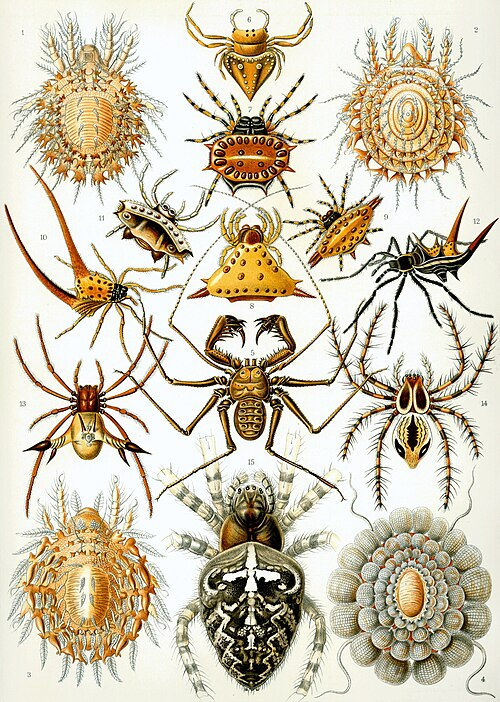
What internal biological changes made this transformation possible? How did a smooth abdominal surface evolve appendages capable of producing silk? This question has long been a subject of debate among paleontologists and developmental biologists.
One hypothesis proposed that spinnerets evolved from ancestral book gills. These organs originally functioned in gas exchange and mucus secretion and may have helped early arachnids breathe in relatively dry environments during the transition to land. According to this idea, genetic changes affecting structures related to book gills might have gradually allowed them to secrete filamentous material, eventually giving rise to spinnerets.
Another group of researchers disagreed. They argued that spinnerets are fundamentally appendages and therefore more closely related to the developmental pathways that produce walking legs. In this interpretation, spinnerets represent limbs that were evolutionarily redeployed to the abdomen, possibly through duplication and regulatory modification of appendage-development genes. Over time, these structures acquired the ability to produce spider silk.
For many years, the lack of transitional fossils directly showing the origin of spinnerets prevented scientists from decisively favoring one hypothesis over the other.

This long-standing debate finally took a major turn in 2026. A study published in Science Advances combined genomic analysis, functional genetic experiments, and cell-level developmental investigation to provide unprecedented evidence about the origin of spinnerets.
To investigate the problem, the researchers examined the chromosomes of spiders and their close relatives, including scorpions and whip scorpions. Their analysis revealed that the common ancestor of these arachnids experienced a rare evolutionary event about 430 million years ago during the Silurian Period: a whole-genome duplication.
This event can be imagined as the sudden appearance of a complete backup copy of the organism's genetic blueprint. With two copies of many genes available, evolution gained additional flexibility. One copy could continue performing its original function, while the other could accumulate changes and potentially acquire new roles without compromising the organism's survival.
Within this duplicated genetic toolkit, the researchers identified two genes called abd-A-1 and abd-A-2. These genes belong to the Hox family, which governs the anterior–posterior organization of the body and plays a crucial role in appendage development.
To determine whether these genes participate in spinneret formation, the team conducted a series of gene-editing experiments using CRISPR technology. When either abd-A-1 or abd-A-2 was individually knocked out, spider embryos still developed spinnerets normally. However, when both genes were simultaneously disabled, spinnerets failed to form entirely.
Additional experiments using RNA interference to reduce the expression of these genes produced similar developmental defects, further confirming their involvement in spinneret formation.

The researchers then turned to single-cell transcriptomics to examine which genes become active in different cells during spider embryonic development. This approach allowed them to reconstruct the developmental pathway that produces spinnerets at the cellular level.
The results revealed that the gene expression patterns activated during spinneret formation closely resemble those used during leg development. In contrast, they differ substantially from the genetic networks associated with book gills or other respiratory structures.
One gene in particular, dac-1, normally involved in patterning the middle regions of spider legs, was strongly activated in cells that later form spinnerets. Functional experiments showed that disabling dac-1 could also cause spinnerets to disappear.

These findings strongly support the hypothesis that spinnerets originated from ancestral appendages rather than from book gills.
More importantly, the study reveals that spinnerets were not an entirely new structure invented from scratch by evolution. Instead, they represent a striking example of biological reuse. The genetic flexibility created by the ancient whole-genome duplication allowed spiders to redeploy an existing developmental program—originally responsible for forming legs—to a new position on the abdomen, eventually producing the silk-spinning organs.
Seen from this perspective, the origin of spider silk was not the result of a single sudden mutation. It emerged from a series of evolutionary events stretching across hundreds of millions of years. An ancient genome duplication in the Silurian laid the genetic groundwork, enabling later morphological innovations during the Devonian and Carboniferous periods.
Every spider web we see today is therefore more than a delicate structure of silk threads. It is a visible trace of an evolutionary history that has unfolded across nearly half a billion years.
Author: Rodrigo
Reference:
Li, F., Yang, H., Zhang, Y., Wang, S., Gu, Q., Wu, M., Jin, P., Huang, X., Zhong, Y., Huang, X., Lin, Y., Guo, X., Li, Y., Zhang, W., & Li, S. (2026). An ancient genome duplication event drives the development and evolution of spinnerets in spiders. Science Advances, 12(3), eadw2173. https://doi.org/10.1126/sciadv.adw2173


Comments