
Anchiornis huxleyi


Age
Jurassic(Oxfordian)
160.89-160.25 Ma
Taxonomy
Kingdom: Animalia
Phylum: Chordata
Class: Sauropsida
Superorder: Dinosauria
Order: Saurischia
Suborder: Theropoda
Family: Anchiornithidae
Genus: Anchiornis
Species: Anchiornis huxleyi
Morphological description
Anchiornis huxleyi was a small, fully feathered paravian theropod dinosaur. In lateral view, the skull is roughly triangular, with a slightly elongate snout that is blunt anteriorly, a large and nearly circular orbit, an elongate external naris, and a large antorbital fossa. The premaxilla bears four closely spaced, subequal teeth, and the teeth of both the upper and lower jaws lack prominent serrations. A more complete set of diagnostic features includes a straight nasal process of the premaxilla, a short rostral ramus of the maxilla, a ventrally positioned promaxillary fenestra, a sheet-like posteroventral process of the dentary, rugose anterior and ventral surfaces of the coracoid, a short deltopectoral crest, an extremely short ischium, and an unusually expanded proximal end of the fibula. The ungual of pedal digit II is only slightly larger than the other pedal claws and lacks the strongly specialized, hyperextensible configuration characteristic of deinonychosaurs. The tail comprises approximately 28–32 caudal vertebrae, with prominent transverse processes anteriorly and longitudinal grooves along the lateral surfaces of the middle and posterior caudals. Differences among specimens in caudal proportions, limb proportions, and the positions of some carpal elements may reflect individual variation, allometric growth, or preservational effects.
The limb proportions are close to those seen near the early stages of avian evolution. The forelimbs are proportionally much longer than in other troodontids and possess a semilunate carpal, while the hindlimbs are also highly elongate, with the tibiotarsus measuring approximately 1.5 times the length of the femur. Early studies interpreted the metatarsus as approaching a subarctometatarsalian condition. Subsequent examinations of additional specimens found no pronounced proximal constriction of metatarsal III and instead suggested a more primitive, Archaeopteryx-like pedal configuration.
Specimen LPM-B00169 preserves approximately ten large pennaceous feathers attached to the forearm, eleven feathers associated with the manus, 12–13 feathers on the lower leg, and 10–11 on the metatarsus. The longest wing feathers reach about 150% of humeral length. The primaries and secondaries are relatively similar in size, with slender rachises, largely symmetrical vanes, and blunt distal ends. Large pennaceous feathers cover much of the lower leg, while long feathers are arranged along the metatarsus and shorter pennaceous feathers occur on the pedal digits, producing conspicuous feathered surfaces on both the fore- and hindlimbs. Two additional types of more plumulaceous feathers are preserved: one consists of nearly parallel filaments joined near their bases, whereas the other has a slender central rachis with barbs extending laterally. Specimen 41HIII 0404, described in 2018, also preserves exceptionally long fibrous plumulaceous feathers along the back. These average approximately 4.1 cm in length, and the longest are about 1.6 times as long as the forelimb feathers of the same specimen. Their function remains unknown.
Etymology
The generic name Anchiornis is derived from the Greek anchi, meaning "near" or "nearby," and ornis, meaning "bird."
The specific name huxleyi honors the British biologist Thomas Henry Huxley, one of the earliest nineteenth-century scientists to systematically investigate the evolutionary relationship between birds and dinosaurs.
Biological description
Anchiornis huxleyi lived in the Yanliao Biota of northeastern China during the Late Jurassic, with most known specimens coming from the Tiaojishan Formation of Jianchang County, Liaoning Province. Early studies estimated the age of these deposits at approximately 161–151 million years ago, while subsequent work has generally placed the Anchiornis-bearing horizons of the Jianchang area at around 160 million years ago, in the Oxfordian. These deposits therefore predate the Solnhofen strata of Germany that preserve Archaeopteryx. The Yanliao Biota represented by the Tiaojishan Formation was a terrestrial ecosystem extending across western Liaoning, northern Hebei, and southeastern Inner Mongolia. In addition to paravian dinosaurs, it preserved lissamphibians, pterosaurs, early mammals, and a wide variety of other vertebrates and invertebrates.
Anchiornis huxleyi is one of the best represented Jurassic paravians in terms of specimen number. The holotype, IVPP V14378, preserves most of the postcranial skeleton, including the trunk, pectoral girdle, pelvis, and limbs, but lacks the skull, part of the cervical series, and the distal end of the tail. LPM-B00169, discovered shortly afterward, is nearly complete and preserves extensive feather impressions, while BMNHC PH828 provides particularly detailed evidence of the plumage. Numerous additional, nearly complete individuals have since been recovered from the Jianchang area, allowing researchers to investigate intraspecific variation, allometric growth, and even the possibility of sexual differences. Two specimens described in 2018, 41HIII 0404 and 41HIII 0415, measure approximately 57.4 and 37.5 cm in length, respectively. Their neurocentral sutures are fully closed, suggesting that both individuals may have reached adulthood.
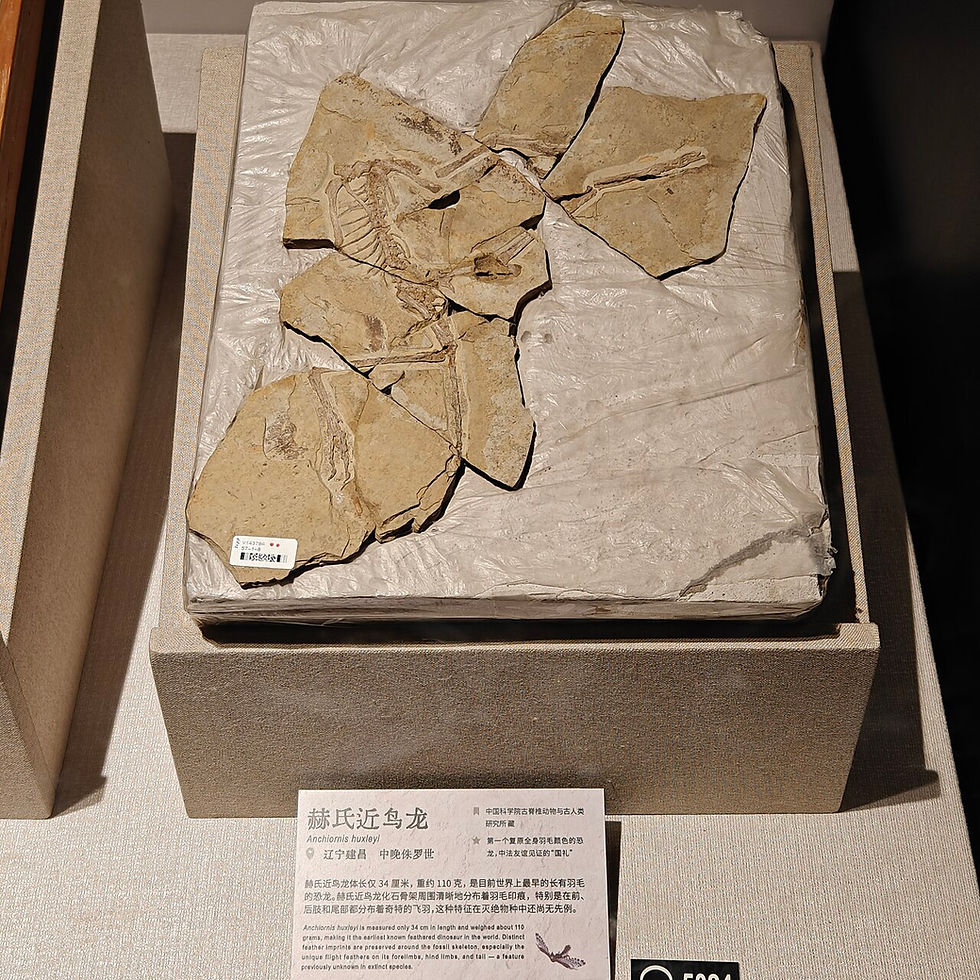


The holotype was relatively small, with an estimated total body length of approximately 34 cm and a body mass of about 110 g. Histological evidence indicates that this individual had reached a subadult to young-adult stage. The vertebral neural arches were fused to their centra, and vascularization in the femoral cortex decreases toward the outer surface, indicating that the rate of growth had already begun to slow. However, no lines of arrested growth or external fundamental system are present, suggesting that the animal had not yet reached the stage at which skeletal growth had completely ceased.
Melanosome-based studies of the plumage of Anchiornis huxleyi indicate that most of the body was gray to dark gray, with reddish-brown speckles across the face and a conspicuous rufous crest on the crown. The long feathers of the limbs were predominantly white with black markings toward their tips. When the forelimbs were spread, these dark feather tips would have formed conspicuous bands. A 2025 re-examination confirmed that the black tips of three rows of primary coverts produced three distinct wing bars, while the dark tips of the primaries formed a fourth.
These black feather tips may also have had a functional significance. In living birds, areas of feathers exposed to particularly heavy abrasion can contain higher concentrations of melanin, which increases mechanical resistance to wear. In Anchiornis, melanin was concentrated toward the tips of the long feathers, precisely where abrasion would have been most likely, suggesting that the dark bands may have contributed to feather durability.
Early studies produced a seemingly contradictory picture of locomotion in Anchiornis. Its forelimbs were proportionally much longer than those of other troodontids and even exceeded those of Microraptor, a condition that was initially regarded as potentially consistent with aerial locomotion. The wrist was also highly mobile and was interpreted as representing a stage preceding the fully developed wing-folding mechanism of birds. Its remiges, however, had slender rachises and largely symmetrical vanes, unlike the more robust and strongly asymmetrical flight feathers of Microraptor and early birds. The hindlimbs were extremely elongate and appear well suited for terrestrial running, yet the lower legs and feet carried extensive long feathers. Extant cursorial animals commonly reduce plumage or pelage on the distal portions of the limbs. Hu Dongyu and colleagues therefore regarded Anchiornis in 2009 as an example of mosaic evolution close to the origin of birds, in which different anatomical systems did not evolve simultaneously toward a single locomotor function.
Whether the pedal feathers of Anchiornis actually contributed to aerodynamic performance remains uncertain. In living birds, feathers on the feet can serve in insulation or protection, but they generally do not form the relatively continuous surfaces seen in Anchiornis, Microraptor, and Pedopenna. Some researchers have therefore suggested that the pedal plumage of these fossil taxa probably had an aerodynamic role and that a four-winged stage may have contributed to the origin of avian flight. The hindlimb plumage of Anchiornis, however, was more primitive in configuration than that of Microraptor and would probably have been less aerodynamically effective. The hypothesis that a four-winged stage represented a necessary step in the origin of flight has remained controversial from the outset.
By 2025, the much larger available sample made it possible to reassess the wing structure in far greater detail. Researchers examined 226 specimens of Anchiornis huxleyi housed at the Shandong Tianyu Museum of Nature and identified nine individuals in which preservation of plumage and color pattern was sufficient for detailed wing analysis. Most possessed approximately 20–25 primary feathers, while specimen STM0-65 preserves 28. Modern volant birds typically have only 9–11 primaries. Anchiornis also possessed three exceptionally long rows of primary coverts, with the third row extending across more than 80% of the wing. Researchers concluded that this wing configuration has no direct analogue among known living birds and suggested that the forelimbs may have performed some currently unidentified, non-aerodynamic function.
All nine exceptionally well-preserved specimens show evidence of growing feathers. Most individuals possessed as many as about five incompletely grown primaries at the same time, with no consistent sequence in their positions and frequent asymmetry between the two wings. Specimen STM0-143 shows especially clear evidence of active molt, with numerous feathers simultaneously at different stages of growth. The 2025 study also concluded that BMNHC PH828, a specimen previously used extensively in reconstructions of Anchiornis wing morphology, was undergoing particularly intensive molt when it died.
This pattern was interpreted as irregular molt, in which flight feathers are replaced gradually without a fixed or predictable sequence and without necessarily being synchronized between the left and right wings. Among living birds, this mode of flight-feather replacement is currently known only in flightless groups, including ostriches and other struthioniforms, the Flightless Cormorant (Nannopterum harrisi), and the Kākāpō (Strigops habroptila). Birds that depend on continuous flight generally undergo more orderly, sequential, and bilaterally coordinated molt, reducing the risk of abruptly compromising the aerodynamic surface of the wings. The irregular molt pattern of Anchiornis therefore suggests that it may not have possessed a stable capacity for sustained flight.
In the original 2009 description, Xing Xu and colleagues placed Anchiornis huxleyi within Avialae, based in part on features such as its limb proportions and similarities to Archaeopteryx. Later that same year, Dongyu Hu and colleagues interpreted LPM-B00169 as a basal troodontid. After additional specimens became available, a 2017 study again favored placement of Anchiornis as a basal avialan, noting that it lacked features typical of deinonychosaurs, including a strongly specialized second pedal digit and lateral exposure of the splenial. A subsequent phylogenetic analysis in 2018 placed Anchiornis, Archaeopteryx, Xiaotingia, Eosinopteryx, and several traditionally recognized troodontids near the base of Avialae, raising the possibility that Troodontidae, as traditionally defined, may not represent a monophyletic group.

(Author: Shui-Ye You)
References
Hu D et al. (2009). A pre-Archaeopteryx troodontid theropod from China with long feathers on the metatarsus. Nature.
Guo X et al. (2018). Morphological and Phylogenetic Study Based on New Materials of Anchiornis huxleyi (Dinosauria, Theropoda) from Jianchang, Western Liaoning, China. Acta Geologica Sinica.
Kiat Y et al. (2025). Wing morphology of Anchiornis huxleyi and the evolution of molt strategies in paravian dinosaurs. Communications Biology.
Longrich NR et al. (2012). Primitive wing feather arrangement in Archaeopteryx lithographica and Anchiornis huxleyi. Curr Biol.
Pei R et al. (2017). New Specimens of Anchiornis huxleyi (Theropoda: Paraves) from the Late Jurassic of Northeastern China. Bulletin of the American Museum of Natural History.
Xu X et al. (2009). A new feathered maniraptoran dinosaur fossil that fills a morphological gap in avian origin. Chinese Science Bulletin.


Comments