
Ankylosaurs or Crocodiles? Don't Get Them Confused — The Aetosaurs

Updated: Apr 11
As the opening chapter of the Mesozoic Era, the Triassic has long remained one of the least familiar periods in deep time. Compared with the Jurassic and the Cretaceous, the Triassic rarely receives the same level of attention. For many people, the era is remembered simply as the time when dinosaurs first began to rise. What is less widely known is that dinosaurs were not the dominant terrestrial animals throughout most of the Triassic. In fact, the land was ruled by another lineage of reptiles entirely.
Today, I—Rodrigo—invite you to travel back to the Triassic to meet one of the most successful groups of land reptiles of that age: the pseudosuchians (Pseudosuchia).

At this point you might be wondering: if this article is about pseudosuchians, why does the title mention Aetosauria instead? Is that a bit misleading? The explanation is actually quite straightforward. Much like the dinosaur clade itself, Pseudosuchia represents a large evolutionary lineage containing reptiles of many different shapes and lifestyles. Within this group were animals that resembled dinosaurs, such as the poposauroids (Poposauroidea), predators that looked like long-legged crocodiles, such as the rauisuchids (Rauisuchidae), and of course the lineage that ultimately gave rise to modern crocodilians. The animals we are focusing on today—the aetosaurs—were one distinctive branch within this broader pseudosuchian family.

What exactly were aetosaurs?
Aetosaurs (Aetosauria), sometimes historically referred to as the "aetosaur order," form a group of heavily armored herbivorous pseudosuchians that lived during the Late Triassic. The clade contains a single family, the Stagonolepididae, and one of its best-known representative genera is Aetosaurus. In total, about 22 genera have been identified, making aetosaurs a relatively diverse and flourishing lineage during the Triassic.

What did aetosaurs look like—and how were they different from dinosaurs or crocodiles?
For members of the crocodile line of archosaurs, aetosaurs had a surprisingly unusual appearance. Unlike most pseudosuchians, which often had elongated bodies and predatory skulls, aetosaurs were broad-bodied animals with small heads and bodies covered in extensive armor. At first glance, they look remarkably similar to the ankylosaurs that would appear much later during the age of dinosaurs.
Because of this superficial resemblance, many people encountering aetosaurs for the first time assume they are dinosaurs. Their limb anatomy, however, tells a different story and reveals their true identity as members of the crocodile lineage.
In an earlier article about phytosaurs, I briefly mentioned that archosaurs evolved several different limb postures. These include the sprawling posture, the erect posture, and the pillar-erect posture. Phytosaurs, for example, possessed a sprawling posture in which the femur extended laterally from the body, similar to the condition seen in many early reptiles. Compared with amphibians, such a pelvic configuration gave reptiles stronger support on land and improved their breathing capacity. (As terrestrial vertebrates evolved limbs capable of supporting the body off the ground, the thoracic cavity could expand more fully. Modern birds and mammals, for instance, possess well-developed chests and fully erect limbs.)

Yet sprawling limbs came with an important limitation. Although this arrangement provided support, locomotion depended heavily on lateral flexion of the spine when running—a style of movement still retained by modern lizards. This greatly limited the potential speed of early terrestrial vertebrates.
As reptile behavior and ecology became increasingly complex, their skeletal anatomy began to change as well. Over time, two new locomotor solutions emerged: the erect posture and the pillar-erect posture.

The pseudosuchians to which aetosaurs belonged evolved the pillar-erect posture. In this configuration, the ilium developed a socket-like articulation that accommodated the head of the femur. This improved support for the hind limbs, but it also imposed a constraint: because the ilium partially blocked the femur, these animals could not achieve fully upright running. Instead, they walked in a semi-erect posture.

Dinosaurs, in contrast, evolved an L-shaped femoral articulation connected to a socket formed by the fusion of the pubis and ischium. This new anatomical configuration brought a revolutionary improvement in locomotor ability, allowing dinosaurs to run upright on two legs. No other archosaurs moved in quite this way, and this became one of the most important differences between dinosaurs and other pseudosuchians.

How Did Aetosaurs Protect Themselves?
In addition to resembling ankylosaurs in overall appearance, the armor of aetosaurs also converged to some extent with that of later ankylosaurs. Broadly speaking, aetosaur armor can be divided into three stages: the light-armored type, the scale-armored type, and the spiny-armored type.
Let us begin with the light-armored type. Representative members include Aetosaurus and Stagonolepis. Taking Stagonolepis as an example, its armor resembled the light leather armor seen on terracotta warriors: osteoderms formed within the skin were distributed across the back and belly, while the sides of the abdomen lacked armor plates. The advantage of this kind of armor was that it provided a certain degree of protection while still preserving flexibility. On the other hand, its weakness was obvious as well: once captured by a more agile predator, the animal would quickly be killed.

As predatory pressure continued to intensify, some aetosaurs began evolving heavier armor. Members such as Typothorax and Paratypothorax developed lateral armor plates and reinforced the original dorsal and ventral bony shields, effectively turning themselves into living armored tanks. Building on this foundation, Typothorax also evolved armor extending toward the cloacal region and lateral plates bearing small spikes, achieving an impressive level of bodily protection.

But was the scale-armored Typothorax the endpoint of aetosaur evolution? Not at all. Desmatosuchus, which lived during the Norian stage of the Triassic, took armor modification even further. In order to defend against attacks from predators approaching from the side, these animals evolved a row of large spikes projecting from their shoulders, making them look rather like the post-apocalyptic thugs illustrated by the Japanese manga artist Tetsuo Hara. Although these latter armor types greatly increased defensive ability, they also caused these late aetosaurs to lose much of their capacity for agile running.
(Note: Tetsuo Hara is the famous Japanese manga artist best known for Fist of the North Star.)

What Did Aetosaurs Eat, and How Did They Forage?
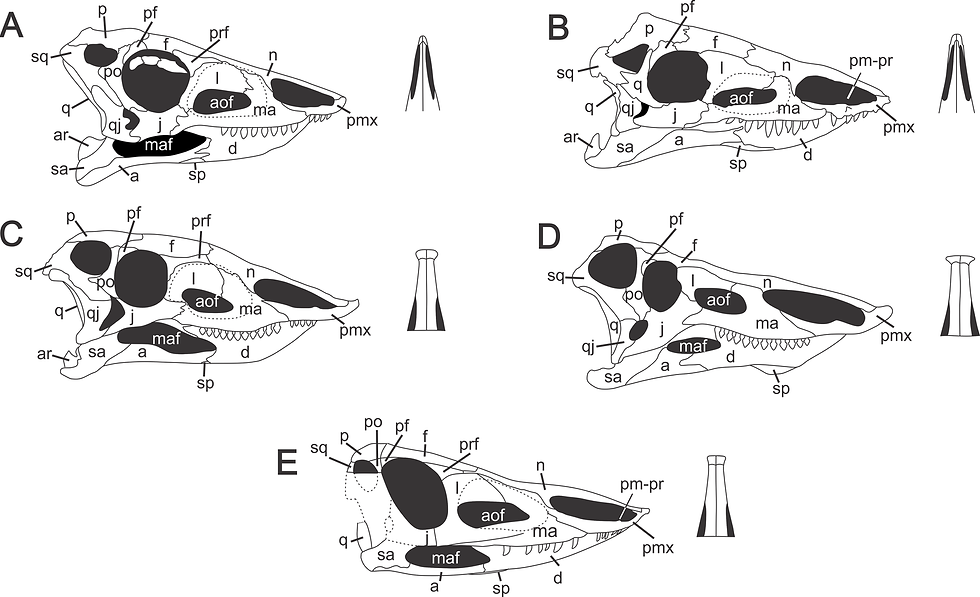
Unlike their crocodilian relatives, all aetosaurs were herbivores. They primarily fed on ferns and early gymnosperms. To adapt to a plant-based diet, their teeth evolved into serrated, leaf-shaped structures somewhat resembling the tines of a garden rake. This structure allowed them to tear off tender fern leaves.

Much like modern wild boars, aetosaurs also ate plant tubers, insect larvae, and eggs when plant resources were scarce. To dig up the underground tubers they favored, they evolved an upturned snout resembling that of a pig along with very large nostrils. These enlarged nostrils provided an excellent sense of smell, while the upturned snout functioned like a rounded shovel, enabling them to root out food buried in the soil.
When Did Aetosaurs Rise, and How Did They Go Extinct?
The origin of Aetosauria has long remained uncertain within paleontology. One commonly accepted classification places Revueltosaurus and the gracilisuchids (Gracilisuchidae) on the same evolutionary branch as the ancestors of aetosaurs. However, exactly which pseudosuchians were most closely related to the ancestors of Aetosauria is still debated. The prevailing view suggests that their common ancestor may have been a small omnivorous pseudosuchian living during the Middle Triassic, probably with a gracilisuchid-like body form and primitive leaf-shaped teeth.

Although the origin of Aetosauria remains debated, paleontologists broadly agree that their rise occurred during the Carnian stage of the Triassic. As mentioned in the earlier article about phytosaurs, the Carnian Pluvial Episode transformed the Triassic climate. What had once been a landscape dominated by deserts became vast forests rich in ferns. Members of Aetosauria likely took advantage of this expansion of vegetation to spread rapidly across the globe.
(Note: aetosaur fossils have been found on many continents, although none have yet been recorded from Australia or Antarctica.)

As these armored reptiles spread across the world, they inevitably encountered many different predators. As discussed earlier, different members of Aetosauria evolved various kinds of armor in response. In addition to changes in armor, their digestive systems also continued to evolve. In order to process large amounts of plant material, their intestines became longer and longer, allowing them to house greater numbers of fermenting bacteria. Under the combined influence of predatory pressure and increasingly elongated digestive tracts, these animals eventually evolved into tank-like reptiles standing more than a meter tall.

At this point, one might assume that such a successful lineage must have dominated the Earth for a very long time. In reality, however, the time between the rise and extinction of Aetosauria was surprisingly brief. After reaching their peak diversity during the Rhaetian stage of the Late Triassic, they soon encountered the Triassic–Jurassic extinction event.

According to a study conducted in the Lisowice Basin of Poland, this catastrophe may have been triggered by increasingly intense volcanic activity. As the supercontinent Pangaea began to break apart, volcanic eruptions became more frequent around the globe. Ash and sulfur dioxide released from these eruptions obscured the sky and drove the Earth into a prolonged volcanic winter. As a result, climates around the world shifted from warm and humid conditions to cold and dry environments.
Vegetation changed dramatically as well. The low-growing fern shrublands that once dominated the landscape—including lycophytes (Lycopodiopsida) and seed ferns (Pteridospermatophyta)—were replaced by tall gymnosperm forests composed of trees such as pines and cypresses. For aetosaurs, which relied heavily on ferns and low-growing gymnosperms, this transformation was devastating.

As if this environmental shift were not enough, another group of large animals better adapted to the new conditions began to rise: the dinosaurs, cousins of the pseudosuchians. By the middle of the Rhaetian stage, prosauropod dinosaurs, represented by Plateosaurus, had entered the stage of Earth's history. Compared with the short, broad-bodied aetosaurs, these long-necked herbivores were far better able to feed on tall gymnosperms. Their strong migratory ability also allowed them to leave their habitats quickly during periods of drought.

There is something deeply ironic about this outcome. Aetosaurs once spread across the world by taking advantage of abundant plant resources, yet in the end they likely starved in lush forests of gymnosperms that they could not efficiently exploit.
Aetosaurs and Humans: Their Significance in Paleontology
In films, documentaries, and exhibitions about prehistoric life, pseudosuchians rarely play major roles. They typically appear in programs about the Triassic as background animals or as a prelude to the rise of the dinosaur dynasty. Our protagonists, the aetosaurs, are no exception. In the Discovery Channel television program When Dinosaurs Roamed America, for example, the aetosaur Desmatosuchus appears mainly as prey fought over by Coelophysis and Postosuchus.

In contrast to their minor role in popular culture, aetosaurs are extremely important in paleontology. Their relatively short fossil record and their tendency to fossilize easily make them excellent index fossils. In addition, their distinctive dietary habits and wide distribution across multiple continents make them valuable subjects for paleoecological research. Many studies concerning the end-Triassic extinction event, in particular, use aetosaur fossils as indicators of ancient ecosystems.

That concludes this introduction to Aetosauria. The next time a friend or family member asks you about crocodiles, why not share the story of these remarkable animals from the Triassic?
In the next installment, I—Rodrigo—will introduce another famous group of Late Triassic pseudosuchians: the rauisuchids, the apex predators that dominated the Triassic before the rise of dinosaurs. Stay tuned!
This is Rodrigo, and I will see you in the next issue.
Author: Rodrigo
References:
1. Parker, William G. (21 January 2016). "Revised phylogenetic analysis of the Aetosauria (Archosauria: Pseudosuchia); assessing the effects of incongruent morphological character sets". PeerJ
2. Desojo, J. B.; Heckert, A. B.; Martz, J. W.; Parker, W. G.; Schoch, R. R.; Small, B. J.; Sulej, T. (2013). "Aetosauria: A clade of armoured pseudosuchians from the Upper Triassic continental beds". Geological Society, London, Special Publications.
3. Carroll, Robert L. (1988). Vertebrate Paleontology and Evolution. W.H. Freeman and Company.
4. Butler, Richard J.; Sullivan, Corwin; Ezcurra, Martín D.; Liu, Jun; Lecuona, Agustina; Sookias, Roland B. (10 June 2014). "New clade of enigmatic early archosaurs yields insights into early pseudosuchian phylogeny and the biogeography of the archosaur radiation". BMC Evolutionary Biology.
5. Martin qvarnström, & Joel vikberg wernström. (2024). Digestive Contents and Food Webs Record the Advent of Dinosaur Supremacy. Nature.


Comments