
Apodiformes (Bird Evolution Series)

Updated: Apr 10
The order Apodiformes includes three extant families:
➤ Apodidae (true swifts)
➤ Hemiprocnidae (tree swifts)
➤ Trochilidae (hummingbirds)
Molecular phylogenetic analyses indicate that Apodiformes diverged from Caprimulgiformes (nightjars and their relatives) during the late Paleocene. Within this lineage, hummingbirds separated from other apodiform birds during the Eocene approximately 42 million years ago, whereas the split between true swifts and tree swifts occurred somewhat later.

Birds belonging to Apodiformes are generally small and possess highly developed flight musculature adapted for energetically demanding aerial lifestyles. The Latin name derives from a- and podi- meaning “without feet,” referring to the extremely small legs characteristic of these birds. Superficially, swifts resemble swallows, and hummingbirds resemble sunbirds (Nectariniidae). However, swallows and sunbirds belong to the order Passeriformes and are only distantly related to Apodiformes; the similarity in appearance arises from convergent evolution.

From an evolutionary perspective, all families within Apodiformes likely originated during the Eocene. The earliest known fossil representative of this lineage is the genus Eocypselus, which dates to the early Eocene and is widely regarded as a probable ancestral form of Apodiformes. Fossils of this genus have been discovered in both Europe and North America. Five species are currently recognized: E. vincenti, E. rowei, E. paulomajor, E. grandissimus, and E. geminus. These birds possessed wings shorter than those of modern relatives, indicating weaker flight capabilities. They likely lacked the high-speed flight of modern swifts and were unable to hover in the air like hummingbirds. Their legs were also larger, suggesting a greater ability to perch on branches. During the Eocene, several families related to modern apodiform birds also existed but later went extinct, including Aegialornithidae, Cypselavidae, and Jungornithidae.

Apodidae
The family Apodidae can be divided into two subfamilies: Apodinae and Cypseloidinae. Approximately 115 species have been described, distributed across most regions of the world, although they are largely absent from polar areas, southern South America, and much of Australia and New Zealand.


True swifts are among the fastest flying birds. Many species can reach speeds of about 110 km/h, and the white-throated needletail (Hirundapus caudacutus) can reach speeds approaching 170 km/h. Compared with tree swifts and hummingbirds, members of Apodidae possess extremely small and weak legs, preventing them from perching on branches or wires like most birds. Instead, they typically cling to vertical rock faces or walls, and inside their nests they rest by lying directly on the nest surface. Because suitable resting places are limited, they spend most of their lives in flight. If a swift accidentally lands on flat ground, it may be unable to take off again and becomes vulnerable to predators.

Swifts drink water by skimming across the surface of lakes or rivers. They capture insects in midair and even collect nest materials such as twigs and grass while flying. Remarkably, in many species courtship and copulation can also occur during flight. Since they cannot perch on branches, their nests are usually built inside tree cavities or rock crevices. These locations allow them to launch directly into flight when leaving the nest and to glide straight into the entrance when returning. The use of saliva as an adhesive for nest construction appears to be an ancestral trait of Apodiformes; swifts, tree swifts, and hummingbirds all show similar nesting behavior. The edible bird's nest used in traditional cuisine is produced by swiftlets belonging to Apodidae, not by swallows.

The currently known stem-group representative of Apodidae is the genus Scaniacypselus, which lived during the Eocene. Two species, S. wardi and S. szarskii, have been identified from fossil sites in Denmark, Germany, and France. The morphology of their legs suggests that they were still capable of perching on branches. Their wings were likely less specialized than those of modern swifts and probably lacked the extreme adaptations for rapid flight. These birds were more arboreal and likely spent far less time flying than modern swifts.


Hemiprocnidae
The family Hemiprocnidae currently includes only four species distributed across Southeast Asia and parts of Oceania. Their habitats are diverse and include mangrove forests, riverine woodlands, forests, and savannas.
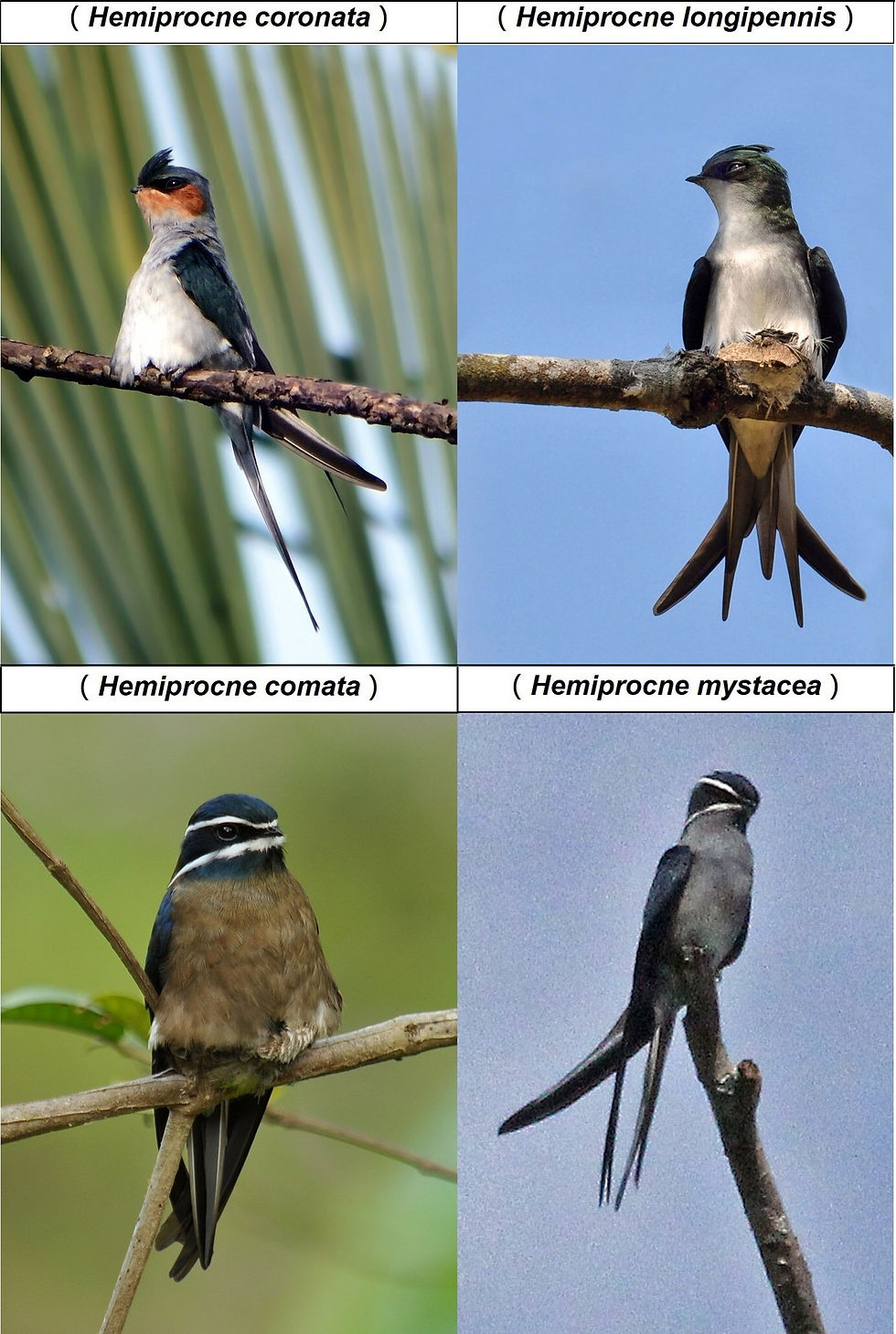
Tree swifts differ from true swifts in several anatomical features, particularly in the skull, upper jaw, and bones of the feet. While most swifts possess dark plumage, tree swifts often display brighter coloration.
Unlike true swifts, tree swifts have sufficiently strong feet to grasp branches, and they build their nests on branches. Their nests are extremely small relative to body size, often barely large enough to support half an egg. Using plant fibers and feathers bound together with saliva, they attach a tiny nest to a branch so inconspicuously that it resembles a small lump of debris. The egg is laid on this narrow structure with its upper half exposed. For nestlings, the nest functions mainly as a small platform on which the feet can rest.

No confirmed stem-group fossils have yet been discovered for Hemiprocnidae.
Trochilidae
The family Trochilidae includes six subfamilies: Florisuginae, Phaethornithinae, Polytminae, Lesbiinae, Patagoninae, and Trochilinae. Approximately 365 species have been described, all distributed throughout North and South America. This family represents the earliest branch to diverge within Apodiformes and displays striking morphological differences compared with other members of the order.
Unlike swifts and tree swifts, hummingbirds feed primarily on nectar. Their unique hovering flight ability is closely linked to this feeding strategy. Compared with swifts, hummingbirds possess legs capable of perching on branches, and they usually construct their nests on branches as well.
Hummingbirds possess some of the most elaborate plumage within Apodiformes. Examples include Loddigesia mirabilis, Aglaiocercus kingii, Calypte anna, Ocreatus underwoodii, Boissonneaua jardini, Heliomaster longirostris, Florisuga mellivora, and Lophornis delattrei. Their brilliant colors have fascinated humans for centuries. As early as the Nazca and Aztec civilizations, hummingbirds held symbolic and religious significance. In later periods, European collectors and museums often accumulated hummingbird specimens, and their feathers were sometimes used to decorate hats. Indigenous peoples of the Americas also captured hummingbirds for trade with Europeans. Although this commercial trade has largely disappeared today, the capture of hummingbirds for display in zoos or aviaries still occasionally occurs.

Molecular analyses suggest that hummingbirds originated around 42 million years ago. However, the earliest fossil evidence of hummingbirds appears in the early Oligocene approximately 34 million years ago, represented by the genus Eurotrochilus. Two species are known: E. inexpectatus and E. noniewiczi. Fossils of this genus have been discovered in Germany, France, and Poland. Interestingly, all living hummingbirds occur exclusively in the Americas, yet fossils of Eurotrochilus indicate that hummingbirds once existed in Europe during the Paleogene. This suggests the possibility that the group may have originated in Europe before later disappearing there. Fossil morphology indicates that these early hummingbirds were already capable of hovering flight and possessed elongated bills and tongues adapted for feeding on nectar.


Some flowering plants appear to have evolved specialized pollination systems in response to hummingbird feeding behavior, producing bird-pollinated flowers known as ornithophilous flowers. These flowers often store nectar deep within tubular structures accessible only to long, slender beaks, ensuring effective pollination when hummingbirds feed.
One hypothesis proposed by paleontologists suggests that hummingbirds may have disappeared from Europe due to competition with later-evolving nectar-feeding insects possessing elongated mouthparts.
Author: Shui Ye-You
Reference:
1. Apodiform | Hummingbirds, Swifts & Tree Swallows. Encyclopedia Britannica
2. Mayr G. (2004). Old World Fossil Record of Modern-Type Hummingbirds. Science.
3. Ksepka DT et al. (2013). Fossil evidence of wing shape in a stem relative of swifts and hummingbirds (Aves, Pan-Apodiformes). Proc Biol Sci.
4. Mayr G. (2015). Skeletal morphology of the middle Eocene swift Scaniacypselus and the evolutionary history of true swifts (Apodidae). Journal of Ornithology.
5. Chen A and Field DJ. (2020). Phylogenetic definitions for Caprimulgimorphae (Aves) and major constituent clades under the International Code of Phylogenetic Nomenclature. Vertebrate Zoology.


Comments