
Bakiribu waridza Is Actually a Fish

Misidentifications and subsequent corrections are not rare in paleontology; they are, in fact, a fundamental part of how the field advances. A fossil discovered in 2025 from the Romualdo Formation of Brazil and named Bakiribu waridza provides a striking example. This specimen was initially described as a pterosaur and even interpreted as the regurgitated remains of prey expelled by a predator. However, with more detailed comparative and anatomical analyses, this conclusion was completely overturned.
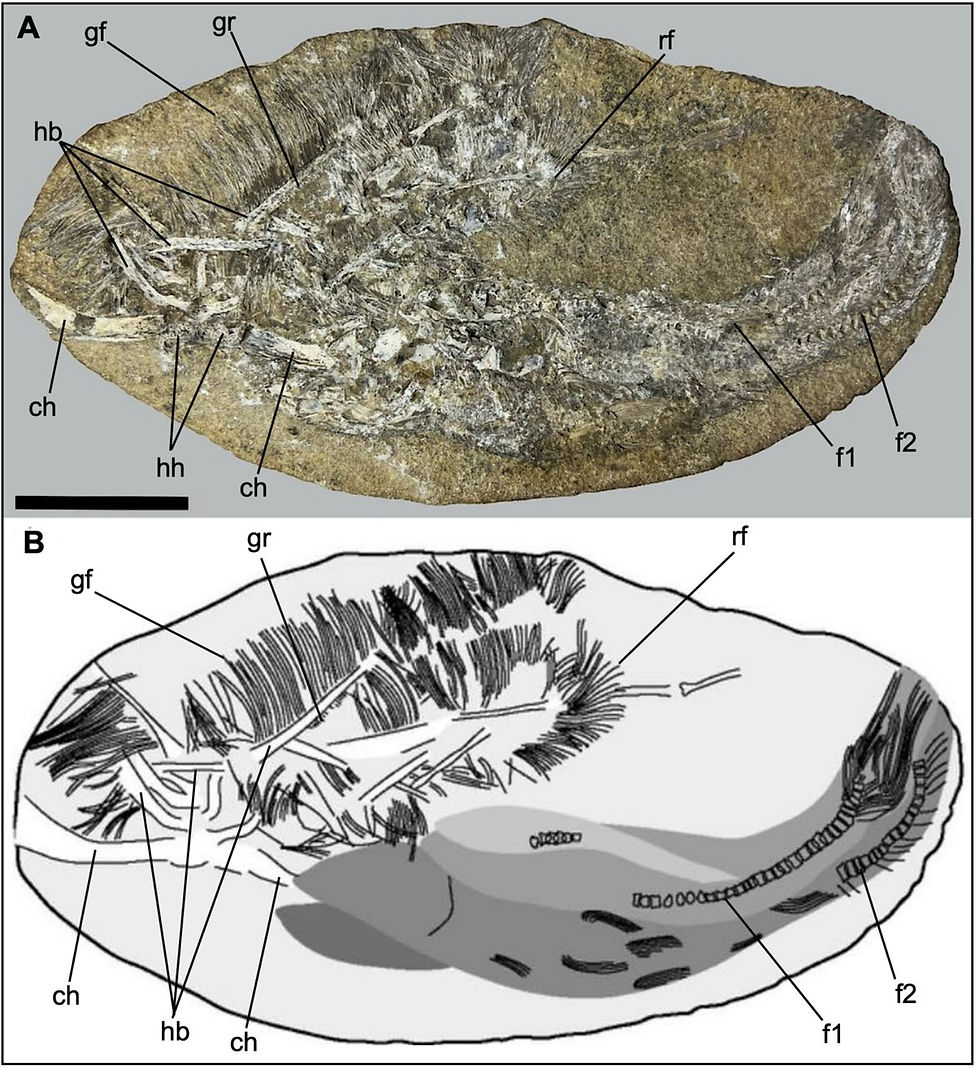
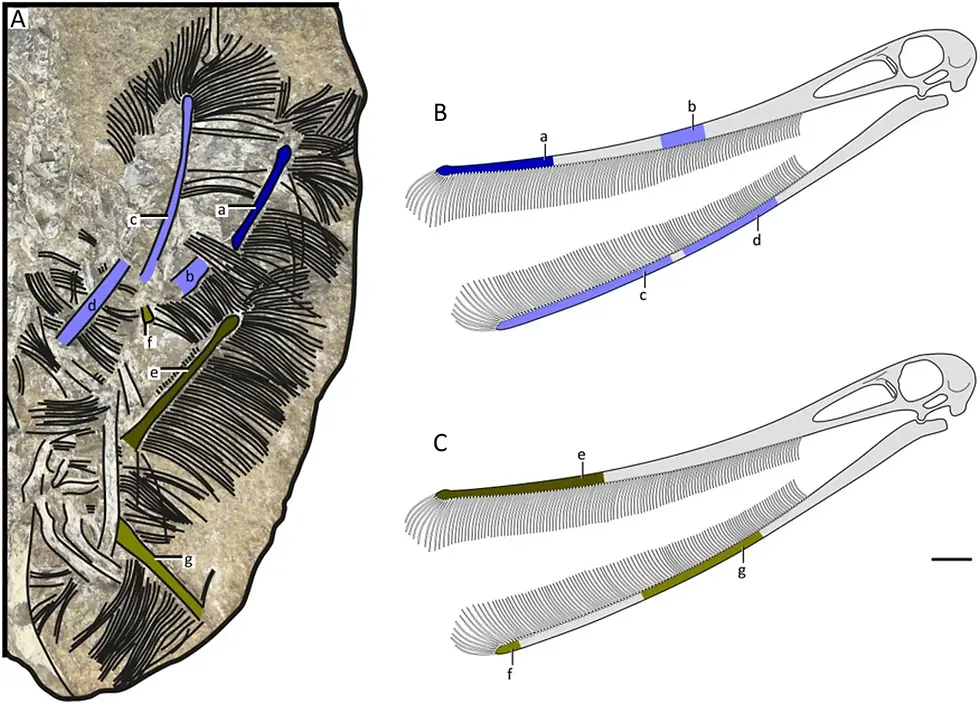
The story began with a concretion preserving multiple fragmentary bony elements associated with the remains of two fish, likely Tharrhias araripis. This association led the original researchers to propose that the assemblage represented a regurgitalite—a mass of indigestible material expelled by a predator. The elongate, needle-like structures were interpreted as pterosaur teeth, and the entire configuration was reconstructed as fragments of the upper and lower jaws. From the outset, however, this interpretation relied heavily on a chain of assumptions.

When other researchers reexamined the material, several inconsistencies became apparent. The slender structures identified as "teeth" lacked fundamental dental tissues such as enamel, dentine tubules, and a defined pulp cavity. Under microscopic observation, they showed a uniform, amorphous texture without the layered organization typical of true teeth. Their arrangement also diverged markedly from that seen in pterosaurs. In pterosaurs, teeth are typically symmetrically distributed along the jaw margins and exhibit consistent patterns of size variation. In contrast, these needle-like elements were largely confined to one side, displayed irregular variation in length, and in some cases were even longer posteriorly—an arrangement incompatible with known pterosaur dentitions.
The elements previously interpreted as jaw bones correspond instead to components of the gill arch apparatus of a bony fish. Researchers identified structures including the ceratohyals, hypohyals, basibranchial, and hypobranchials—skeletal elements that support the gill filaments in the respiratory system of actinopterygian fishes. These features closely resemble those of Early Cretaceous taxa such as Cratoamia. The slender structures once thought to be teeth are in fact gill filaments attached to the gill arches. These filaments are typically arranged perpendicular to the supporting bones, increasing the surface area available for gas exchange. In well-preserved specimens, gill rakers can also be observed along the opposite margin, where they function in filtering food particles. Furthermore, if the assemblage truly represented regurgitated material, one would expect evidence of digestive processes, yet the fine structures are largely intact and show no clear signs of mechanical or chemical damage.
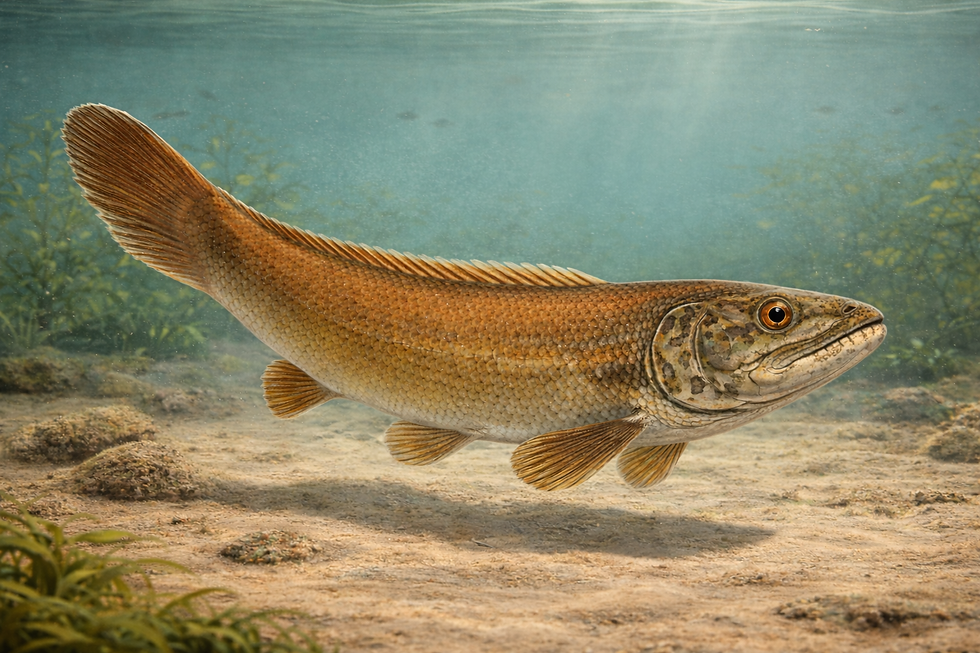
Two more plausible scenarios have been proposed to explain the fossil. In one, small fish became lodged in the buccal cavity of a larger fish, ultimately leading to its death and subsequent burial. In the other, the remains represent a coincidental association, with multiple organisms preserved together within the same concretion as it formed in the sedimentary environment.
This type of misinterpretation is not unprecedented. As early as 1939, a specimen named Belonochasma aenigmaticum was also mistaken for a pterosaur because its gill arches and filaments superficially resembled elongate teeth. Only later, through comparison with more complete material, was it correctly identified as the gill apparatus of a fish.
Ultimately, Bakiribu waridza has been redefined as indeterminate remains of an actinopterygian fish, and the name is now regarded as a nomen dubium—lacking sufficient diagnostic features to support its validity as a distinct species. This revision does not alter our understanding of filter-feeding pterosaurs, which are well established by abundant fossil material, such as the hundreds of specimens of Pterodaustro guinazui that clearly demonstrate their identity and feeding strategy.

Fossils never present answers directly. They are fragments of evidence—pieces of a much larger puzzle. Only through the integration of anatomy, comparative analysis, and geology can those fragments be assembled into a coherent picture of life in the past.
Author: Shui-Ye You
References:
Pêgas RV et al. (2025). A regurgitalite reveals a new filter-feeding pterosaur from the Santana Group. Scientific Reports.
Unwin DM et al. (2026). Reinterpretation of Bakiribu waridza from the Romualdo Formation (Lower Cretaceous) of Brazil: a fish not a pterosaur. An Acad Bras Cienc.


Comments