
Carcharodontosaurus saharicus


Age
Cretaceous(Cenomanian)
100.5-93.9 Ma
Taxonomy
Kingdom: Animalia
Phylum: Chordata
Class: Sauropsida
Superorder: Dinosauria
Order: Saurischia
Suborder: Theropoda
Family: Carcharodontosauridae
Genus: Carcharodontosaurus
Species: Carcharodontosaurus saharicus
Morphological description
The anatomy of Carcharodontosaurus saharicus is currently based primarily on the Moroccan neotype, SGM-Din 1. This specimen preserves most of the major regions of the skull, including the maxilla, nasals, lacrimals, frontals, parietals, and a relatively complete braincase, as well as several teeth. The principal missing elements include the premaxillae, squamosals, quadratojugals, quadrates, and most of the palate. Several cervical vertebrae, including SGM-Din 3–5, have also been referred to this species. The reconstructed skull measures approximately 1.63 m in length, indicating that C. saharicus possessed an exceptionally large head.
The maxilla is deep, and its lateral surface is densely ornamented with grooves and ridges, many of which are associated with neurovascular channels. The ventral margin of the external antorbital fossa forms a laterally projecting ridge that is particularly well developed anteriorly. The alveolar margin of the maxilla is convex, and the ventralmost foramina are positioned some distance above the tooth row, separated from it by a relatively smooth strip of bone. Medially, a deep ventrally facing fossa occurs beneath the anteromedial process of the maxilla. The medial longitudinal crest is relatively subdued and gradually disappears before reaching the anteromedial process. A 2007 study interpreted an accessory opening in the maxilla as the maxillary fenestra and considered the promaxillary foramen to be absent. A re-evaluation published in 2025 instead favored identifying this opening as the promaxillary foramen, suggesting that a true maxillary fenestra may have been absent in most adult carcharodontosaurids.
In dorsal view, the nasals are constricted near their midpoint and have a rugose external surface. A sharply delimited supranarial fossa is present, while the portion of the antorbital fossa extending onto the nasal is concealed laterally by a bony lamina. No nasal horn is currently known in Carcharodontosaurus saharicus. The frontals are fused to one another and posteriorly to the parietals. The supraorbital region is formed by the lacrimal and postorbital, excluding the frontal from the orbital margin. The lacrimal-frontal articulation is exceptionally deep, reaching approximately 6.5 cm, and its dorsal margin arches prominently above the orbit. The anteromedial corner of the supratemporal fossa is deeply invaginated, and an approximately sigmoidal crest extends across its anterior wall, probably associated with muscle attachment.
The braincase is highly pneumatic, with large pneumatic recesses surrounding the internal carotid region and adjacent to the occipital condyle, as well as a deep, funnel-shaped basisphenoid recess. The endocranial cast indicates that the olfactory tract was positioned above the brainstem. A 2025 re-examination measured the maximum transverse width of the cerebrum at approximately 5.3 cm. The teeth are blade-shaped and strongly compressed labiolingually. The original Algerian specimens, which are now lost, had crowns with nearly straight posterior margins and prominent arcuate enamel wrinkles along their margins. Teeth from the Moroccan neotype are more strongly recurved posteriorly and exhibit extreme labiolingual compression. Distinct enamel wrinkles occur along both the mesial and distal margins of the anterior and middle maxillary crowns.
The cervical vertebrae of Carcharodontosaurus saharicus are exceptionally low and broad. Their posterior articular surfaces are approximately reniform, with the centra substantially wider than high, and they possess a strongly developed, hypertrophied ventral keel.

Etymology
The generic name Carcharodontosaurus is derived from carcharo-, meaning "jagged," "sharp," or "saw-like"; -odont, meaning "tooth"; and -saurus, meaning "lizard."
The specific name saharicus means "from the Sahara" or "Saharan."
Biological description
Carcharodontosaurus saharicus lived in North Africa during the early part of the Late Cretaceous. The Moroccan neotype SGM-Din 1 was recovered east of the oasis of Er Remlia from Cenomanian terrestrial deposits in the upper part of the Kem Kem Group. A 2007 study noted that these deposits have also yielded fossils of Spinosaurus, Deltadromeus, and the rebbachisaurid sauropod Rebbachisaurus.
Carcharodontosaurus saharicus was clearly among the largest terrestrial predators of its time. Based on the approximately 1.63-m-long skull of SGM-Din 1, adult individuals have been reconstructed at roughly 12.5–13.3 m in total body length. Because no complete postcranial skeleton is known, body proportions have largely been reconstructed using more completely known allosauroids such as Allosaurus and Acrocanthosaurus as anatomical guides. A three-dimensional volumetric model produced an estimated body mass of approximately 6.23 metric tons, while isometric scaling based on Allosaurus and Acrocanthosaurus yielded a mean estimate of approximately 5.91 metric tons.
Bite-force estimates from different studies are broadly comparable. A 2015 analysis scaled the jaw musculature of Allosaurus to the skull dimensions of Carcharodontosaurus saharicus and estimated a bite force of approximately 28.2 kN at the midpoint of the tooth row. A 2022 study predicted the physiological cross-sectional areas of the jaw adductor muscles using skull width and phylogenetic information. Using a skull width of 55.8 cm for C. saharicus, the model produced an estimated anterior bite force of approximately 11,312 N and a maximum posterior bite force of approximately 25,449 N.
A 2015 biomechanical study also discussed the possibility of inertial feeding in Carcharodontosaurus saharicus. In this feeding behavior, rapid movements of the head and neck momentarily propel a food item away from the teeth, allowing it to be caught again and repositioned within the mouth. Comparable behavior occurs in living reptiles. Based on biomechanical work suggesting that Tyrannosaurus could manipulate food boluses of approximately 50 kg in this manner, the authors proposed that the neck musculature of Carcharodontosaurus may likewise have been capable of handling food items of a similar magnitude.
Phylogenetically, early studies placed Carcharodontosaurus among derived members of Carcharodontosauridae, closely related to the South American genera Giganotosaurus and Mapusaurus. A 2025 reanalysis, however, indicated that the long-standing practice of assigning numerous fragmentary large theropod remains from North Africa to Carcharodontosaurus requires substantial re-evaluation. For example, the Egyptian specimen SNSB-BSPG 1922 X 46 was historically referred to Carcharodontosaurus saharicus, but its re-examination resulted in the recognition of a distinct genus and species, Tameryraptor markgrafi. Likewise, Carcharodontosaurus iguidensis was never recovered as the sister taxon of C. saharicus in any of the phylogenetic analyses conducted in that study, leaving its assignment to Carcharodontosaurus uncertain pending additional material and more detailed comparisons.
Sauroniops pachytholus from the Kem Kem Group has previously been proposed as a junior synonym of Carcharodontosaurus saharicus. The 2025 study instead provisionally regarded Sauroniops as a nomen dubium until more complete material becomes available. These taxonomic revisions have substantially narrowed the range of material that can be confidently attributed to Carcharodontosaurus saharicus. Consequently, major uncertainties remain concerning much of its postcranial anatomy, locomotor biology, and predatory behavior.
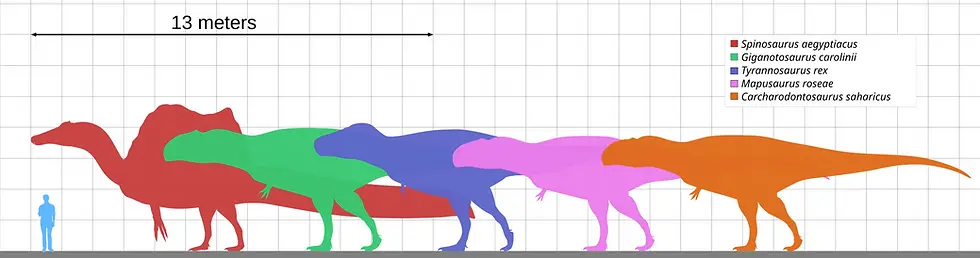
(Author: Shui-Ye You)
References
Brusatte SL and Sereno PC. (2007). A new species of Carcharodontosaurus (Dinosauria: Theropoda) from the Cenomanian of Niger and a revision of the genus. Journal of Vertebrate Paleontology.
Henderson DM and Nicholls R. (2015). Balance and Strength—Estimating the Maximum Prey-Lifting Potential of the Large Predatory Dinosaur Carcharodontosaurus saharicus. The Anatomical Record.
Kellermann M et al. (2025). Re-evaluation of the Bahariya Formation carcharodontosaurid (Dinosauria: Theropoda) and its implications for allosauroid phylogeny. PLOS One.
Sakamoto M. (2022). Estimating bite force in extinct dinosaurs using phylogenetically predicted physiological cross-sectional areas of jaw adductor muscles. PeerJ.


Comments