
Cretaceous Giant Octopuses as Large as Mosasaurs

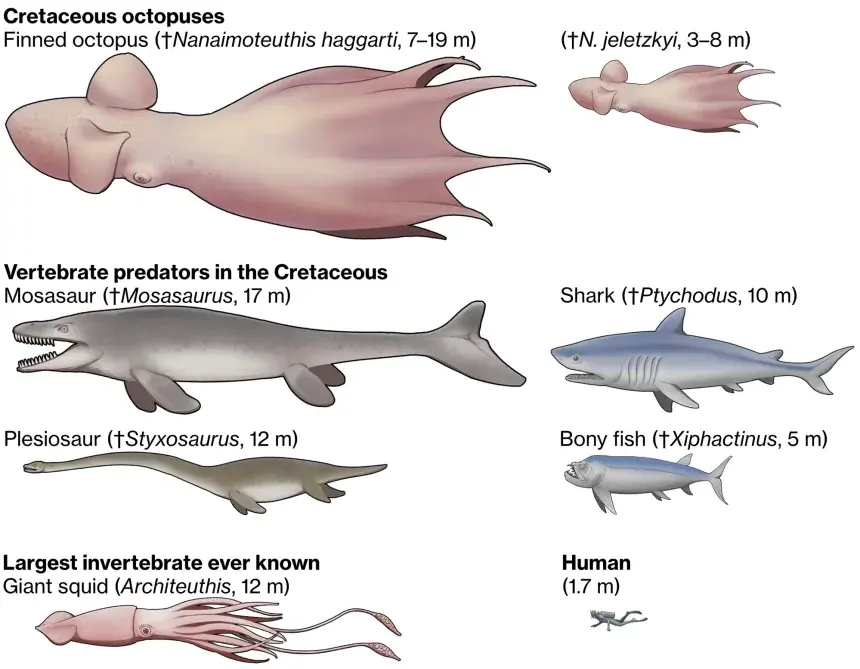
The oceans of the Cretaceous usually bring to mind apex predatory vertebrates such as Mosasaurus, plesiosaurs, giant fishes, and large sharks. These animals held an advantage in predation and competition through immense body size, powerful locomotion, sharp sensory abilities, and advanced cognition. In contrast, invertebrates across this long interval have often been regarded as smaller prey animals, with many groups gradually developing hard external shells as protection against predation pressure. Yet one study has reopened a window onto the Cretaceous ocean, suggesting that finned octopuses may have included giant, intelligent apex predators with powerful biting abilities.

The central evidence comes from one of the few parts of an octopus that can be preserved in the fossil record: the jaw. Because octopuses have soft bodies, they rarely leave complete fossils after death. Researchers therefore cannot reconstruct their entire body form from skeletons in the way they often can for dinosaurs or marine reptiles. In cephalopods, the jaws are made of stiffened chitin, which can sometimes survive under special preservational conditions. The study reexamined 15 large fossil jaws of Octobrachia, also known as Octopodiformes, previously reported from Cretaceous sediments in Japan and Vancouver Island, Canada. The researchers also discovered 12 additional jaws of finned octopuses from Cretaceous rocks in Japan through a digital fossil-mining method. In this approach, fossil-bearing rocks are ground down layer by layer in the laboratory. After each extremely thin layer is removed, a high-resolution image is taken, creating a sequential digital record. Imaging data and AI are then used to identify fossils hidden inside the rock from large tomographic datasets. Because the method is destructive, the original fossil cannot be preserved afterward.


The researchers revised the taxonomy of these fossils and reorganized them into two species: Nanaimoteuthis jeletzkyi and Nanaimoteuthis haggarti. The genus Nanaimoteuthis had previously been assigned to Vampyromorpha, the group that includes vampire squids, but this study places it within Cirrata, the finned octopus suborder of Octopoda. The newly discovered specimens also extend the stratigraphic range of N. jeletzkyi to the earliest Cenomanian through the late Campanian, about 100 to 72 million years ago. N. haggarti occurs from the Santonian to the late Campanian, about 86 to 72 million years ago. This means that the record of finned octopuses is older than previously recognized, and that octopuses were already active inhabitants of the shelf seas around the North Pacific during the Cretaceous.
What makes these fossils especially striking is their size. Using the allometric relationship between jaw length and mantle length in modern finned octopuses, the researchers estimated that the largest individuals of N. jeletzkyi had a mantle length of about 0.67 to 1.84 meters. Including the arms, their total length may have reached about 2.8 to 7.7 meters. N. haggarti was even larger, with an estimated mantle length of about 1.58 to 4.43 meters and a total length of about 6.6 to 18.6 meters. Its jaw was roughly 1.5 times larger than the largest known jaw of the living giant squid, Architeuthis dux. Its estimated total length was great enough to rival large Cretaceous bony fishes, chondrichthyans, plesiosaurs, and mosasaurs.

Large body size alone, however, is not enough to prove that these animals were apex predators. Because all of the specimens came from low-energy outer-shelf deposits, they were unlikely to have been heavily abraded by waves, currents, or transport. Their excellent preservation also allowed the researchers to infer that the wear on the jaws was probably not the result of later damage or mechanical preparation, but a trace of feeding behavior during life. In the largest adult specimens of both Nanaimoteuthis species, the jaw tip is blunt and the jaw edges are rounded, whereas these same structures were sharp in juveniles. The portion of the jaw tip lost to wear accounts for about 10% of the total jaw length, a degree of wear more severe than that seen in many living cephalopods that frequently crush hard-shelled prey. The jaws also preserve chips, scratches, polished surfaces, and cracks. Many chips are larger than 1 millimeter, and some scratches reach up to 5 millimeters in length. These marks occur near the rostrum and jaw edges, running vertically or obliquely. Together, they indicate that the jaws repeatedly endured strong mechanical stress and often processed hard food items, such as shells, bones, or other tough tissues of prey. The animals were therefore inferred to have been active carnivores capable of dismantling large prey with powerful jaws. Octopuses also possess long, flexible arms that can seize prey before the jaws cut, crush, and tear it apart. For an octopus more than ten meters long, this body plan would have been sufficient to place it high in the Cretaceous food web.
The wear marks on these jaws were also not perfectly symmetrical. In both Nanaimoteuthis species, the right jaw edge was more heavily worn than the left. The researchers interpreted this as possible evidence of lateralized behavior, meaning that the animal may have preferred one side when capturing or processing prey. Similar behavior is known in living octopuses, and lateralization is often associated with more developed nervous systems and cognitive abilities. A preference for one side suggests that different behavioral tasks may be distributed between different sides, implying a degree of functional specialization in the nervous system. The researchers therefore proposed a bold but evidence-based inference: the earliest octopuses may already have possessed advanced intelligence, and their predatory behavior may have been flexible and complex.
Nanaimoteuthis jeletzkyi and Nanaimoteuthis haggarti call to mind the enormous deep-sea cephalopods of Jules Gabriel Verne's Twenty Thousand Leagues Under the Seas (Vingt mille lieues sous les mers)—creatures large enough to dominate the deep and threaten other animals. This study suggests that, long before such monsters entered human imagination, something very much like them truly existed in the Cretaceous ocean.

Author: Shui-Ye You
Reference:
Ikegami S et al. (2026). Earliest octopuses were giant top predators in Cretaceous oceans. Science.


Comments