
Defensive Hairs of Dermestid Larvae Were Longer 100 Million Years Ago Than They Are Today

Insects of the beetle order Coleoptera and the family Dermestidae are common in modern ecosystems. Often known as skin, larder, and carpet beetles, many species occur in dried animal remains, leather, feathers, natural history collections, stored products, and other organic materials. From a human perspective, they can sometimes be troublesome pests. Ecologically, however, they are an important part of decomposer networks. By feeding on animal and plant remains, they help return biological nutrients to natural cycles. They also have value in forensic entomology, because the occurrence of dermestid beetles at different developmental stages on a corpse can provide clues about the postmortem interval.


The larvae of dermestid beetles look strikingly hairy. At first glance, their appearance may recall caterpillars of Lepidoptera or bristly millipedes of Polyxenida. Their bodies bear highly specialized defensive setae, including spicisetae and hastisetae. A hastiseta has an elongate shaft bearing sharply pointed scales, with a distinctive arrowhead-shaped structure at its tip. These setae can entangle or hinder predators, providing mechanical defense against small enemies such as mites, beetles, ants, and spiders. In some cases, they may even lead to the death of the predator.

To understand how the defensive setae of dermestid larvae changed through evolutionary time, researchers compiled and examined 59 fossil specimens of dermestid larvae and data from 11 extant larvae, including 36 newly discovered amber-preserved specimens. These new fossils come from different regions and geological time slices, including Miocene Lausitz amber from Germany, Dominican amber, New Zealand amber, Eocene Baltic amber, and Cretaceous Canadian and Kachin Myanmar amber. Thirty-five of the new specimens could be confidently assigned to Dermestidae. This substantially expands the fossil record of dermestid larvae. Although such fossils were once considered extremely rare, their apparent scarcity may have resulted from difficulties in identification, preservation limits, collection bias, and underreporting in the literature.
The researchers examined the larvae's heads, antennae, mouthparts, thoracic legs, posterior abdominal regions, and setal morphology. In dermestid larvae, the posterior end of the abdomen often bears a dense tuft of hastisetae. The central finding of the study is that Cretaceous dermestid larvae generally had longer setae than extant larvae, indicating a more developed condition in the past, especially in nudisetae and spicisetae, whereas hastisetae showed less obvious difference. These Cretaceous specimens also reveal considerable morphological diversity, particularly those preserved in Kachin amber, suggesting that dermestid larvae had already undergone substantial morphological differentiation by that time.
Miocene:


Eocene:

Cretaceous:


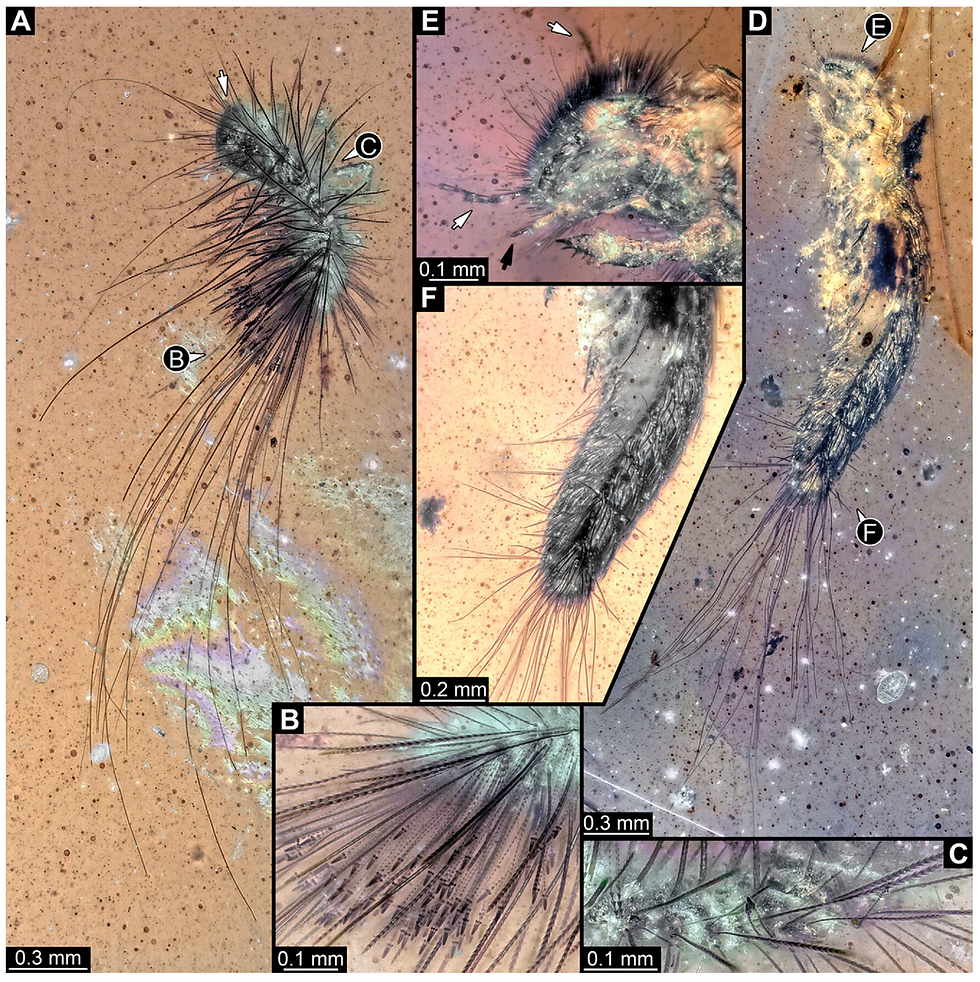
The researchers did not overextend the paleoecological interpretation of these longer setae. Even so, living caterpillars provide a useful comparison: species with long hairs are often considered better defended, because such hairs can make them harder for predators to swallow, irritate skin or mucous membranes, create a physical barrier, and prevent parasitoid wasps from bringing their ovipositors into contact with the body surface. In living dermestids, including larvae of Megatominae, long setae can serve similar ecological functions. For this reason, interpreting the long setae of Cretaceous dermestid larvae as enhanced defensive structures is the most natural explanation.
The small clues sealed in amber give us a rare glimpse of these unusual insect larvae in ancient Cretaceous forests, where even tiny decomposers carried defensive equipment more elaborate than that of many of their living relatives.
Author: Shui-Ye You
Reference:
Cadre JL et al. (2025). New Amber Fossils Indicate That Larvae of Dermestidae Had Longer Defensive Structures in the Past. insects.


Comments