
Deinonychus antirrhopus

Age
Cretaceous(Aptian to Albian)
115–108 Ma
Taxonomy
Kingdom:Animalia
Phylum:Chordata
Class:Reptilia
Order:Saurischia
Family:Dromaeosauridae
Genus:Deinonychus
Species:Deinonychus antirrhopus
Morphological description
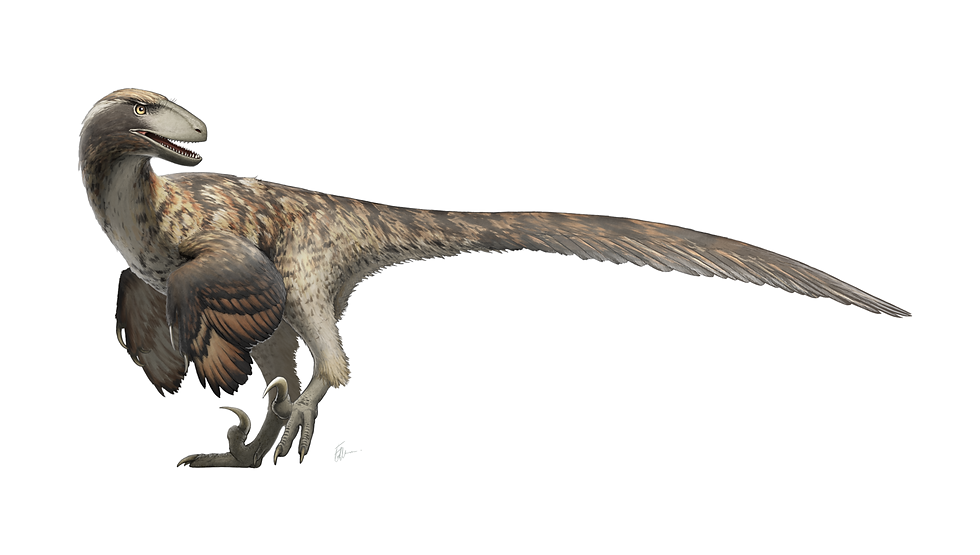
Deinonychus antirrhopus was a medium-to-large-sized dromaeosaurid dinosaur. Its body length was approximately 3.5 meters, with an estimated weight of around 90 kilograms, though some fossil specimens suggest that the largest individuals may have exceeded 4 meters in length.

Adult individuals possessed skulls measuring approximately 41 centimeters long. The jaws were powerful and lined with around 70 curved, blade-like teeth. The snout was narrow, while the jugals expanded broadly outward, giving the animal strong binocular vision. Its antorbital fenestrae were particularly large.
The forelimbs of Deinonychus were large and robust, bearing three digits. The first digit was the shortest, while the second was the longest. The second toe of each hind foot possessed a large sickle-shaped claw that could reach lengths of up to 13 centimeters and was likely used during predation.
Based on fossil evidence from closely related species, Deinonychus was probably extensively covered in feathers during life.
Etymology
The genus name Deinonychus is derived from the Ancient Greek words δεινος (deinos), meaning “terrible,” and ονυξ (onyx), meaning “claw,” referring to the enlarged sickle-shaped claw on the second toe of the hind foot.
The species name antirrhopus refers to a hypothesis regarding the function of its tail.
Biological interpretation
Fossils of Deinonychus antirrhopus have primarily been discovered in the U.S. states of Montana, Wyoming, and Oklahoma. Its fossils were first discovered in 1931 by Barnum Brown in southern Montana. During a new excavation in 1964, additional Deinonychus fossils were uncovered, including the holotype specimen YPM 5205. In 1969, researchers compared the fossils discovered in 1931 and 1964, concluded that they belonged to the same species, and formally named the animal Deinonychus antirrhopus.
At the time, researchers believed that the tail of Deinonychus contained a series of elongated bony processes and ossified tendons that stiffened the tail, allowing it to provide better balance and turning ability, which inspired the species name antirrhopus (“counterbalancing”). However, in 2000, researchers reexamined the fossils and discovered that the supposed ossified tendons were actually gastralia. Additionally, fragments of eggshells were found closely associated with these gastralia, suggesting that Deinonychus may have been incubating eggs using body heat in a manner similar to modern birds. This may further indicate that Deinonychus was warm-blooded.
Phylogenetic analyses indicate that Deinonychus belonged to the subfamily Dromaeosaurinae within Eudromaeosauria and occupied a relatively basal position within the subfamily.
Geological analysis of the formations where its fossils were discovered suggests that Deinonychus inhabited floodplains or swampy environments that included tropical or subtropical forests, deltas, and lagoons. Fossils of Tenontosaurus have also been found near Deinonychus remains, and Deinonychus teeth were scattered around the Tenontosaurus fossils, indicating a feeding relationship between the two animals.
The discovery of Deinonychus was highly significant. At the time, both the scientific community and the general public largely viewed dinosaurs as large, sluggish animals. However, the relatively small body size and evidently agile anatomy of Deinonychus completely challenged this traditional image and helped inspire renewed debate over whether dinosaurs were warm-blooded animals. This shift in perspective later became known as the Dinosaur Renaissance.

Furthermore, the hands of Deinonychus showed clear similarities to those of birds, leading researchers to propose that birds evolved from dinosaurs—a hypothesis that was later strongly supported by further discoveries.
(Author: Bai Leng)
Reference
1. Ostrom, J. H. (1970). Stratigraphy and paleontology of the Cloverly Formation (Lower Cretaceous) of the Bighorn Basin area, Wyoming and Montana. Bulletin of the Peabody Museum of Natural History.
2. Brinkman, D. L., Cifelli, R. L., Czaplewski, N. J. (1998). First occurrence of Deinonychus antirrhopus (Dinosauria: Theropoda) from the Antlers Formation (Lower Cretaceous: Aptian–Albian) of Oklahoma. Oklahoma Geological Survey Bulletin.
3. Ostrom, J. H. (1969). Osteology of Deinonychus antirrhopus, an unusual theropod from the Lower Cretaceous of Montana. Peabody Museum of Natural History Bulletin.
4. Ostrom, J. H. (2019). A New Theropod Dinosaur from the Lower Cretaceous of Montana. Osteology of Deinonychus antirrhopus, an Unusual Theropod from the Lower Cretaceous of Montana.
5. Makovicky, P.J., Grellet-Tinner, G. (2000). Association between a specimen of Deinonychus antirrhopus and theropod eggshell. In Bravo, A.M., T. Reyes (eds.). First international symposium on dinosaur eggs and babies, Isona i Conca Dellà Catalonia, Spain, 23–26 September 1999.
6. Grellet-Tinner, Gerard (2006). Oology And The Evolution Of Thermophysiology In Saurischian Dinosaurs: Homeotherm And Endotherm Deinonychosaurians?. Papéis Avulsos de Zoologia.
+44.836667, -108.392222


Comments