
I May Look Strange, but I Am Gentle — Shringasaurus indicus

Updated: Apr 10
When people think of horned reptiles, the first animals that usually come to mind are creatures such as Triceratops or the Jackson's chameleon. Yet long before Triceratops appeared on Earth, another group of unusual horned reptiles had already evolved. These animals possessed an appearance that seemed almost assembled from different creatures: a body reminiscent of a giant lizard, a skull somewhat comparable to that of the horned dinosaur Carnotaurus, and a neck and teeth that bring to mind early long-necked herbivores. These peculiar reptiles are known as Shringasaurus.

The genus Shringasaurus lived during the Middle Triassic and belongs to a strange lineage of reptiles called azendohsaurids, members of the broader group Allokotosauria within Archosauromorpha. Their anatomy appears extremely unusual. As suggested earlier, they almost look like evolutionary “composites.” Although their outward appearance may resemble members of the two major reptile lineages of that time—archosauriforms and lepidosauromorphs—they do not belong to either of these dominant groups. Instead, they represent a more basal branch of archosauromorph reptiles, close relatives of the ancestors that would later give rise to crocodiles, dinosaurs, and birds.
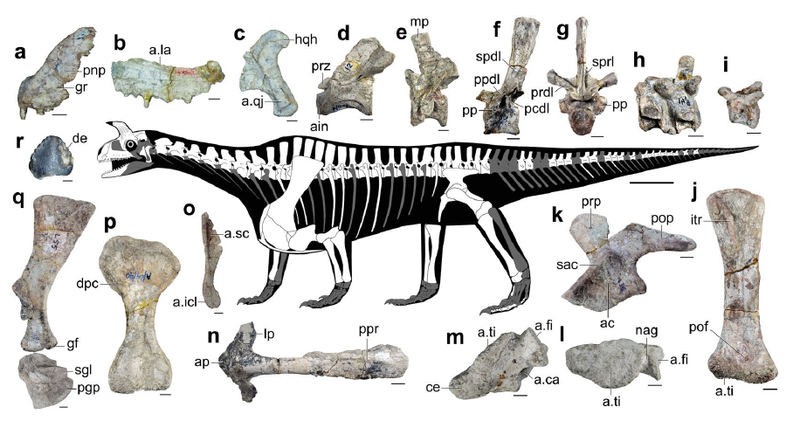
Compared with their more derived descendants, the body plan of azendohsaurids remains relatively primitive. Their scapulae are long, the shoulder joints point backward, and their hip joints extend laterally from the body. These skeletal features give them a somewhat awkward posture, with the front of the body appearing higher than the rear during locomotion. Despite this primitive structure, azendohsaurids were among the few reptile groups of their time experimenting with new evolutionary directions.

One of their most remarkable innovations was the evolution of a relatively long neck. By increasing the number of cervical vertebrae, these animals developed a neck somewhat reminiscent of that seen later in early sauropod dinosaurs. Such a structure allowed them to reach and feed on the tender leaves of tall ferns and other vegetation. To efficiently crop these plants, they also evolved leaf-shaped teeth, a dental design similar to that later found in many herbivorous dinosaurs.

Among all azendohsaurids, Shringasaurus stands out as the most specialized member. Its brow bones extend outward to form prominent bony horns above the eyes, producing a striking resemblance to the horns of much later ceratopsian dinosaurs. The function of these horns has attracted considerable attention among paleontologists. Current interpretations suggest that they were likely associated with sexual selection. Evidence for this idea comes from fossil specimens showing that some individuals possess horns while others lack them. Such variation hints at sexual dimorphism within the species. Whether these horns truly served as display structures or as weapons in competition between individuals remains uncertain, and further fossil discoveries will be required to resolve this question.

Beyond their unusual appearance, fossils of Shringasaurus have also gained attention in the field of paleopathology. Among azendohsaurids, this species is one of the rare cases where fossil evidence of cervical vertebral disease has been identified. A study published in 2018 reported a pathological specimen belonging to an adult individual in which two cervical vertebrae had fused together. The cause of this condition remains uncertain. Researchers have suggested several possibilities, including congenital developmental defects or infections caused by microorganisms.
Even today, many mysteries surrounding Shringasaurus remain unresolved. Questions such as where these animals originally evolved from and why they ultimately disappeared from the fossil record are still open. Future discoveries may eventually shed light on these puzzles and reveal more about the life and evolution of this extraordinary Triassic reptile.
Author: Rodrigo
References:
Sengupta, S.; Ezcurra, M.D.; Bandyopadhyay, S. (2017). "A new horned and long-necked herbivorous stem-archosaur from the Middle Triassic of India". Scientific Reports. 7 (1): 8366.
Sengupta, S. (2018). "Fusion of cervical vertebrae from a basal archosauromorph from the Middle Triassic Denwa Formation, Satpura Gondwana Basin, India". International Journal of Paleopathology. 20: 80–84.


Comments