
Innate Mechanism That Helps Chicks Recognize Adults: Big and Red

Updated: Apr 10
In the earliest stages of life, the ability to quickly recognize which adults can provide protection is crucial for survival. Newly hatched chicks, for example, must decide which individuals are worth approaching even though they have no prior experience. They rely on built-in visual preferences to guide their initial choices. Both chicks and ducklings rapidly form attachments to their mother through imprinting, a learning process that allows them to follow and remain close to a caregiver. At the same time, hatchlings are surrounded by siblings from the same brood. While siblings help maintain group cohesion and improve vigilance against predators, the mother provides far more important resources such as warmth, guidance in foraging, and protection. Because of this imbalance, chicks that fail to prioritize adults over peers would face a disadvantage in survival. This raises a key question: when chicks first encounter the world, what visual cues allow them to approach adults rather than other juveniles?

In the red junglefowl and domestic chicken (Gallus gallus), adults differ from chicks in several conspicuous visual traits. Adult birds tend to have darker plumage and soft tissues around the head, and these regions also contain stronger red coloration. Chicks, by contrast, appear brighter and often show more yellow tones. Visual signals related to the head—such as the location of the face, the eyes, and the color distribution of the beak and surrounding tissues—are particularly effective in attracting chicks' attention. Body size is another obvious difference: adult birds are much larger than newly hatched chicks. Because of this, "largeness" itself may serve as a visual cue indicating adulthood. Previous studies have shown that chicks can distinguish different sizes, yet whether they spontaneously prefer larger or redder stimuli without any prior experience had not been directly tested. Researchers therefore focused on two visual features that most clearly distinguish adult chickens from juveniles: size and color.
To investigate the chicks' earliest preferences, eggs were incubated and hatched in complete darkness so that the animals would have no visual experience before testing. Within 14 hours after hatching, each chick was placed in an experimental arena equipped with a monitor on each side. The screens displayed square shapes that differed in size and color. On one side there was a single large square, while the opposite side showed five smaller squares whose combined area matched that of the large one. All shapes moved slightly back and forth horizontally to maintain equal levels of visual stimulation. Researchers recorded which side the chick approached first, where it spent most of its time, and how its preference changed during a twenty-minute observation period.
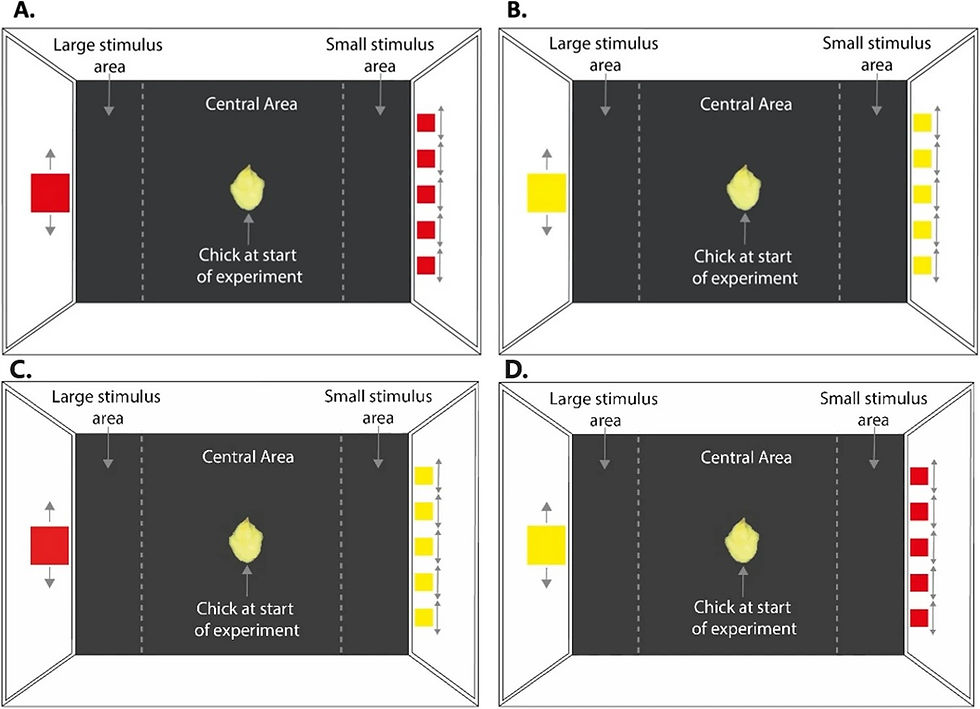
The results revealed that large red shapes were the most attractive stimulus. Ninety-one percent of the chicks made a choice, and among them 76 percent initially walked toward the large red square. Most of their time during the experiment was then spent near that stimulus. The preference was especially strong during the first five minutes and remained stable afterward. This pattern suggests that even before receiving any visual information from the outside world, chicks naturally approach features that resemble adult characteristics—objects that are both large and red. When the shapes were changed to yellow, a color more typical of young birds, the chicks' attraction dropped sharply. Only 65 percent approached either side, their movements were slower, and they often remained near the center of the arena, indicating that yellow stimuli were not particularly compelling to newly hatched chicks.
However, when the combinations were reversed—presenting a large yellow square against five small red squares—the preference shifted dramatically. Most chicks moved toward the cluster of small red squares. The color red itself is therefore highly attractive and can outweigh the influence of size. Even when paired with a smaller shape, red stimuli still drew more attention than larger yellow ones. When chicks were presented with two red stimuli differing only in size, they still tended to choose the larger red object. This indicates that size and color have additive effects: when both cues signal adult-like characteristics, the attraction becomes strongest.
These innate preferences likely help chicks approach their mother more efficiently during the earliest stages of life. Once contact with the adult is established, imprinting further strengthens the social bond. In contrast, bright yellow or other juvenile-like visual cues appear far less attractive and may even reduce a chick's tendency to approach. In natural environments, such colors are more typical of young individuals. Through evolution, this predisposition has been preserved as a mechanism ensuring that newly hatched chicks—at their most vulnerable stage—can quickly locate the adult hen that provides warmth, protection, and guidance.
Author: Shui-Ye You
Reference:
Freeland LV et al. (2025). Assessing preferences for adult versus juvenile features in young animals: Newly hatched chicks spontaneously approach red and large stimuli. Learning & Behavior.


Comments