
Life atop an Andean Volcano: How the Andean Leaf-Eared Mouse Pushes the Limits of Mammalian Survival

In the Andes along the border between northern Chile and northwestern Argentina, towering volcanoes, salt flats, and arid grasslands form the Puna de Atacama. Cold, severely hypoxic, and extremely dry, this region was long considered incapable of supporting mammals year-round. Yet the Andean leaf-eared mouse (Phyllotis vaccarum) ranges from the coastal lowlands of northern Chile to volcanic summits above 6,700 meters. Individuals have even been found on the 6,739-meter summit of Volcán Llullaillaco. This small rodent is therefore the world's highest-dwelling mammal and possesses one of the broadest known elevational ranges of any mammalian species.
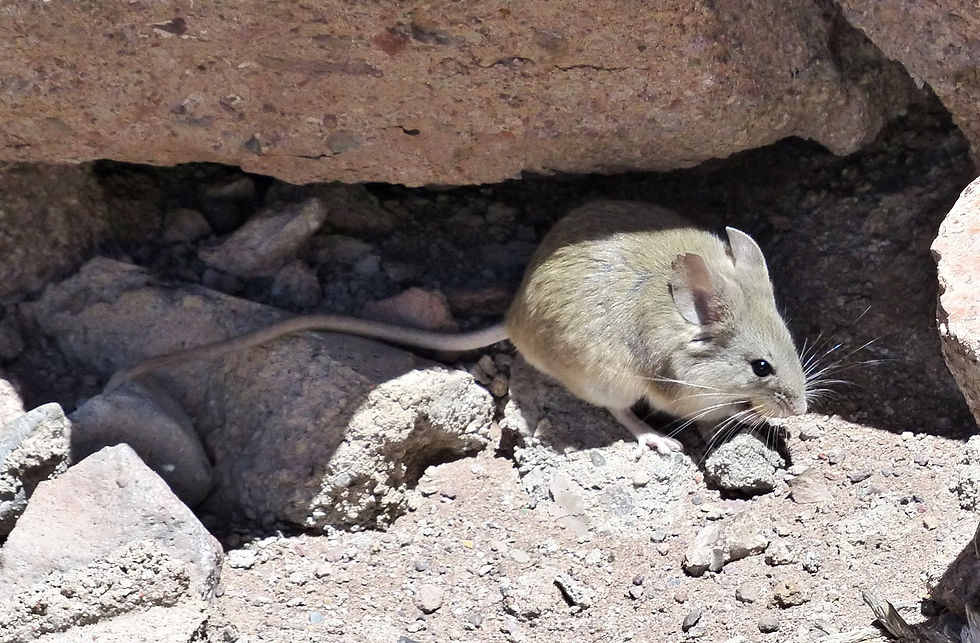
At the summit of Llullaillaco, air temperatures remain below 0°C almost continuously, and barometric pressure is only about 45 kilopascals, compared with approximately 101.3 kilopascals at sea level. Each breath contains only 44% of the oxygen available at sea level. Well-trained, acclimatized mountaineers may tolerate such conditions briefly, but they cannot survive there indefinitely. The challenge is even greater for an Andean leaf-eared mouse, whose body is far smaller than that of a human. Small animals have a high surface-area-to-volume ratio and therefore lose body heat rapidly. They must continually oxidize nutrients to maintain their body temperature, yet hypoxia restricts aerobic metabolism. As a result, these mice must increase heat production while having less oxygen available to support it.

To understand how Andean leaf-eared mice occupy such an extraordinary elevational range, researchers conducted five high-elevation expeditions between 2020 and 2023 and surveyed sites at different elevations across northern Chile. They collected 167 mice from 33 localities, including 14 individuals from above 6,000 meters. The collection sites included the volcanoes Copiapó, Llullaillaco, Ojos del Salado, Púlar, and Salín. After filtering the data for sequencing quality, coverage, and relatedness, the researchers retained whole-genome data from 123 Andean leaf-eared mice to examine genetic differences among populations from different elevations.
From the coast to the volcanic summits, the mice exhibited remarkably little population structure, indicating substantial gene flow among animals living at different elevations. The researchers then kept highland and lowland Andean leaf-eared mice under the same laboratory conditions for at least two weeks and compared them with Darwin's leaf-eared mouse (Phyllotis darwini), a predominantly lowland species. This common-garden experimental design helped minimize differences caused by the animals' recent environmental conditions. The mice were exposed to cold to elicit both shivering and nonshivering thermogenesis, and their maximal rates of oxygen consumption were measured under oxygen conditions simulating sea level and elevations of 4,300 and 7,000 meters.

As simulated elevation increased, maximal thermogenic capacity declined in all groups, but the decline was smaller in highland Andean leaf-eared mice. Under oxygen conditions equivalent to an elevation of 7,000 meters, the highland mice retained a greater aerobic scope. In other words, beyond the baseline metabolism required to sustain life, they could mobilize more aerobic capacity for heat production. Basal metabolic rates did not differ significantly among the groups. The advantage of the highland population therefore emerged when the mice faced cold and hypoxia: under these conditions, they could sustain a higher maximal rate of aerobic thermogenesis.
The physiological basis of this difference could be traced to skeletal muscle. Highland Andean leaf-eared mice had a higher mitochondrial respiratory capacity in the gastrocnemius, an important muscle for shivering thermogenesis. They also had higher activities of cytochrome c oxidase, β-hydroxyacyl-CoA dehydrogenase, and citrate synthase, enzymes involved in the mitochondrial electron transport system, fatty acid β-oxidation, and the tricarboxylic acid cycle, respectively. Their interscapular brown adipose tissue also showed a greater capacity for fatty acid oxidation. In short, highland mice possess enhanced mitochondrial metabolism that enables them to convert the chemical energy stored in lipids into the heat needed to maintain body temperature.
Carbohydrate oxidation yields slightly more energy per unit of oxygen consumed than fat oxidation, giving carbohydrates a potential metabolic advantage when oxygen is scarce. For this reason, high-elevation animals have sometimes been expected to rely more heavily on carbohydrates. Andean leaf-eared mice provide a different example. Under cold, hypoxic conditions, both highland and lowland populations primarily used lipids to fuel thermogenesis. Fat has a high energy density and is particularly suitable for sustaining heat production over extended periods.
Many high-elevation mammals have evolved hemoglobins with increased oxygen affinity. In Andean leaf-eared mice, however, hemoglobin–oxygen affinity did not differ significantly between highland and lowland populations, nor did the researchers detect population differences in arterial oxygen saturation. The mice may therefore use a different physiological route to help maintain oxygen delivery. Carbonic anhydrase in red blood cells accelerates the reversible conversion between carbon dioxide and bicarbonate: CO2+H2O ⇌ HCO3−+H+
This enzyme plays an important role in transporting carbon dioxide through the blood and maintaining acid–base balance. High-elevation hypoxia stimulates increased pulmonary ventilation, but excessive carbon dioxide loss can produce respiratory alkalosis. Red blood cells from Andean leaf-eared mice had lower carbonic anhydrase activity than those from Darwin's leaf-eared mice. The researchers proposed that this lower activity could slow carbon dioxide excretion, permitting greater ventilation during hypoxia while limiting disruption of systemic acid–base balance. Increased ventilation may thus provide an alternative means of safeguarding arterial oxygen saturation without requiring an increase in hemoglobin–oxygen affinity. Because reduced carbonic anhydrase activity was shared by both highland and lowland Andean leaf-eared mice, it may be a species-level characteristic that helps support their unusually broad elevational distribution.
The study also found that Andean leaf-eared mice consume plants containing toxic secondary compounds. Because different plant species occur at low and high elevations, the mice are likely exposed to different dietary toxins across their range. Naturally elevated concentrations of arsenic in volcanic sediments may provide an additional source of toxins entering the body through food. Accordingly, genes involved in metabolizing foreign compounds showed pronounced genetic differentiation among mice from different elevations. These included genes encoding cytochrome P450 enzymes, glutathione S-transferases, ATP-binding cassette transporters, and solute carrier transporters. Together, these proteins participate in the functionalization, conjugation, and cellular elimination of potentially toxic compounds. Such genetic differences suggest that local plant communities and other sources of toxins may have shaped the capacity of mice at each elevation to metabolize the compounds encountered in their diets.
Responses to hypoxia and foreign compounds may also interfere with one another because their signaling pathways use some of the same regulatory machinery. For example, hypoxia-inducible factors and the aryl hydrocarbon receptor rely on members of the ARNT family as dimerization partners. Consequently, activation of one pathway may affect the regulation of the other. Andean leaf-eared mice must therefore cope simultaneously with oxygen scarcity and chemically defended food plants, and maintaining effective responses to both challenges may itself impose a strong evolutionary pressure. Their survival across this immense elevational range reflects coordinated adaptations involving skeletal muscle, mitochondrial metabolism, lipid oxidation, acid–base regulation, and hepatic biotransformation pathways.
Author: Shui-Ye You
Reference:
Liphardt S et al. (2026). Adaptation across an extreme elevational gradient in Andean leaf-eared mice, the world's highest-dwelling mammal. Science.


Comments