
Pliosaurus funkei


Age
Jurassic(Tithonian)
146 Ma
Taxonomy
Kingdom: Animalia
Phylum: Chordata
Class: Sauropsida
Order: Plesiosauria
Family: Pliosauridae
Genus: Pliosaurus
Species: Pliosaurus funkei
Morphological description
Pliosaurus funkei was established on the basis of two specimens, PMO 214.135 (the holotype) and PMO 214.136. Its most diagnostic combination of characters includes a massive mandibular retroarticular process, cervical vertebral centra with a strongly rugose ventral surface lacking a rounded keel, and proportionally elongate humeri that are markedly longer relative to body size than those of several other species of Pliosaurus.
Although the skull is incompletely preserved, the rostral remains indicate that the premaxilla probably bore five pairs of teeth, with an unusually long diastema between the fourth and fifth alveoli, nearly twice the spacing between the other teeth in the tooth row. The upper and lower teeth interlocked, and the mandibular symphysis contained at least six pairs of teeth; because its anterior end is missing, the original number may have been greater. The splenial contributed to the ventral surface of the mandibular symphysis, with its anterior extent reaching approximately the interval between the fourth and fifth alveoli. One of the better-preserved teeth has the trihedral cross-section characteristic of Pliosaurus, with longitudinal enamel ridges on the lingual surface and a smooth labial surface. The largest preserved tooth in the holotype measures approximately 6 cm in diameter.
The cervical vertebral centra are extremely short and broad, with their length approximately half their width or height. Their articular surfaces are circular and biconcave. The more anterior cervical vertebrae also possess an anteroventrally projecting ventral lip. The pectoral and dorsal vertebrae generally resemble those of other large pliosaurids.
The retroarticular process of the mandible in PMO 214.136 is particularly massive and bears a large fossa approximately 4 × 2 cm in size, which may have served as an attachment site for a muscle or tendon. Its posterior end is broadly rounded, differing in morphology from the retroarticular processes of several other species of Pliosaurus. The right coracoid of the holotype is approximately 1.2 m long and was the largest coracoid then described for any specimen of Pliosaurus; it also possesses a relatively elongate anteromedial process. The right humerus measures approximately 1 m in length and is likewise among the largest known in any pliosaur. The complete forelimb is estimated to have been approximately 3 m long, with the humerus comprising about one-third of its total length. The unusually elongate humerus relative to body size is one of the most distinctive aspects of the body proportions of P. funkei.
Both specimens represent extremely large individuals. Estimates based on cervical vertebral dimensions and the size of the occipital condyle suggest a skull length of approximately 1.6–2.0 m for the holotype PMO 214.135 and approximately 2.0–2.5 m for PMO 214.136. Total body length is estimated at approximately 10–13 m for both individuals, although PMO 214.136 is clearly larger than PMO 214.135.
Etymology
The genus name Pliosaurus is derived from the Greek pleion, meaning "more," and sauros, meaning "lizard."
The specific name funkei honours Bjørn Funke and his wife, May-Liss Knudsen Funke. Bjørn Funke discovered the holotype specimen, PMO 214.135, and both he and his wife devoted several years of volunteer work to the palaeontological collections of the Natural History Museum, University of Oslo. The new species was therefore named after the Funke family.
Biological description
Pliosaurus funkei lived in the Svalbard archipelago during the Late Jurassic. The holotype, PMO 214.135, was discovered south of Sassenfjorden on the southeastern side of Mount Knerten, Spitsbergen, Norway. It comes from the Slottsmøya Member of the Agardhfjellet Formation, approximately 30 m below the Myklegardfjellet Bed. Both specimens of P. funkei occur within the Middle Volgian, which the study broadly correlated with the Middle Tithonian.
The Slottsmøya sea in which these animals lived was an open-marine environment far from land. Its sediments consist mainly of dark-grey to black silty mudstone, and the seafloor was deposited under oxygen-deficient conditions. Palaeogeographic reconstructions place the nearest shorelines several hundred kilometres to the north and west, indicating that P. funkei inhabited a broad, high-latitude offshore marine setting rather than shallow coastal waters. Numerous plesiosaur and ichthyosaur fossils have been recovered from the same unit, indicating a diverse marine reptile fauna.
Both PMO 214.135 and PMO 214.136 were interpreted as adult individuals. Although their neural arches are not fused to the vertebral centra, the study noted that this condition is also common among other large pliosaurids and therefore cannot be treated as a straightforward indicator of immaturity. The humerus of PMO 214.135 bears a distinct tuberosity associated with mature individuals, while the anterior process of the coracoid is also well developed. In addition, the cervical vertebral centra of both specimens show a clear osteosclerotic condition with a highly spongy internal structure. Taken together, these morphological and histological features indicate that both individuals had reached adulthood.
One of the most striking biological features of P. funkei is the unusually large relative size of its forelimbs. Relative paddle lengths vary considerably among species of Pliosaurus and other pliosaurids. Some of this variation may reflect ontogenetic differences, while some appears to represent genuine interspecific variation. Such differences in limb proportions were suggested to reflect variation in swimming modes and lifestyles. The elongate forelimbs of P. funkei therefore suggest that its locomotor mechanics may have differed from those of many other large pliosaurids.
The preservation of the fossils also provides information about what happened after death. PMO 214.135 appears to have settled on its dorsal side on the seafloor and became disarticulated prior to burial. Nevertheless, much of the axial skeleton remained arranged approximately in anatomical order from anterior to posterior, while much of the forelimb remained closely associated. Subsequent erosion destroyed much of the skull and dispersed fragments into a nearby narrow ravine. Two minor strike-slip faults later displaced portions of the coracoid and humerus. Fragmentary ophiuroid remains were also recovered from the surrounding sediment.
The preservation history of PMO 214.136 was additionally affected by modern permafrost thaw. The specimen was contained within a large slumped block of shale, and movement of the block dispersed the skeletal remains across an area approximately 6 × 12 m. The distribution of the bones during excavation suggests that the cranial remains had probably been nearly articulated before burial. Some bones were enclosed in an iron-rich concretionary matrix that also contained occasional ophiuroid remains.
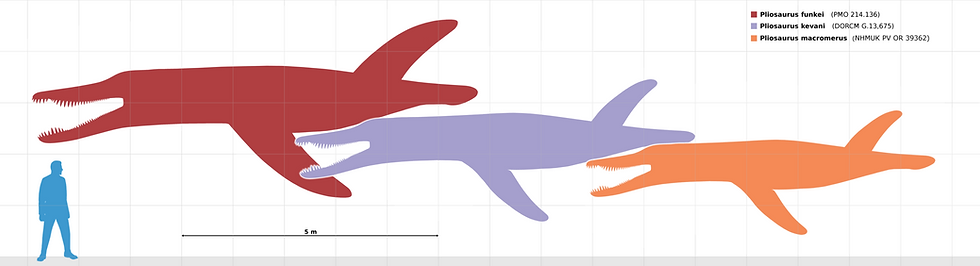
(Author: Shui-Ye You)
Reference
Knutsen EM et al. (2012). A new species of Pliosaurus (Sauropterygia: Plesiosauria) from the Middle Volgian of central Spitsbergen, Norway. Norwegian Journal of Geology.


Comments