
Pliosaurus kevani

Age
Jurassic(Kimmeridgian)
155-154 Ma
Taxonomy
Kingdom: Animalia
Phylum: Chordata
Class: Sauropsida
Order: Plesiosauria
Family: Pliosauridae
Genus: Pliosaurus
Species: Pliosaurus kevan
Morphological description
The holotype of Pliosaurus kevani, DORCM G.13,675, consists of a nearly complete, large skull. The skull measures approximately 200 cm along the dorsal midline and is about 80 cm wide across the jaw joints. The snout is broad and robust, with pronounced mediolateral expansion of the caniniform regions of the premaxilla and maxilla, producing a wide rostrum capable of accommodating large teeth.
Its most important diagnostic features include a subrectangular sheet of the maxilla that extends anteriorly over the alveolar surface of the premaxilla and contacts the distalmost premaxillary alveolus; a pineal foramen completely surrounded by a raised rim; the mesialmost postsymphysial dentary alveoli everted to face dorsolaterally; and a pronounced dorsoventral concavity on the lateral surface of the posterior mandible. The premaxilla bears six closely spaced alveoli, with the distalmost alveolus reduced in size, resulting in distinctly anisodont dentition. The dentary is estimated to have contained 36–37 alveoli in total, of which approximately 14–15 were located within the mandibular symphysis, making the symphysis relatively long for a species of Pliosaurus.
The teeth of Pliosaurus kevani differ from those of most other species of Pliosaurus. Their crowns are suboval in cross-section, with only a slightly flattened labial surface rather than the broad, flat triangular surface typical of fully trihedral teeth in other species of the genus. They are therefore described as subtrihedral. Only sparse enamel ridges occur on the flattened labial surface. This dental morphology may represent one of the autapomorphies of the species. At present, the only fossil material that can be confidently assigned to Pliosaurus kevani consists of the skull.

Etymology
Genus name Pliosaurus: Plio- is derived from Greek and means "more" or "greater," while saurus means "lizard."
Species name kevani: Named in honour of Kevan Sheehan, the principal discoverer and collector of DORCM G.13,675. Sheehan operated a small café in Dorset, England, and gradually recovered fragments of the enormous skull over several years while taking regular walks along the coast.
Biological description
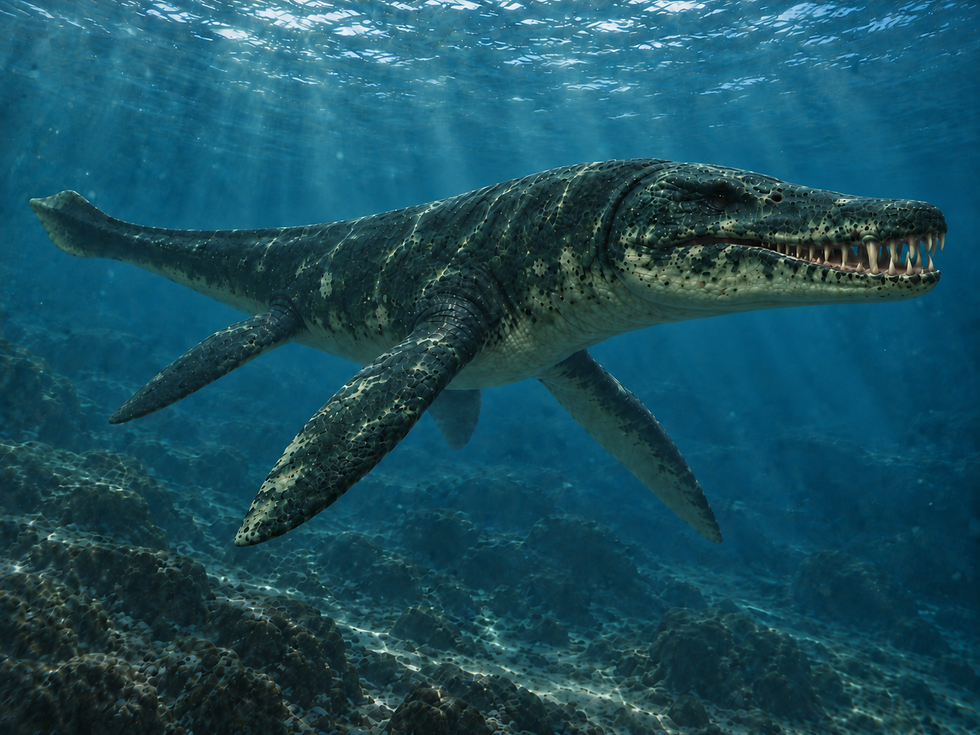
Pliosaurus kevani lived during the early Kimmeridgian of the Late Jurassic. The holotype was recovered from the Wyke Siltstone bed of the Kimmeridge Clay Formation at Osmington Bay, Dorset, England. With a skull approximately two metres long, DORCM G.13,675 represents the largest substantially complete pliosaurid skull currently known from the Kimmeridge Clay Formation. Researchers have suggested that the animal was broadly comparable in size to Pliosaurus funkei. Because no postcranial skeleton can be confidently assigned to P. kevani, however, its total body length cannot be estimated directly from the specimen.
Earlier species of Pliosaurus generally possessed longer mandibular symphyses, and that of P. kevani is estimated to have contained approximately 14–15 symphysial alveoli. In later species, the symphysis became progressively shorter, in some cases containing as few as six alveoli. This evolutionary trend has been interpreted as potentially related to an increasing ability to capture and process large prey. More broadly among pliosaurids, primitive marine predatory forms tended to possess elongate rostra and long mandibular symphyses, features associated with a more piscivorous feeding ecology. Large Jurassic pliosaurids independently evolved shorter symphyses capable of performing better under the loads generated while feeding on large prey. Although P. kevani retains a relatively long symphysis compared with later species of Pliosaurus, its symphysis was still proportionally shorter than those of earlier, long-snouted pliosaurids such as Marmornectes and Peloneustes, indicating a clear adaptation toward macropredation.
A 2014 study of DORCM G.13,675 using computed tomography, muscle reconstruction, finite-element analysis, and other biomechanical approaches provided further insight into its feeding behaviour. Estimated bite force increased substantially toward the rear of the jaws. Near the first tooth at the tip of the snout, bite force was estimated at approximately 9.6–16.9 kN, whereas at the position of the 36th dentary tooth it reached approximately 27.7–48.7 kN. The highest posterior estimate approached 49 kN, indicating that the animal was capable of seizing large prey and applying considerable force to large bones.
After correcting for body size, however, the skull of Pliosaurus kevani was not exceptionally resistant to bending or torsional loads. Finite-element analysis showed that during anterior biting, elevated stresses were concentrated near the premaxilla–maxilla junction, whereas the posterior end of the mandibular symphysis experienced the highest stresses in the lower jaw. Compared with broad, short-snouted crocodilians of equivalent size, its rostrum was less resistant to bending and torsion. The biomechanical results therefore do not support frequent use of violent lateral shaking or rotational movements to tear apart prey.
A feeding strategy more consistent with its mechanical properties would have involved processing prey with the large postsymphysial teeth. The animal may first have seized its prey, then used a series of movements to reposition it within the mouth before applying powerful crushing bites with the larger teeth farther back in the jaws. Repeated biting could progressively weaken the prey until it was killed and made easier to dismember and swallow.
A long, massive rostrum moving rapidly through water would generate substantial hydrodynamic drag. Increasing bone mass to improve resistance to bending and torsion would also increase both weight and hydrodynamic costs. The study therefore proposed that giant pliosaurids may have evolved a functional trade-off between skull strength and aquatic manoeuvrability. Their skulls were not extremely reinforced, but their enormous absolute size still provided substantial mechanical strength. Combined with powerful jaw adductor musculature and robust teeth, this would have allowed them to process very large prey effectively.
The dimensions of the jaws also imposed a clear limit on the size of prey that could be swallowed whole. The distance between the left and right jaw joints was approximately 70–80 cm. Under a conservative estimate, prey around 50–60 cm in diameter could theoretically have been swallowed without prior processing, whereas larger prey would have required some form of manipulation or dismemberment. Pliosaurus kevani has been interpreted as a large, generalist apex predator within the Kimmeridgian marine food web. Its enormous body size, robust teeth, powerful jaw musculature, and high bite force would have enabled it to prey upon most animals in its environment up to roughly half its own body length.
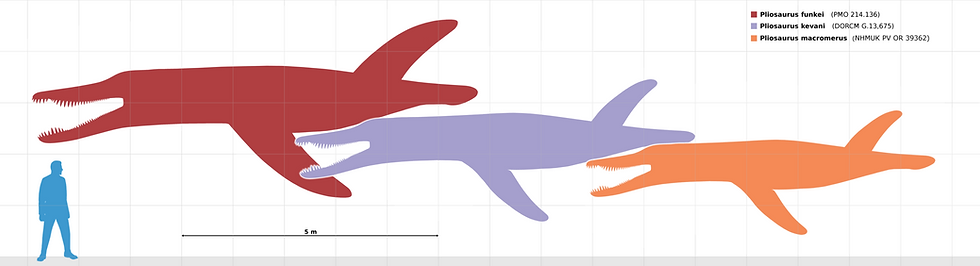
(Author: Shui-Ye You)
References
Benson RBJ et al. (2013). A Giant Pliosaurid Skull from the Late Jurassic of England. PLOS One.
Foffa D et al. (2014). Functional anatomy and feeding biomechanics of a giant Upper Jurassic pliosaur (Reptilia: Sauropterygia) from Weymouth Bay, Dorset, UK. J Anat.
50.636389, -2.389722


Comments