
Pliosaurus westburyensis


Age
Jurassic(Kimmeridgian)
151 Ma
Taxonomy
Kingdom: Animalia
Phylum: Chordata
Class: Sauropsida
Order: Plesiosauria
Family: Pliosauridae
Genus: Pliosaurus
Species: Pliosaurus westburyensis
Morphological description
Pliosaurus westburyensis had a relatively narrow, gracile snout, with only slight lateral expansion of the caniniform regions of the premaxilla and maxilla. One of its diagnostic features is the unusually wide spacing of the premaxillary alveoli. The premaxilla bears six alveoli, and the distalmost alveolus is similar in size to the more mesial alveoli, indicating that the premaxillary dentition lacks pronounced anisodonty. There is also no distinct diastema between the premaxillary and maxillary alveolar rows.
The teeth are fully trihedral, with a broad, flattened labial surface lacking enamel ridges. The mandible has 18 postsymphysial alveoli. Because the anterior portion of the mandibular symphysis is missing in the holotype, the complete alveolar count cannot be determined directly. Earlier studies estimated that the symphysis may have contained 10–11 pairs of teeth, but a 2013 reassessment suggested that this number may have been overestimated and that the actual count may have been closer to the nine symphysial alveoli present in Pliosaurus carpenteri. The preserved mandible is approximately 1.6 m long.
The maxilla possesses a long, sheet-like posteromedial process that extends posteriorly along the medial side of the external naris toward the maxilla–frontal contact, terminating close to the midpoint of the orbit; its medialmost prong extends even farther posteriorly beyond the external naris. The premaxilla–parietal suture is also positioned unusually far posteriorly, with its anteriormost point located around, or slightly posterior to, orbital midlength, a feature that distinguishes P. westburyensis from other known thalassophoneans. The parietal crest is dorsally high and anteroposteriorly extensive, forming a prominent parietal eminence at its highest point. The internal naris lies approximately level with the ninth maxillary alveolus. The jugal possesses a long posteroventral process that extends beneath the squamosal. The ventral surfaces of the cervical centra lack a longitudinal ridge.
Etymology
The genus name Pliosaurus: the Greek prefix plio- means "more" or "greater," while sauros means "lizard."
The species name westburyensis: derived from the town of Westbury in Wiltshire, England, near which the holotype specimen BRSMG Cc332 was discovered.
Biological description
The holotype of Pliosaurus westburyensis, BRSMG Cc332, consists of a skull and partial postcranial remains. It was discovered on 2 July 1980 in the old quarry at Westbury, Wiltshire, England, within the Kimmeridge Clay Formation, approximately 1 m below the Crussoliceras Limestone. The 2013 study that formally named the species identified P. westburyensis as a large pliosaur that inhabited the seas around what is now Britain during the Late Kimmeridgian of the Late Jurassic.
The taxonomic history of the specimen has been complicated. In 1993, BRSMG Cc332 was referred to Pliosaurus brachyspondylus, primarily on the basis of its trihedral teeth, a reconstructed long mandibular symphysis, and the absence of a ventral ridge on the cervical centra. However, the mandibular symphysis itself is not preserved, and the proposed count of 10–11 pairs of symphysial teeth was based largely on reconstruction. This interpretation was subsequently questioned. By 2012, the diagnostic criteria separating species of Pliosaurus remained unstable, and the referral of BRSMG Cc332 to P. brachyspondylus could not be confirmed. In 2013, Roger B. J. Benson and colleagues reassessed Late Jurassic pliosaurids and concluded that BRSMG Cc332 possessed a sufficiently distinctive combination of characters to warrant recognition as a new species, Pliosaurus westburyensis.
This taxonomic history also affected interpretations of another Westbury specimen, BRSMG Cd6172. A 2012 study found that Cc332 and Cd6172 were remarkably similar in relative cranial and mandibular proportions, the positions of several anatomical landmarks, and tooth morphology, with most proportional differences being less than about 10%. The caniniform and posterior hooked teeth of the two specimens also showed no statistically significant differences in stoutness or crown curvature. Cc332, however, had a narrower and more gracile snout, more widely spaced premaxillary teeth, and a distinctly taller and more strongly developed parietal crest. The authors therefore suggested that these differences might reflect sexual dimorphism: the smaller Cc332, with its more developed parietal crest, may have represented a younger male, whereas the larger Cd6172 may have been an older female.
The 2013 reassessment changed this interpretation. After comparing a broader range of Pliosaurus specimens from different localities, Benson and colleagues concluded that the differences between Cc332 and Cd6172 were too substantial to be explained satisfactorily as intraspecific variation. In particular, the unusually wide spacing of the premaxillary alveoli in Cc332 was regarded as a unique feature. BRSMG Cc332 was therefore designated the holotype of Pliosaurus westburyensis, while BRSMG Cd6172 became the holotype of a second new species, Pliosaurus carpenteri.
The snout of P. westburyensis also preserves a structure that may have been associated with olfaction. Near the level of the fifth premaxillary alveolus is a very small foramen. In 2012, researchers proposed that such foramina in pliosaurs might have been associated with an accessory olfactory organ, perhaps comparable to the vomeronasal, or Jacobson's, organ of living reptiles. This interpretation remains speculative, however, and there is currently insufficient evidence to demonstrate that the opening was actually associated with a vomeronasal organ.
In terms of feeding ecology, P. westburyensis possessed the characteristic adaptations of a large Late Jurassic marine macropredator. The 2013 study described species of Pliosaurus as large-bodied predators with robust skulls and trihedral teeth. P. westburyensis itself possessed strongly developed, fully trihedral teeth, consistent with a feeding strategy involving relatively large prey. Late Jurassic species of Pliosaurus also show an evolutionary trend toward shortening of the mandibular symphysis. Mechanical studies suggest that shorter symphyses may perform better under the stresses generated during the capture and processing of large prey. Because the anterior portion of the mandibular symphysis is missing in Cc332, however, its complete length cannot be measured directly, so this pattern should be regarded as part of the broader functional and evolutionary context of the lineage rather than as a directly measured feeding adaptation of P. westburyensis itself.
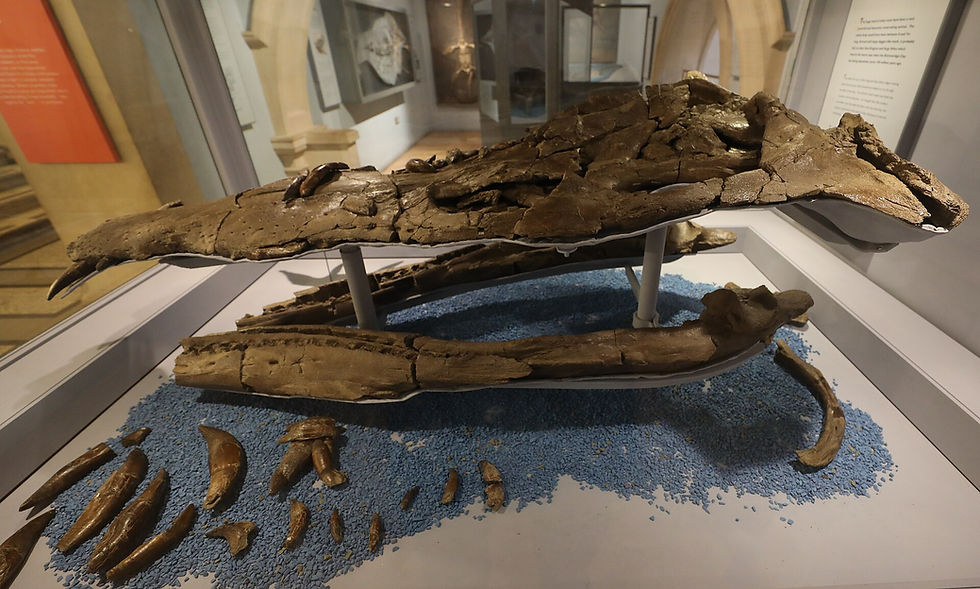
(Author: Shui-Ye You)
References
Benson RBJ et al. (2013). A Giant Pliosaurid Skull from the Late Jurassic of England. PLOS One.
Sassoon J et al. (2012). Cranial anatomy, taxonomic implications and palaeopathology of an Upper Jurassic Pliosaur (Reptilia: Sauropterygia) from Westbury, Wiltshire, UK. Palaeontology.


Comments