
Staurikosaurus pricei

Age
Late Triassic (Carnian)
233 Ma
Taxonomy
Kingdom:Animalia
Phylum:Chordata
Class:Reptilia
Order:Saurischia
Family:Herrerasauridae
Genus:Staurikosaurus
Species:Staurikosaurus pricei
Morphological description
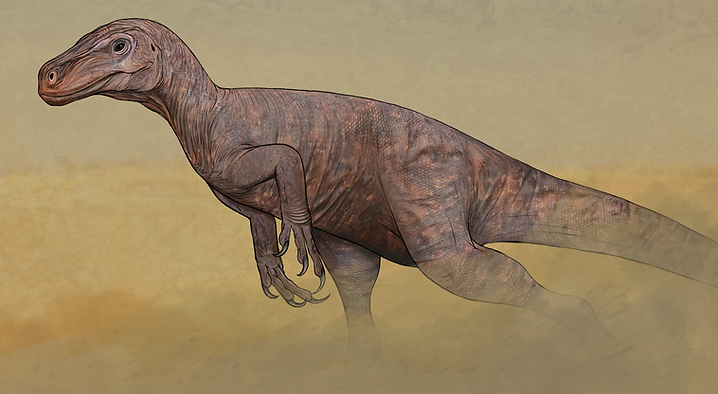
Staurikosaurus pricei was a relatively small and agile carnivorous animal, estimated to have reached about 2.2 m in length and weighed approximately 12 kg. Its limbs were relatively long and slender.

Its teeth were laterally compressed, serrated along the edges, and curved backward, forming typical ziphodont teeth adapted for cutting and tearing flesh during feeding. The dentary was nearly equal in length to the femur, indicating that Staurikosaurus pricei had a relatively large head.
The tail was proportionally long, consisting of more than 40 caudal vertebrae. Its stiffened structure suggests that the tail was held straight off the ground while running, likely helping maintain balance and stability during running and jumping.
Etymology
The genus name Staurikosaurus is derived from the Ancient Greek σταυρικός ("cross") and the common dinosaur suffix -saurus ("lizard"). The "cross" refers to the Southern Cross constellation, indicating that it was a dinosaur from the Southern Hemisphere.
The species name honors the Brazilian paleontologist Llewellyn Ivor Price, who also discovered the fossil of Staurikosaurus.
Biological interpretation
The holotype of Staurikosaurus pricei was discovered in 1936 from the Santa Maria Formation in Rio Grande do Sul, Brazil. It is catalogued as MCZ 1669 and was formally described and named in 1970.

Fossils of Staurikosaurus are rare. Besides the holotype, only one additional specimen has been referred to the genus. This specimen was named Teyuwasu barberenai in 1999, but later studies suggested that it actually belongs to Staurikosaurus. However, other researchers have questioned this assignment, arguing that the material is too incomplete for a reliable comparison. The relationship between the two taxa therefore remains uncertain and requires further study.
Phylogenetic analyses place Staurikosaurus pricei within Herrerasauridae. It was much smaller than Herrerasaurus, and may have been more closely related to Sanjuansaurus. However, the overall phylogenetic position of Herrerasauridae remains unresolved, so the precise classification of Staurikosaurus is still uncertain.
Staurikosaurus pricei inhabited arid to semi-arid environments where the vegetation was dominated by ferns, seed ferns, cycads, and conifers. The apex predators of this ecosystem were rauisuchians (Rauisuchia), while herrerasaurids, including Staurikosaurus pricei, occupied the niche of secondary predators. Medium- to large-sized herbivores were mainly represented by rhynchosaurs (Rhynchosauria) and dicynodonts (Dicynodontia).
(Author: Bai Leng)
Reference
1. Colbert, E. H. (1970). A Saurischian dinosaur from the Triassic of Brazil. AM. MUS.
2. Grillo, O. N., Azevedo, S. A. K. (2011). Recovering missing data: estimating position and size of caudal vertebrae in Staurikosaurus pricei Colbert, 1970. Annals of the Brazilian Academy of Sciences
3. Paul, G. S. (2016). The Princeton Field Guide to Dinosaurs. Princeton University Press.
4. Rodrigues, I. C., Mizusaki, A. M. P., Lima, L. G., Maraschin, A. J. (2019). Comparative evolution of clay minerals in southern Paraná Basin (Brazil): Implications for triassic paleoclimate. Journal of South American Earth Sciences.
5. Garcia, M. S., Müller, R. T., Dias-Da-Silva, S. (2019). On the taxonomic status of Teyuwasu barberenai Kischlat, 1999 (Archosauria: Dinosauriformes), a challenging taxon from the Upper Triassic of southern Brazil. Zootaxa.
6. I. D. Pinto. (1956). Artrópodos da Formaçāo Santa Maria (Triássico Superior) do Rio Grande Do Sul, com notícias sôbre alguns restos vegetais. Boletim da Sociedade Brasileira de Geologia.
-29.698056, -53.768611


Comments