
The Adorable Arctic Mochi – The Ringed Seal

Updated: Apr 10
Do you like mochi? Rodrigo certainly does—especially during this season, when a limited-edition strawberry daifuku appears. The chewy texture paired with the sweet-and-tart flavor of strawberries is simply irresistible. Today, Rodrigo is going to introduce a special winter "Arctic daifuku."
Wait—this is The Sound of Evolution, a place that talks about biological evolution. Why suddenly introduce desserts? Don't worry. This "daifuku" is not actually a sweet. But their appearance might be even sweeter than a dessert. They are the ringed seals of the genus Pusa.

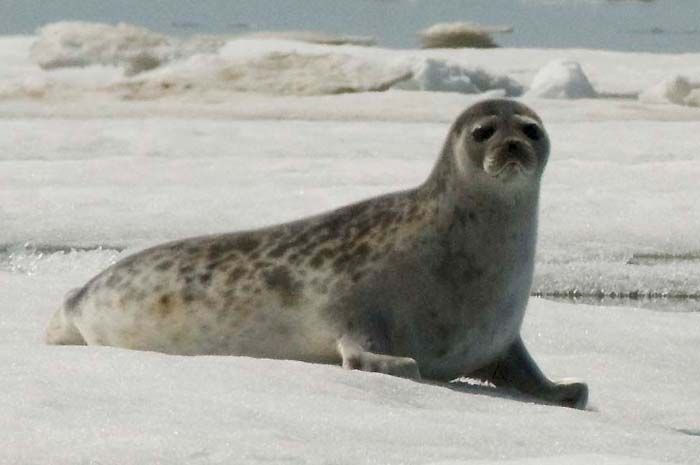
The "sesame daifuku" we are talking about today—well, actually the ringed seal—has the scientific name Pusa hispida. This species mainly inhabits the Arctic Ocean, the Bering Sea, and the Sea of Okhotsk. The species name hispida refers to the ring-shaped markings on its fur, which resemble silver rings scattered across its body. As one of the smallest seals in the world, adult ringed seals usually measure about 100–175 cm in body length and weigh roughly 32–140 kg. Like most seals, newborn pups are covered in thick white fur, making them look like little snow-white daifuku. As they mature, this coat is replaced by gray or brown fur—rather like sesame- or soybean-powder-flavored mochi.
Male and female seals develop somewhat different coats after reaching adulthood. In males especially, the face undergoes a dramatic transformation during the breeding season: the fur around the face is shed, leaving the skin dark and wrinkled, which can make them resemble a peeled black kiwi. Like many seals living within the Arctic Circle, ringed seals are naturally shy animals. They typically live solitary lives and only gather during the breeding season. Every spring, around April, the breeding period begins. During this time, male seals crawl across the ice searching for mates. Unlike humans, ringed seals have no concept of family life. A male will stay with a female for a short time before mating, but once mating is complete, he departs immediately in search of another partner.

There is little long-term attachment between mother and offspring either. After a gestation period of about nine months, the female gives birth to a pup on floating sea ice. The pup is nourished with extremely rich, high-fat seal milk. This maternal relationship lasts only about two months. During this period the mother not only nurses the pup but also teaches it basic skills such as swimming and hunting. Once the nursing period ends, the mother—much like the father earlier—leaves the pup behind on the ice. The young seal then remains alone until its white natal fur eventually sheds.
Despite being a relatively small mammal, the ringed seal has a surprisingly long lifespan, typically around 25–30 years. Females reach sexual maturity at about four years of age, while males mature at around seven. Beyond their longevity, ringed seals also play an important ecological role as both predator and prey. They commonly feed on fish such as cod and sculpins, as well as crustaceans and other invertebrates, helping maintain ecological balance in Arctic marine ecosystems. At the same time, their large populations make them an important food source for many Arctic predators. Ringed seals provide vital calories and protein for animals such as polar bears, killer whales, and Greenland sharks, and they are also an important resource for Inuit communities. Yes—humans are among their natural predators. In fact, many Arctic seal species, including the ringed seal, hold deep cultural significance for the peoples of the Arctic.

However, global warming is gradually threatening both Inuit traditions and the seals themselves. Rising ocean temperatures are reducing the sea ice needed for seal reproduction. As suitable ice platforms disappear, ringed seals have increasingly shifted toward breeding along shorelines instead of on stable ice. This change makes it difficult for Inuit hunters to continue their traditional hunting practices. At present, the global population of ringed seals is still considered stable. Yet some subspecies—such as the Saimaa ringed seal—are already classified as vulnerable. With continued warming oceans and increasing marine pollution, their future remains uncertain.

Fortunately, growing awareness of wildlife conservation and the expansion of ecotourism have encouraged high-latitude countries to pay closer attention to ringed seal populations. Japan, one of the countries near the Arctic region, provides an example. Several aquariums there keep ringed seals for educational purposes. The famous Osaka Aquarium Kaiyukan even maintains a dedicated exhibit for them. Beyond public display, the aquarium collaborates with the Hokkaido government to support breeding programs and rescue efforts for ringed seals.
That concludes today's introduction to the ringed seal. What do you think of this charming Arctic animal? If you ever have the chance, visiting Hokkaido might give you the opportunity to see one in person—and perhaps encounter a delightful surprise along the way.
Ringed seal video (male and female): In the video, Yuki and Arare are female seals, while Moya is a male seal. Thanks to 灰色の脳細胞 for sharing footage filmed at Kaiyukan Aquarium:
Ringed seal pup video:
Author: Rodrigo
Reference:
Lowry, L. (2016). "Pusa hispida". IUCN Red List of Threatened Species. (2023)水族館の仲間たち ワモンアザラシ. おたる水族館.


Comments