
The Cambrian Substrate Revolution

In many shallow marine environments today, the upper layers of the seafloor are shaped by the burrowing, feeding, and movement of worms, crustaceans, mollusks, and other benthic animals. These activities produce a constantly disturbed layer of surficial sediment. Before the Cambrian, however, many shallow marine seafloors were dominated by microbial mats. These layered microbial communities acted like a living net spread across the sediment surface. Microbial filaments bound sand and mud grains together, stabilizing the sediment surface and creating a sharp boundary between the water column and the sediment below.
The world faced by Ediacaran benthic animals was very different from that of modern seafloors. Vertical burrowing was still poorly developed, so the sediment was not extensively mixed from within, and oxygen could not penetrate far beneath the seafloor. As a result, the deeper layers of the sediment commonly remained under anoxic conditions. Most animal activity was therefore restricted to the mat surface, within the mat, or immediately beneath it. Some animals grazed or foraged across the surface, as in the case of Kimberella. Some suspension feeders inserted part of the body into the matground to maintain an upright position, as in Cloudina. A smaller number of animals moved through very shallow levels beneath the microbial mat, as suggested for Ikaria wariootia.


The Cambrian Substrate Revolution describes the gradual reorganization of this early seafloor system by Cambrian animals. As benthic animals evolved deeper and more intensive burrowing behavior, the seafloor was no longer stabilized mainly by microbial mats. Bioturbation by animals became a major force altering the physical character of marine sediment. The once sharp water-sediment interface became blurry, sediment water content increased, and oxygen and nutrients could penetrate into deeper sediment layers. The seafloor mixed layer, typical of many Phanerozoic fine-grained marine substrates, records this post-Cambrian world in which animals increasingly disturbed and homogenized the upper few centimeters of sediment.
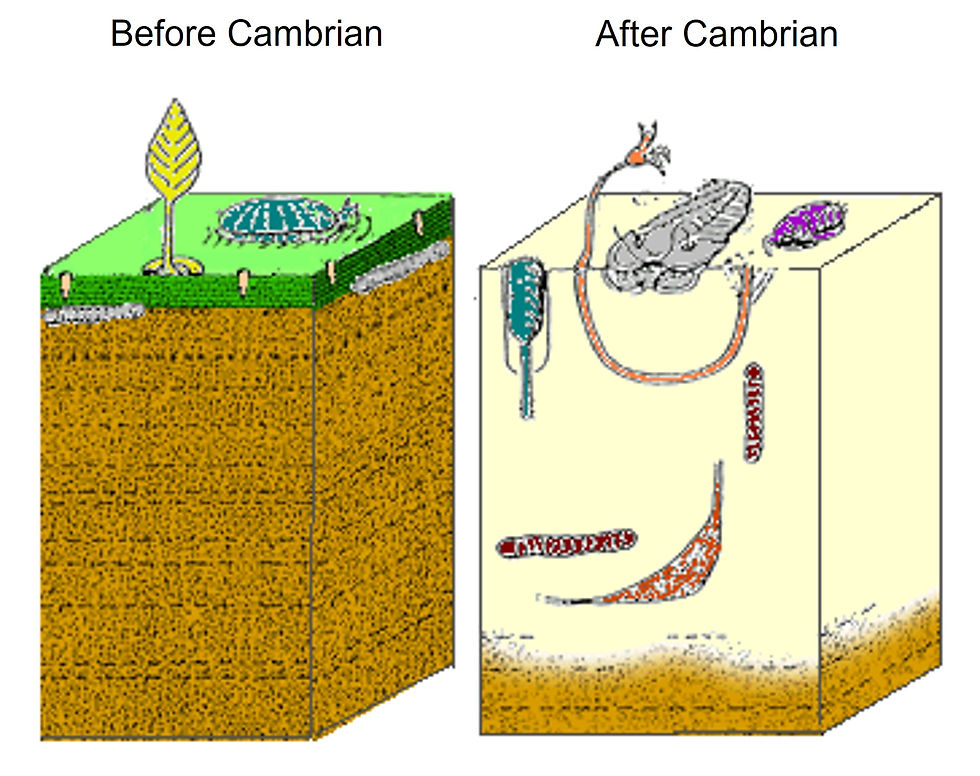
As microbial mats were weakened, animals that depended on stable surfaces, sharply defined interfaces, and layered food resources had to face new environmental conditions. Some likely shifted into settings where microbial mats or hard substrates remained available, including groups such as polyplacophorans and some eocrinoids. Other species began to adapt to newly available unconsolidated sediments, oxygenated layers, and small-scale microenvironments. This is why the Cambrian Substrate Revolution is often discussed together with the Cambrian Explosion: at the same time that animal body plans and skeletons were diversifying rapidly, the seafloor beneath those animals was also being transformed.

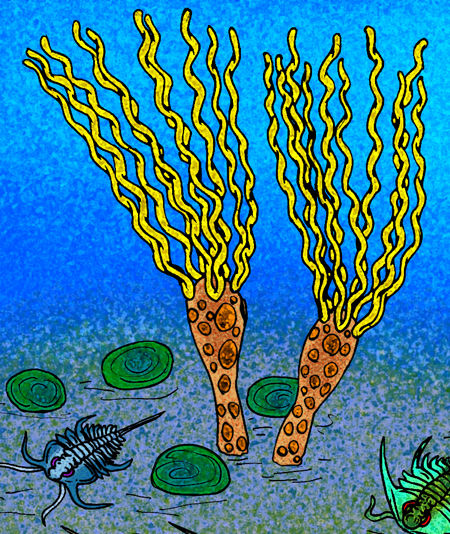
Echinoderms are among the most important groups for understanding the Cambrian Substrate Revolution because they possessed mineralized skeletons that were readily preserved, leaving a relatively clear fossil record. Many early Cambrian suspension-feeding echinoderms, including helicoplacoids, edrioasteroids, and eocrinoids, have traditionally been interpreted as organisms adapted to stable seafloors with low levels of bioturbation and without a well-developed mixed layer. As burrowing became deeper and the sediment became less stable, this mode of life may have come under pressure. Some groups gradually developed the ability to attach to hard substrates, while others evolved stems or holdfast structures that helped them avoid the instability of disturbed soft sediment.


Helicoplacoids have often been regarded as victims of the Cambrian Substrate Revolution. They were small animals and were once thought to have been unable to shift to hard-substrate attachment or to evolve root-like anchoring structures. As shallow marine muds and sands were increasingly disturbed by animals, their available habitat may have contracted, leading to their extinction by the middle to late Cambrian. The main cause of their extinction, however, remains debated. Edrioasteroids and eocrinoids, by contrast, have generally been viewed as more capable of responding to changing substrate conditions. Through hard-substrate attachment and other stabilizing strategies, these groups persisted beyond the Cambrian, with edrioasteroids surviving into the Permian and eocrinoids into the Silurian.
Later research on Cambrian suspension-feeding echinoderms has made this picture more complex. A reassessment of attachment strategies in 83 Cambrian echinoderm species combined direct fossil evidence of attachment with interpretations based on functional morphology. The results indicate that many Cambrian echinoderms may have been able to use hard substrates early in their evolution, rather than relying mainly on clayey substrates stabilized by microbial mats. This means that some groups did not wait until seafloors became strongly disturbed before evolving hard-substrate attachment. They may already have possessed morphological features that prepared them for changing substrate conditions during the Cambrian.
Mollusks and trace fossils provide another line of evidence. Some early grazing traces have been interpreted as records of mollusks or soft-footed animals moving across the seafloor surface. These scratch-like traces are often associated with sedimentary structures indicating the presence of microbial mats. Yet many bedding-parallel meandering traces that were common in Early Cambrian shallow marine environments became more restricted to deep-sea settings after the Cambrian. This pattern reflects an onshore-offshore retreat of environments in which mat-related substrates and low levels of vertical bioturbation remained available.

The Cambrian Substrate Revolution was not the only cause of the Cambrian Explosion, but it is essential for understanding the early Cambrian world of animal life. When animals began to burrow more deeply into the seafloor, they were searching for food and shelter, while also changing the relationships among oxygen, sediment, microbes, and other organisms. From that point onward, marine sediment became an ecological environment continually reshaped by animal activity.
Author: Shui-Ye You
References:
Bottjer DJ. (2010). The Cambrian Substrate Revolution and Early Evolution of the Phyla. Journal of Earth Science.
Bottjer DJ et al. (2000). The Cambrian Substrate Revolution. GSA TODAY.
Zamora S et al. (2017). The Cambrian Substrate Revolution and the early evolution of attachment in suspension-feeding echinoderms. Earth-Science Reviews.


Comments