
The Multifunctional Eversible Vesicles of Springtails
- 演化之聲

- Mar 13
- 3 min read
Updated: Apr 10

Springtails (Collembola) belong to the subphylum Hexapoda and are closely related to insects. These tiny arthropods, commonly known as springtails, inhabit a wide range of moist environments, including leaf litter, soil surfaces, low vegetation, and even tree canopies. A distinctive feature shared by all members of Collembola is the presence of a ventral tube, or collophore, located on the first abdominal segment. At the tip of this tube lies a pair of structures known as eversible vesicles—elongated organs that can rapidly extend outward from the body and retract again when not in use.
In species belonging to the order Symphypleona, these vesicles are particularly well developed. When fully extended, they may reach lengths exceeding twice the body length of the animal. Under resting conditions, the vesicles remain withdrawn inside the ventral tube, but when needed they can be pulled outward through the tube opening. Their extension and retraction are controlled by a combination of internal muscle rods and hydraulic pressure within the body cavity.

Microscopic examination reveals that the surface of each vesicle tip is densely covered with numerous tiny papillae. Within these papillae are transverse ducts that connect to a central lumen running through the vesicle and ultimately leading into the body cavity. This anatomical arrangement allows the vesicles to absorb moisture from the surrounding environment and transport water directly into the body. The papillae may also assist in adhering small particles of food, enabling the springtail to guide them toward the mouth during feeding.
The vesicles are long enough to reach virtually any part of the springtail's body. As a result, they also function as cleaning organs. Springtails use them to remove dust, water droplets, and other debris from their body surface. These animals maintain a remarkably high level of bodily cleanliness, frequently grooming themselves with the vesicles. The antennae and head are cleaned most often. Observations indicate that even when a springtail remains stationary, it may clean its antennae more than eighty times within a single hour, with each cleaning movement lasting roughly two to five seconds.
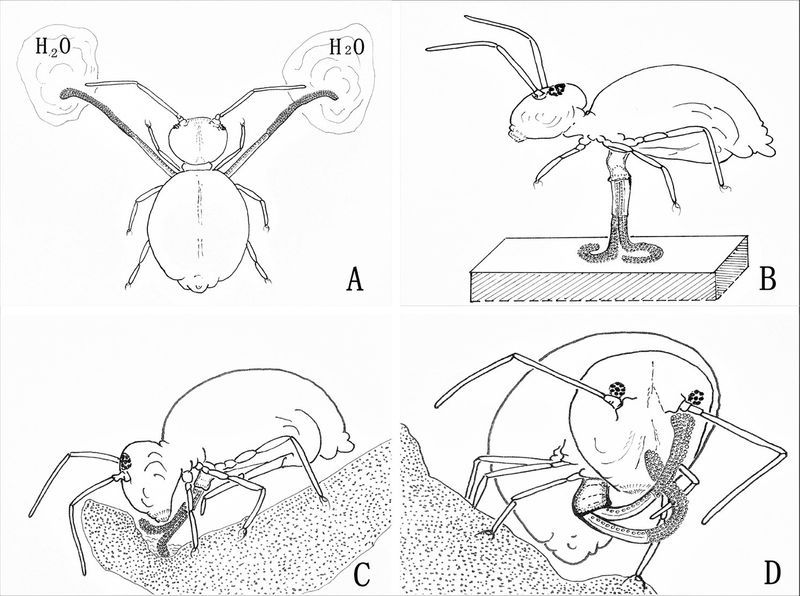
Springtails are perhaps best known for their extraordinary ability to jump. This movement is powered by a specialized appendage called the furca, located on the fourth abdominal segment. When released, the furca rapidly propels the animal into the air, allowing it to escape potential threats. However, the landing surface after such a jump can sometimes be extremely smooth. In these situations, the eversible vesicles play a crucial role.
During the latter stage of a jump, the vesicles extend outward so that their tips make contact with the landing surface before the legs do. The papillae on the vesicle tips provide strong adhesion, enabling the animal to grip even smooth materials such as glass. Once the springtail has stabilized its body and firmly placed all six legs on the surface, the vesicles retract quickly back into the ventral tube.
Through this remarkable combination of structural design and functional versatility, the eversible vesicles serve multiple roles in the daily life of springtails. They assist in water absorption, feeding, body cleaning, and stabilization during landing. These multifunctional organs represent a crucial evolutionary adaptation that greatly enhances the survival of these minute yet highly successful terrestrial arthropods.

Author: Shui-Ye You
Reference:
Chen CG et al. (2019). Structure and functions of the ventral tube of the clover springtail Sminthurus viridis (Collembola: Sminthuridae). Sci Rep.


Comments