
White-vented Myna

Updated: Apr 10
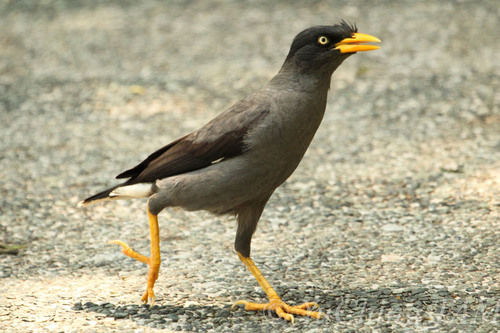
The white-vented myna (Acridotheres javanicus) belongs to the order Passeriformes, family Sturnidae, and genus Acridotheres. It is a bird frequently encountered in the pet trade. Owing to its remarkable vocal ability and strong learning capacity, this species has long been favored as a companion bird. In Chinese-speaking markets it is commonly referred to as "Bage," "Thai myna," "Javan myna," or "forest myna." In international contexts it is widely known as the white-vented myna or Javan myna.
Behavior and Ecology
Like many members of the starling family, mynas are social birds that typically move and forage in groups. Individuals are often observed feeding in small flocks consisting of several birds.
White-vented mynas also display pronounced territorial behavior. Disputes frequently occur, often involving one pair confronting another pair over territory, mating opportunities, or access to food. During these encounters, the attacking bird may pin its opponent to the ground and strike from a dominant position, while the opponent attempts to reverse the situation. Such confrontations generally last between one and ten minutes. The purpose of these conflicts is usually to demonstrate dominance rather than to inflict serious injury, and the interaction ends when the defeated bird retreats and flies away. During the nesting period, individuals may actively drive away other birds or occupy nests originally built by different species.
Behaviorally, the white-vented myna is notable for its strong learning ability. It produces loud, complex vocalizations and various calls, including distinctive sounds resembling "diu-diu-diu." These calls are used for communication among individuals. When predators are nearby or when preparing to take flight, white-vented mynas may also mimic the calls of other birds as part of their warning signals.
Morphology
The white-vented myna is a medium-small bird. Adults typically measure about 21–23 cm in body length, and both males and females weigh approximately 100 grams.
The species has a striking appearance. Its body plumage is primarily black, while the wings are dark brown to black. The bases of the primary flight feathers are white, forming a conspicuous white wing patch that becomes clearly visible in flight. A white band is also present on the tail, and the undertail coverts are white. A short crest is present on the forehead.
The bill, legs, and feet are yellow, and the eyes are lemon-yellow. Juveniles are generally lighter brown in coloration. There is no obvious sexual dimorphism between males and females. The eggs of the white-vented myna are blue.
Native Range and Habitat
The white-vented myna is native to Bali and Java. Through human-mediated introduction, populations have also become established in many other regions, including Thailand, southern Malaysia, Singapore, Sumatra, the Lesser Sunda Islands, Taiwan, Puerto Rico, Japan, and Nepal.
In its native range, this species prefers open woodland, agricultural land, and areas near human settlements. Due to its strong adaptability, escaped individuals are also capable of forming populations in urban environments.
Housing Requirements in Captivity
White-vented mynas are curious and active birds. Therefore, an appropriately sized enclosure is essential. A cage measuring at least 40 × 30 × 30 cm (length × width × height) is recommended. Common cage materials include bamboo, wood, or stainless steel. Bamboo and wood structures provide a more naturalistic environment that may reduce stress responses, whereas stainless steel cages are easier to clean. Owners may choose according to their needs.
Within the cage, several structural elements should be included: perches, feeding areas, sheltered spaces, enrichment toys, and substrate lining.
For perches, materials such as apple wood or willow branches are suitable. Installing two to three perches with different diameters (approximately 1–3 cm) is recommended. The highest perch should be positioned about 10–15 cm below the cage top, while the lowest perch should be about 20 cm above the cage floor, with spacing of 15–20 cm between them to reduce the risk of collisions during flight.
To create a sheltered space, a small bird nest or a simple cover made from a cardboard box can be placed inside the cage. The enclosure should measure at least 15 × 15 × 15 cm. It is best positioned in a corner of the cage at a height of 15–20 cm above the cage floor, providing the bird with a sense of security.
The feeding area should include a dedicated water dispenser and feeding dishes. A spill-resistant water dispenser is recommended. For food, separate small bowls should be used to divide fruits and vegetables, grains, and protein sources. These bowls can be placed in cage corners approximately 10–15 cm away from perches to allow easy access.
Enrichment toys should be made from durable materials that allow chewing and help maintain beak health. Suitable materials include wood and rubber. Examples include hard wooden branches 3–5 cm in diameter and 10–15 cm in length, rubber balls with a diameter of 5–8 cm, or small bell toys. These items help reduce boredom-related stereotypic behaviors. Toys may be placed approximately 20–30 cm from perches to allow sufficient space for movement and play.
For cage lining, newspaper or non-toxic wood shavings (free of additives such as formaldehyde) can be used. Newspaper should be layered one to two sheets thick, while wood shavings should be 2–3 cm deep. The substrate should be replaced regularly to maintain hygiene.
Feeding Conditions

The white-vented myna is omnivorous. In the wild it feeds mainly on seeds, fruits, nectar, and insects, and may occasionally consume human food waste. In captivity, suitable foods can generally be divided into four categories: grains, protein sources, fruits and vegetables, and formulated feeds.
Grain-based foods such as rice, millet, and corn provide energy. Protein sources may include mealworms and crickets.
Feeding requirements vary with age.
During the nestling stage, feeding should occur every 1–2 hours. Suitable foods include specialized nestling formulas or diluted egg yolk paste, supplemented with small amounts of vegetable puree. Feeding should continue until the chick stops begging.
During the juvenile stage, feeding frequency can be reduced to four to five times per day. Diets may consist primarily of protein sources and fruits or vegetables, and pellet-based feed can gradually be introduced. Each feeding typically amounts to 10–15% of the bird's body weight.
For adult birds, feeding two to three times per day is sufficient. Each feeding should amount to approximately 5–10% of body weight. The primary diet can consist of grains and formulated feed, supplemented with protein sources and fruits or vegetables to maintain balanced nutrition.
Because mynas have relatively short digestive tracts and absorb fats inefficiently, fat-rich foods should be avoided. High-fat nuts should be limited to less than 5% of the diet.
Breeding Conditions

In Taiwan, the white-vented myna is considered an invasive species, and in principle it should not be bred privately.
In natural environments, mynas commonly nest in tree cavities, rock crevices, or abandoned nests of other birds. In introduced regions, they often use artificial structures such as streetlights, culverts, and holes in utility poles as nesting sites. Nest materials typically include twigs, roots, coarse fibers, and various debris.
The breeding season generally occurs between February and July each year. During this period, males attract females through vocal displays. White-vented mynas are generally considered monogamous, and once a pair forms, the partners rarely change.
The incubation period lasts about 13–14 days, and the nestling stage lasts approximately 25 days. During incubation and chick rearing, both parents take turns incubating the eggs and caring for the young.
Preventing Invasive Spread
Although the white-vented myna is native to Java, it has become vulnerable within its native range due to heavy trapping. However, the species is highly adaptable, and released or abandoned individuals can easily establish populations in new environments.
When introduced to new regions, white-vented mynas may compete with native birds for food resources. Hybridization with the native crested myna (Acridotheres cristatellus) has also been documented, posing a risk to the genetic integrity and population stability of native species.
Because of these ecological risks, the species was designated in Taiwan in 2022 as a restricted import item.
Pet owners therefore must follow the principle of "no abandonment and no release." Under no circumstances should white-vented mynas be released into the wild. If an owner is unable to continue caring for the bird, it should be responsibly transferred to another qualified keeper.
Author: Rodrigo
References:
(2016)."White-vented Myna (Acridotheres javanicus)". Handbook of the Birds of the World Alive.
BirdLife International (2020). "Acridotheres javanicus". IUCN Red List of Threatened Species.
Stephanie Yuan Chia , Yi-Ting Fang , Yi-Ting Su , Pei-Yu Tsai , Chia Hsieh , Shu-Han Tsao , Jia-Yang Juang , Chih-Ming Hung , Mao-Ning Tuanmu (2023) A global database of bird nest traits. Scientific Data, 10, 923
蕭木吉主撰,李政霖繪圖(2015)。臺灣野鳥手繪圖鑑。台北:農委會林務局,北市野鳥學會。
台灣鳥類誌(下) The Avifauna of Taiwan Vol.3[42338]
Lola。(2025)。【獸醫監製】八哥壽命、疾病預防飼養攻略&6大八哥缺點。forpetsupply。https://www.forpetsupply.com/acridotheres-cristatellus/


Comments