
Why Do Columbid Nests Always Look Unfinished?

Anyone seeing a pigeon or dove nest for the first time might easily mistake it for a few dead twigs that happened to become lodged in a tree or on a windowsill. Several slender sticks are loosely laid across one another, with only a shallow depression in the center. Sometimes the white eggs or nestlings can be seen directly through the nest from below. The nests of many members of the family Columbidae do indeed look remarkably flimsy, but this apparent crudity reflects a construction strategy that provides only the features necessary for successful nesting.
The Picazuro Pigeon (Patagioenas picazuro) offers a good example. Observations in southeastern Brazil showed that these pigeons collect small twigs from trees or pick up fallen ones from the ground, then carry them to nests built on palm leaves or in other trees. The male is mainly responsible for transporting the material. In one recorded nest-building session, a male returned to the nest with small dead twigs 15 times in 73 minutes. On some trips, he spent five or six minutes breaking off a suitable twig before carrying it back, placing it at the nest, pausing briefly, and setting off again. The female generally remained at the nest to receive and arrange the material. Little effort was devoted to producing a neat or uniform shape; the goal was simply to accumulate enough twigs to form a platform capable of supporting an egg.

A study conducted on the campus of Swami Ramanand Teerth Marathwada University in Nanded, India, documented 133 nests of Feral Pigeons (Columba livia). The nests were found under building roofs, on window sunshades, above lintels, and inside or on top of fuse boxes, air-conditioning units, and other ready-made structures. The researchers classified them into three forms: whole or roughly circular nests, half-circular nests, and irregular nests. Where sufficient space was available, pigeons arranged twigs into a more complete circular outline. Where a wall or box already supported one side of the nest, they built only a semicircle. In rock crevices, well walls, or existing depressions in buildings, they sometimes placed only a few sticks on the sloping surface to prevent the eggs from rolling away. Nest shape therefore follows no rigid design and changes according to the support already provided by the nesting site.


This helps explain why columbid nests can be built with so little material. For these birds, a tree fork, the hard rachis of a palm leaf, a rock crevice, a windowsill, or the upper surface of a box already serves as part of the nest. The added twigs are needed mainly to stabilize the eggs and provide support. Feral Pigeon nests are constructed largely from long, straight, sparsely branched pieces of dry plant material, including grass stems, leaf rachises, and dead twigs of uneven lengths. Roughly circular nests measure approximately 22–25 cm across, while the central nest cup measures only about 10–12 cm. This leaves barely enough room for an incubating adult together with its eggs or small nestlings. As the nestlings grow and can no longer fit comfortably inside, they may move beside the nest and continue to receive food there.
Small clutch sizes also reduce the structural demands placed on the nest. Picazuro Pigeons generally lay a single egg, although two eggs occasionally occur. Among other South American columbids, the Pale-vented Pigeon (Patagioenas cayennensis), Scaled Dove (Columbina squammata), and Ruddy Ground-dove (Columbina talpacoti) produce no more than two eggs per clutch, and Feral Pigeons follow the same general pattern. Because the nest does not need to support a large clutch and several growing nestlings, there is little need for a broad, deep, heavily constructed nest cup.
The time spent raising young is also relatively limited. In the Picazuro Pigeon, the incubation period was recorded as approximately 14 days, while the nestling period averaged about 19 days. The Ruddy Ground-dove also had an incubation period of about 14 days, followed by a shorter nestling period averaging approximately 13 days. Each breeding attempt therefore involves only a small number of young, and the nest is required to support them for a relatively brief period. When a simple platform is sufficient to complete this task, energy does not need to be invested in a prolonged and highly elaborate building process.

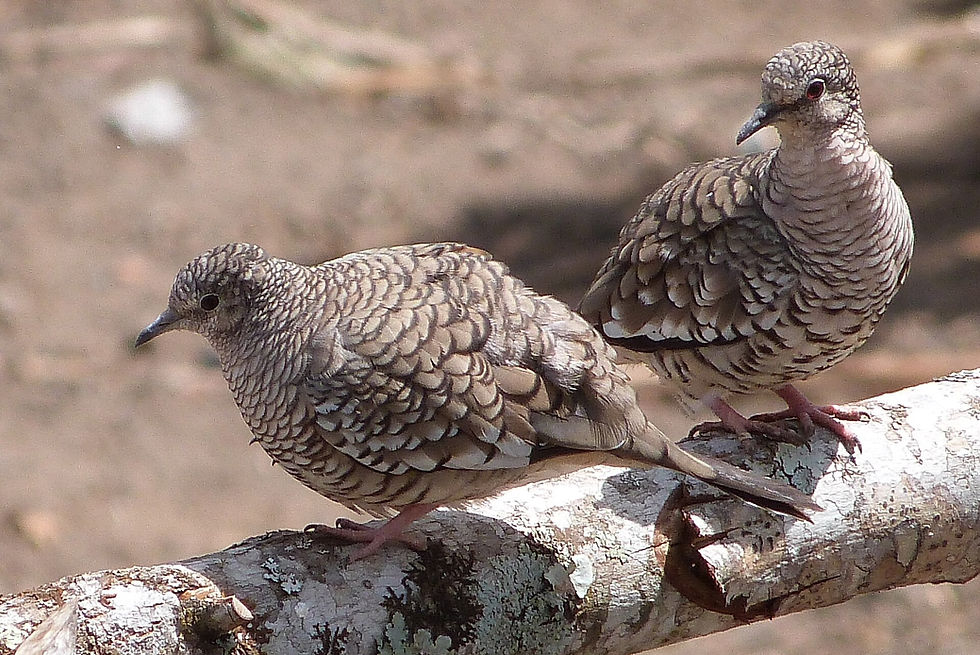

Parental care in some columbids also compensates for the limited protection provided by the nest itself. Male and female Picazuro Pigeons alternate during incubation and brooding. The female remains on the nest at night, while the male takes her place during the day. During a changeover, the arriving bird may first perch nearby and give a quiet call before carefully approaching the nest. Once the sitting adult rises and leaves, its partner quickly settles over the egg or nestling, so the nest is seldom left exposed for long.
After hatching, a parent continues to brood the young for some time. The adult occasionally looks beneath its breast, touches the nestling with its bill, and rises to feed it by regurgitation. Protection from temperature changes and other environmental conditions therefore depends heavily on the presence of the parents. The nest mainly provides a stable location, while much of the shelter, warmth, vigilance, and feeding is supplied through parental behavior.
Columbids commonly have extended breeding seasons, and some species can reproduce during nearly every month of the year. This gives rapid nest construction a practical advantage. Picazuro Pigeon nests have been recorded in southeastern Brazil throughout the year. When food and suitable nest sites are abundant, Feral Pigeons may also breed repeatedly within a single year and frequently reuse the same nest. Before another breeding attempt, the pair adds more twigs and repairs damaged portions, while only a small proportion of nests are abandoned. Reusing and rebuilding an existing nest saves the time that would otherwise be required to construct a completely new one for every clutch.
A simple nest does carry risks. If the twigs are too loosely arranged, eggs or nestlings may fall from the structure. Nest predation was also frequent in a study of columbids in central Brazil: 37 of the 60 monitored Picazuro Pigeon nests were depredated. In contrast, nests placed in human-made structures on the university campus experienced little recorded predation because the buildings provided numerous sheltered and relatively secure nesting sites.
Columbid nest construction can therefore be understood as a "minimum but sufficient" reproductive strategy. The nest needs only to prevent the eggs from rolling away under most conditions, provide a place where the adult can sit securely, and support the nestlings until they are ready to leave. Because these birds may breed several times within a year, their reproductive strategy does not depend on making every individual nesting attempt completely secure. For pigeons and doves, a loose platform of scattered twigs has already accomplished its most important task.
Author: Shui-Ye You
References:
Jadhav M et al. (2018). Nests and nest materials of birds in SRTM University area at Nanded, Maharashtra State. IJAR.
Marini MÂ et al. (2010). Breeding Biology of Columbidae in Central Brazil. Ornitología Neotropical.
Oniki Y and Willis E. (2000). Nesting behavior of the Picazuro pigeon, Columba Picazuro (Columbidae, Aves). Brazilian journal of biology.


Comments