
A Rhinoceros That Was Not a Rhinoceros — The Evolution of Megacerops and the Brontotheres

Updated: Apr 11
The film Ice Age carries cherished memories for many audiences. Its warm moments, comedic scenes, and the parade of prehistoric animals make the story unforgettable. One memorable moment features two rhinoceros-like mammals attacking the protagonists over scarce Ice Age vegetation, only to be knocked down by Manny the mammoth (Mammuthus). Those apparent "rhinos" are the focus of today's story: Megacerops.
Megacerops, also known as "Brontotherium," is an extinct perissodactyl belonging to the family Brontotheriidae. The name "Brontotherium" was once applied to what was thought to be a distinct genus, but later research showed that these fossils represent the same animal as Megacerops, rendering the name invalid.
The term "brontothere" itself has an intriguing cultural origin. Among the Sioux (Lakota) people of North America, stories long circulated about mysterious "thunder horses" that appeared during violent storms. According to the tradition, these enormous creatures, crowned with horns, arrived with lightning and thunder. No one had ever seen them alive; after storms passed, however, large bones were said to appear scattered across the Black Hills, a sacred landscape for the Lakota.
These accounts eventually reached the ears of two nineteenth-century paleontologists, Othniel Charles Marsh and Edward Drinker Cope, whose rivalry would later become famous as the "Bone Wars." Fascinated by the stories, both scientists organized expeditions to the Black Hills through connections with the Sioux communities. Their searches uncovered numerous fossils of large rhinoceros-like mammals. In recognition of the thunder-horse legend, Cope coined the name Brontotherium, meaning "thunder beast" (from Greek brontē, thunder, and therion, beast).

Although brontotheres superficially resemble rhinoceroses, they belong to the order Perissodactyla and share closer evolutionary ties with horses and tapirs. In fact, brontotheres are particularly close relatives of the horse lineage (family Equidae). This relationship may appear surprising at first glance—how could a massive, horned animal be related to horses? The explanation lies deep in the evolutionary history of early perissodactyls.
Near the transition between the Paleocene and the Eocene, Earth experienced a dramatic climatic episode known as the Paleocene–Eocene Thermal Maximum (PETM). During this interval of intense global warming, warm oceanic air masses penetrated continental interiors, and forests spread across much of the planet. It was during this lush, humid world that brontotheres first emerged.
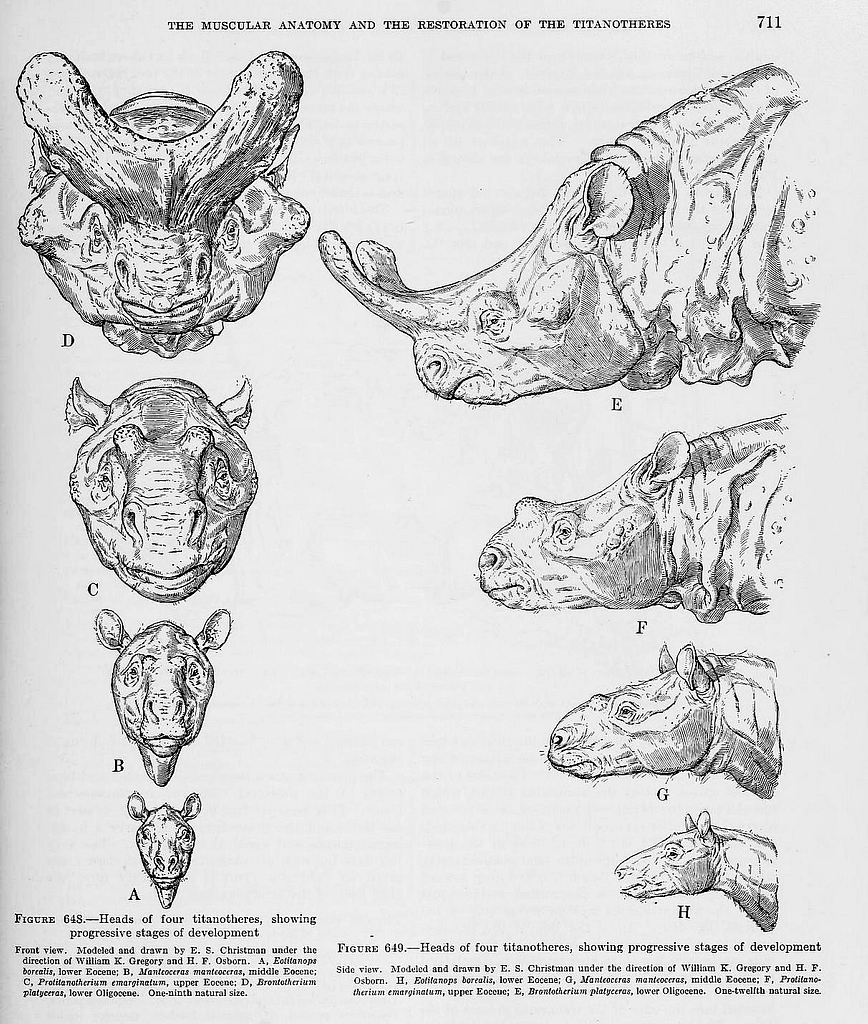
The earliest known member of the family is Eotitanops borealis. In contrast to its later gigantic descendants, this early species looked strikingly different. Its body plan resembled certain early members of Equoidea, such as Palaeotherium. Rather than a towering giant, it was a relatively small animal with long limbs and multi-toed feet, resembling a dog-sized creature with a horse-like silhouette.

From this point forward, the evolutionary paths of horses and brontotheres gradually diverged. While horses later adapted to open environments, brontotheres thrived in warm, humid forests. To browse on tender broad-leaf vegetation, some species began to increase in body size. Larger bodies provided advantages: they enabled animals to reach foliage more efficiently and offered protection against predators. Over time, natural selection favored progressively larger forms.
This evolutionary trajectory ultimately produced the colossal members of Brontotheriidae. In North America, the lineage culminated in giants such as Megacerops, while Asia hosted equally impressive relatives such as Embolotherium, belonging to the subfamily Embolotheriinae. These animals ranked among the largest herbivorous mammals of the Eocene.
Yet their dominance proved temporary. During the late Eocene, global environmental conditions began to shift dramatically. Mountain-building events altered atmospheric circulation, and newly rising mountain ranges blocked the flow of warm maritime air into continental interiors. As climates cooled and dried, forests gradually gave way to expanding grasslands.
Another major event intensified this trend: the Azolla event in the Arctic Ocean, during which massive blooms of the freshwater fern Azolla removed significant quantities of carbon dioxide from the atmosphere. With declining atmospheric CO₂ levels, global temperatures continued to fall.
These environmental transformations favored animals adapted to open habitats. Grazing species such as early horses and rhinoceroses evolved durable, high-crowned teeth capable of processing abrasive grasses rich in silica. Brontotheres, however, remained specialized forest browsers. Their teeth lacked the durability required for grazing, and their ecological niche disappeared as forests retreated. Gradually, the once-dominant giants faded from the fossil record and vanished near the close of the Eocene.


Despite their rhinoceros-like appearance, the horns of brontotheres differ fundamentally from those of modern rhinoceroses. In living rhinoceroses, the horns are composed primarily of keratin—the same protein found in hair and fingernails. In Megacerops and its relatives, the horns were not keratin structures but bony projections formed from the nasal and frontal bones of the skull.
Functionally, however, these structures likely served roles similar to those in modern rhinos. Fossil evidence suggests strong sexual dimorphism: males possessed larger horns than females. Such features likely played roles in courtship displays, territorial competition, and social signaling. In some species, such as Embolotherium, the nasal bones developed large hollow cavities that may have amplified vocalizations, aiding communication within herds or intimidating predators.
Dental anatomy also distinguishes brontotheres from rhinoceroses. As forest browsers, brontotheres fed mainly on tender leaves and broadleaf plants. Their molars were brachydont, meaning the crowns were relatively low compared with the roots, and their outer enamel ridges formed characteristic W-shaped patterns. These teeth functioned well for slicing soft foliage but wore down rapidly when exposed to abrasive grasses.
Rhinoceroses, by contrast, possess hypsodont teeth—tall crowns with extensive enamel layers—an adaptation particularly suited for grinding tough grasses. This difference illustrates how dietary specialization can shape the evolutionary fate of entire lineages.
Although brontotheres have long since vanished, their legacy remains vivid. Museum halls frequently display these imposing animals as icons of Cenozoic mammalian evolution, rivaling the popularity of creatures such as the saber-toothed cat Smilodon or the woolly mammoth. Popular media has also kept their image alive. The brontotheres depicted in Ice Age and the massive Embolotherium portrayed in the documentary series Walking with Beasts are among the most recognizable examples. Even the hammer-headed Titanothere seen in the film Avatar draws inspiration from these prehistoric mammals.
In recent decades, new fossil discoveries from Asia and North America have deepened scientific understanding of brontothere diversity and evolution. Each new specimen adds detail to the portrait of these ancient giants that once thundered through Eocene forests. One might imagine that paleontologists today continue the storytelling tradition once carried by Lakota elders—recounting the tale of the mysterious "thunder horses" whose bones still emerge from the earth long after their footsteps have faded from the world.
Author: Rodrigo
References:
1. Thomas C. Grane, Gregg Temkin.(2002)The Making of Ice Age. 20th Century Fox.
2. Mayor, Adrienne. (2014).Placenames Describing Fossils in Oral Traditions. Archived from the original on 2014-09-04. Retrieved 2019-06-21.
3. Mihlbachler, Matthew C. (June 2008). Species Taxonomy, Phylogeny, and Biogeography of the Brontotheriidae (Mammalia: Perissodactyla). Bulletin of the American Museum of Natural History.
4. Mader, Bryn J. (September 2013) .A species-level revision of the North American brontotheres Eotitanops and Palaeosyops (Mammalia, Perissodactyla). Department of Biological Sciences and Geology, Queensborough Community College.
5. Sanisidro, O.; Mihlbachler, M. C.; Cantalapiedra, J. L. (2023). A macroevolutionary pathway to megaherbivory. Science. 380 (6645): 616–618.
6. Brontotheriidae. American Museum of Natural History, https://research.amnh.org/paleontology/perissodactyl/evolution/groups/brontotheriidae.
7. Kwan, Paul W.L. (2007). Digestive system I. Tufts University. Archived from the original on 20 October 2013. Retrieved 4 July 2019.
8. Maria Wilhelm, Dirk Mathison. (2009)Avatar: A Confidential Report on the Biological and Social History of Pandora.


Comments