
A Tooth Embedded in the Skull: New Evidence for Tyrannosaurus Predation

Updated: Apr 9
Tyrannosaurus is one of the most well-known carnivorous dinosaurs among the general public. With its massive and robust body, reaching lengths of over 12 meters, it has become a favorite among dinosaur enthusiasts.
However, its enormous size has also led to considerable debate. Some paleontologists argue that such a large body would have prevented Tyrannosaurus from running quickly, making it difficult to catch prey. Combined with its keen sense of smell, this has led to the hypothesis that Tyrannosaurus may have been primarily a scavenger, relying on scent to locate carrion.
On the other hand, many paleontologists have challenged this view. Features such as binocular vision and an exceptionally powerful bite—both highly advantageous for hunting—suggest that Tyrannosaurus possessed the capability for active predation. Furthermore, as the largest carnivorous dinosaur in North America at the time, and one of the few species capable of preying upon large herbivorous dinosaurs, the ecosystem would struggle to maintain balance if Tyrannosaurus were not a predator. Unchecked herbivore populations could eventually lead to ecological collapse. Therefore, Tyrannosaurus was likely an active apex predator rather than merely a scavenger.
These two perspectives have long been debated. In particular, while the predator hypothesis appears well-supported, it has historically lacked direct evidence—namely, fossils of herbivorous dinosaurs that were clearly preyed upon by Tyrannosaurus. Although many fossils bearing Tyrannosaurus teeth or bite marks have been discovered, it is often impossible to determine whether these marks were inflicted before or after the animal’s death, leaving room for scavenging interpretations.
To conclusively demonstrate predatory behavior, bite marks would need to show signs of healing. While such evidence would indicate that the prey survived an initial attack—thus implying a failed predation attempt—it would also confirm that Tyrannosaurus actively attacked living prey. However, identifying the species responsible for such bite marks is difficult, especially since no associated teeth are usually preserved with the wounds. As a result, definitive evidence has remained elusive.

In 2005, a fossil of Edmontosaurus annectens, catalogued as MOR 1627, was discovered. This specimen consists of a nearly complete skull, with a particularly remarkable feature: a fragment of a tooth embedded in the nasal bone, having penetrated it entirely. The specimen was later re-examined in a study. Although the individual showed no signs of healing—suggesting it may have already been dead at or before the time of injury—the research team analyzed the interaction between the tooth fragment and the skull from multiple angles, concluding that the animal most likely died as a result of an attack by the tooth’s owner.
First, based on the morphology and size of the tooth fragment, most local predators were ruled out, leaving only an adult Tyrannosaurus as a plausible candidate. Estimates suggest the tooth belonged to an individual with a skull length of about one meter and a body mass of several tons. Further analysis of the tooth’s curvature and cross-sectional shape identified it as a maxillary (upper jaw) tooth. The direction of curvature also indicates that Tyrannosaurus likely bit the snout of Edmontosaurus from the front.
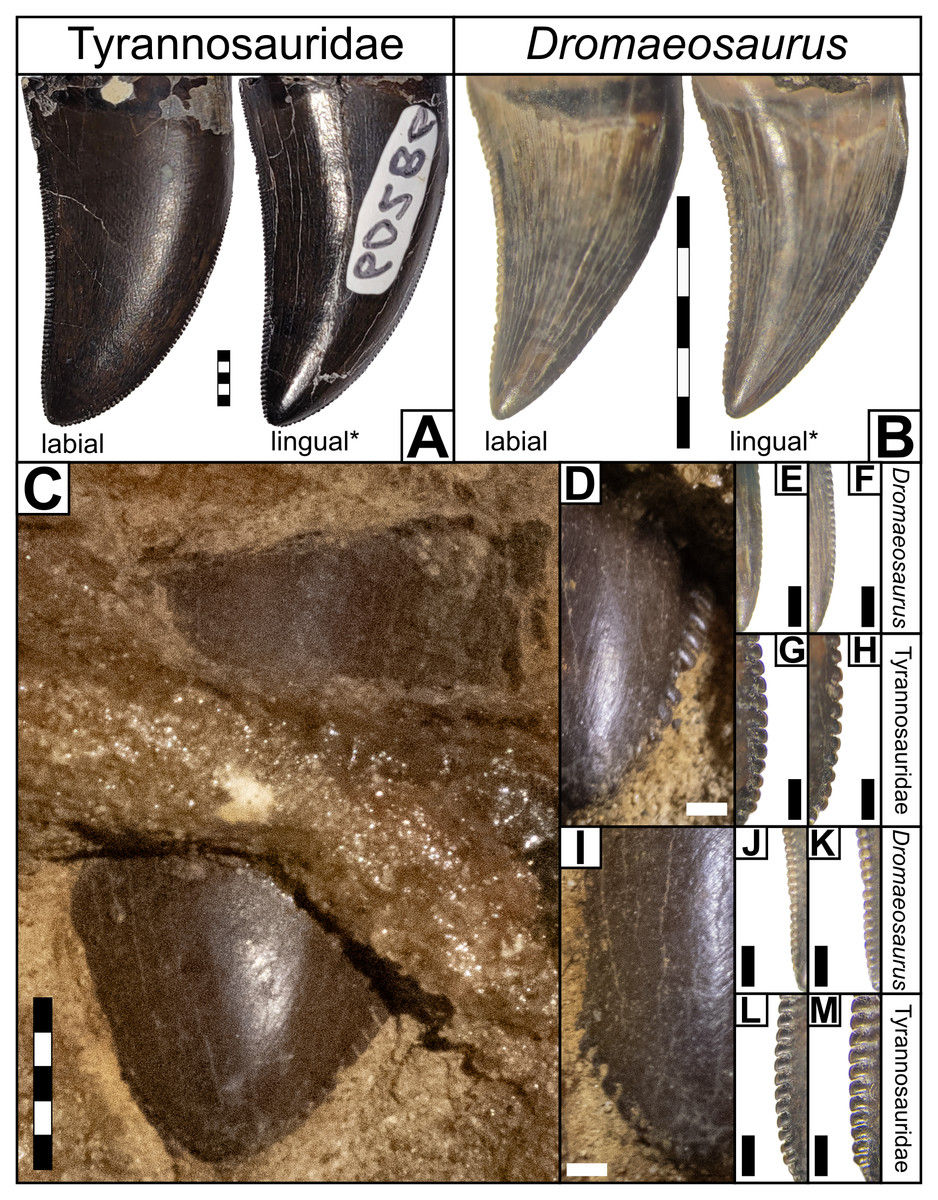
At this stage, the analysis was largely complete, and the remaining question concerned how to interpret the origin of the bite.
Typically, damage to the snout region of prey animals can result from either predation or carcass dragging. However, dragging is unlikely to produce such deep punctures; it more commonly leaves multiple scratches or shallow gouges. Moreover, predators tend to drag smaller prey, whereas Edmontosaurus was comparable in size to Tyrannosaurus. Additionally, dragging marks would more likely appear on the sides of the skull rather than on the top (nasal region). Therefore, the possibility of carcass dragging is considered low. Notably, some modern predators, such as crocodilians, kill prey by biting the snout to prevent breathing, leading to suffocation. Based on this, the study suggests that Tyrannosaurus may have employed a similar hunting strategy.
Could these bite marks have resulted from feeding behavior? In most animals, the head contains relatively little flesh and is not a primary feeding target for predators. Some exceptions exist, such as hyenas, which may bite into the skull early in feeding—not to consume flesh, but to crush the skull and access the brain. However, given that Edmontosaurus had a relatively small brain compared to modern large herbivorous mammals, it is unlikely that Tyrannosaurus would have targeted the head specifically for brain consumption.

Although MOR 1627 does preserve some shallower bite marks that may have resulted from feeding, the skull remains largely intact, and the distribution of bite marks is limited. This suggests that the predator only fed briefly before abandoning the skull. Similar behavior can be observed in modern ecosystems. For example, there are records of Tragelaphus whose postcranial skeletons were almost entirely consumed after weeks of feeding, leaving behind an almost intact skull with only minor fragments. If MOR 1627 underwent a similar process, this could explain why only the skull was preserved.
While the MOR 1627 specimen does not provide definitive proof of active predation by Tyrannosaurus, the multiple lines of analysis strongly suggest that the Edmontosaurus most likely died as a result of an active attack. This finding therefore adds an important piece of evidence supporting the hypothesis that Tyrannosaurus was indeed an active predator.
(Author: Bai Leng)
reference:
Wyenberg-Henzler, T. C. A., Scannella, J. B. (2026). Behavioral implications of an embedded tyrannosaurid tooth and associated tooth marks on an articulated skull of Edmontosaurus from the Hell Creek Formation, Montana. PeerJ.


Comments