
Wooden Spear and Elephant Bones: How the Lehringen Site Changed Our View of Neanderthal Hunting

Updated: Apr 9
Research from the Lehringen site in Germany suggests that around 125,000 years ago, Neanderthals living at the northern edge of Europe may have successfully hunted one of the largest land animals of their time, the straight-tusked elephant (Palaeoloxodon antiquus).

Lehringen first became famous because of the discovery in 1948 of a 2.38-meter-long wooden thrusting spear. At the time, this was the only complete wooden hunting weapon known from the Paleolithic. Even more strikingly, the spear was found in association with the skeleton of a straight-tusked elephant. At first glance, this combination seemed to point directly to a Neanderthal hunting event. Yet this was also where the controversy began. Because the excavation conditions in 1948 were poor and the original documentation was limited, some researchers later questioned whether the wooden spear had really been used for hunting at all. Could it simply have ended up near the elephant remains by chance, perhaps washed toward the lakeshore together with the carcass?
A recent study carried out the first systematic zooarchaeological and taphonomic analysis of the entire Lehringen faunal assemblage. Unsurprisingly, the straight-tusked elephant remains were central to the investigation. Based on tooth wear and skeletal development, the individual appears to have been a male around 30 years old that had not yet fully completed its growth. Parts of the skeleton were exceptionally well preserved, including several cervical vertebrae, thirteen thoracic vertebrae, the sternum, many ribs, and much of the limb skeleton. Cut marks were identified on fragments of seven ribs, and two thoracic vertebrae also preserved cut marks on their dorsal spines.
Most of these marks are located on the outer surfaces of the ribs, and their orientation is generally perpendicular or oblique to the long axis of the bone. This pattern is consistent with defleshing, especially the removal of muscle from the thoracic and abdominal region. Even more revealing, one rib bears a series of nearly parallel cut marks on its internal surface. These marks strongly resemble traces produced when a hand or tool enters the thoracic or abdominal cavity to open the body and remove the internal organs. This suggests that when Neanderthals accessed the elephant carcass, it was still relatively fresh. If the animal had already been heavily decomposed or extensively scavenged by carnivores, the thoracic cavity and internal organs would be unlikely to have been processed in this way. For this reason, the study suggests that Neanderthals gained primary access to the carcass very soon after the elephant's death.

Although the researchers did not identify a clear spear wound on the bones themselves, the overall pattern of evidence is compelling. The Lehringen elephant preserves traces of fresh-state defleshing and probable evisceration, butchered stone tools were found nearby, and the wooden spear was discovered directly associated with the skeleton. Taken together, these lines of evidence make the interpretation of a successful Neanderthal elephant hunt the most convincing explanation currently available.
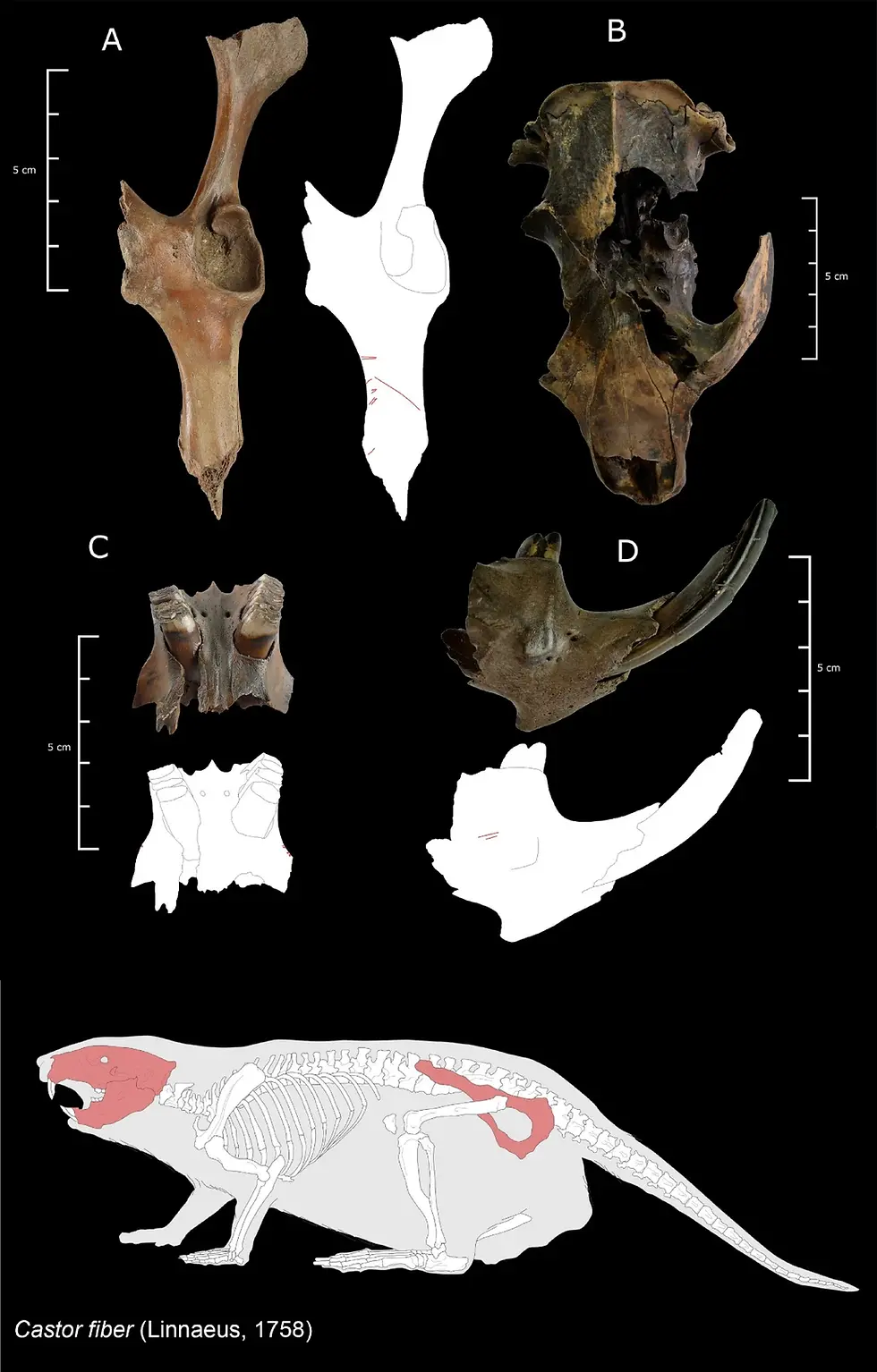
The site, however, tells a broader story than a single dramatic encounter with an elephant. The Lehringen assemblage also includes remains that likely belong to Eurasian beaver (Castor fiber), brown bear (Ursus arctos), aurochs (Bos primigenius), several deer species, fish, birds, and turtles. Some of these animals also preserve clear traces of human modification. For example, one beaver pelvis fragment bears multiple cut marks on the ilium, indicating that the hind limb and pelvic joint were disarticulated and the flesh subsequently removed. A maxilla also shows fine, symmetrical cut marks near both zygomatic arches, precisely where the chewing musculature would have attached, suggesting that the mandible may have been deliberately removed. These details suggest that Lehringen was not simply the location of a single hunting episode, but rather a repeatedly used lakeside resource locality for Neanderthals.
A rib from a medium- to large-sized mammal, likely attributable to a brown bear, also preserves clear cut marks whose direction is consistent with meat removal from the loin region. In addition, a distal femur fragment of brown bear shows impact damage, suggesting that Neanderthals may have deliberately broken the bone open to extract marrow. For human groups living in Pleistocene Europe, the value of an animal extended far beyond its muscle tissue alone. Internal organs, fat, marrow, and hide would all have represented important resources.

The aurochs remains tell a somewhat different story. At least three subadult individuals were identified at Lehringen, one of them represented by an almost complete skeleton, while the other two are more fragmentary. Unlike the straight-tusked elephant or the brown bear, the cut marks on aurochs bones are relatively sparse and subtle. Only a few modifications were observed, including traces on the mandible and a lumbar vertebra. This pattern does not suggest that aurochs were the focus of repeated, specialized hunting at the site. Instead, they appear to have been one of several prey animals exploited more opportunistically.
Taken together, the faunal evidence from Lehringen reveals Neanderthals as people who were highly familiar with their environment, capable of recognizing the value of different animal resources, and able to process even dangerous large-bodied prey. This is a far richer and more realistic image than the old stereotype of Neanderthals as crude and limited "primitive humans."
Author: Shui-Ye You
Reference:
Verheijen I et al. (2026). Faunal exploitation at the elephant hunting site of Lehringen, Germany, 125,000 years ago. Scientific Reports.


Comments