
Aquilolamna milarcae

Updated: Apr 10
Age
Cretaceous(Turonian)
93 Ma
Taxonomy
Kingdom: Animalia
Phylum: Chordata
Class: Chondrichthyes
Order: Lamniformes (?)
Family: Aquilolamnidae
Genus: Aquilolamna
Species: Aquilolamna milarcae
Morphological description
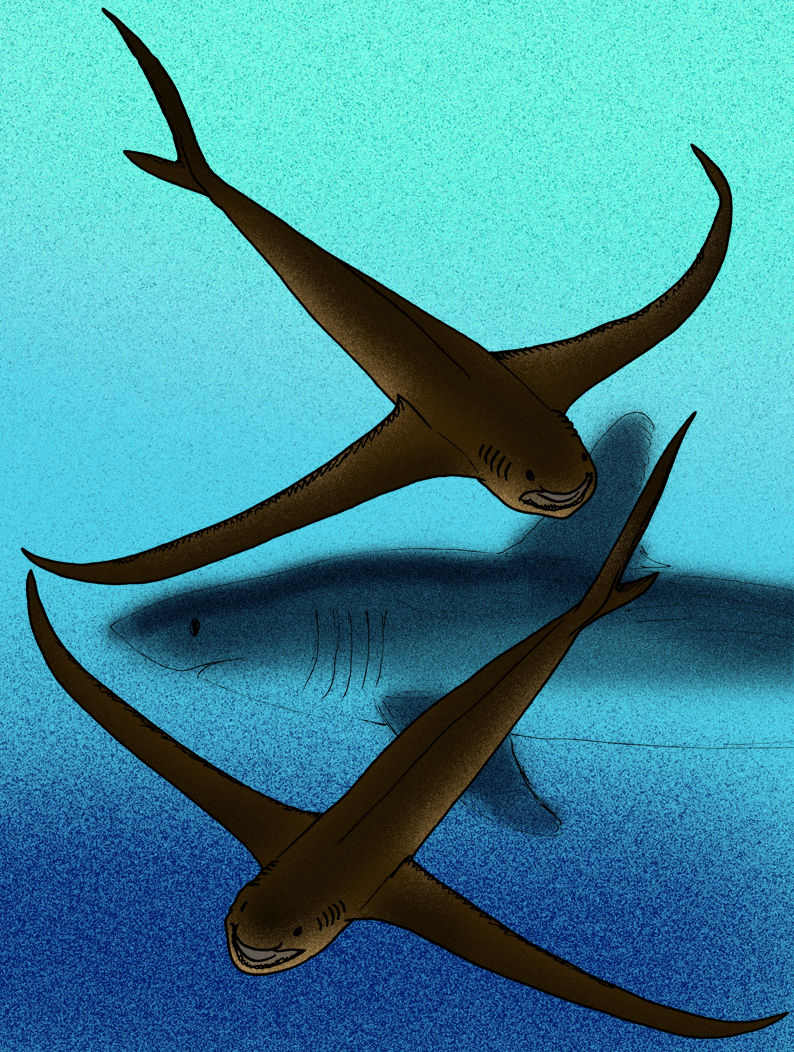
Aquilolamna milarcae possessed exceptionally large, wing-like pectoral fins, with a span reaching approximately 1.9 meters, while the total body length was only about 1.65 meters. The head was broad, and the overall body exhibited a streamlined, torpedo-shaped form.
The fossil also preserves a caudal fin similar to that of most sharks. However, aside from the pectoral and caudal fins, no additional fins have been clearly identified. It remains uncertain whether these structures were absent in life or simply not preserved in the fossil record.
Etymology
The genus name combines the Latin aquila ('eagle') with Lamna, a reference to mackerel sharks, highlighting its wing-like pectoral fins and inferred gliding lifestyle in open oceans.
The species name refers to the Museo La Milarca, where the specimen is housed.
Biological description
This species was discovered in Mexico. Due to its unusual morphology, lack of closely related forms, and the absence of preserved teeth—an important feature for classifying elasmobranchs—its taxonomic placement remains uncertain, though current analyses tentatively assign it to Lamniformes.
Based on its morphology, Aquilolamna milarcae is interpreted as a pelagic suspension feeder. Its ecological role appears comparable to that of modern manta rays, but it predates them by more than 30 million years.
Unlike manta rays, which generate propulsion by flapping their pectoral fins, Aquilolamna milarcae likely relied on its caudal fin for thrust while using its enlarged pectoral fins for stabilization, allowing it to glide efficiently through the open ocean.
(Author: Bai Leng)
References
1. Vullo, R., Frey, E., Ifrim, C., González, M. A. G., Stinnesbeck, E. S., Stinnesbeck, W. (2021). Manta-like planktivorous sharks in Late Cretaceous oceans. Science.
2. Smith, B. (2021). Fossil of 'long-winged' shark from Cretaceous period found in Mexican quarry. www.abc.net.au.
26.4, -100.01


Comments