
Caihong juji
- 演化之聲

- Mar 30
- 4 min read
Updated: Apr 9

Age
Jurassic(Oxfordian)
161.5-154.8 Ma
Taxonomy
Kingdom: Animalia
Phylum: Chordata
Class: Sauropsida
Superorder: Dinosauria
Order: Saurischia
Suborder: Theropoda
Clade: Paraves
Infraorder: Deinonychosauria
Genus: Caihong
Species: Caihong juji
Morphological description
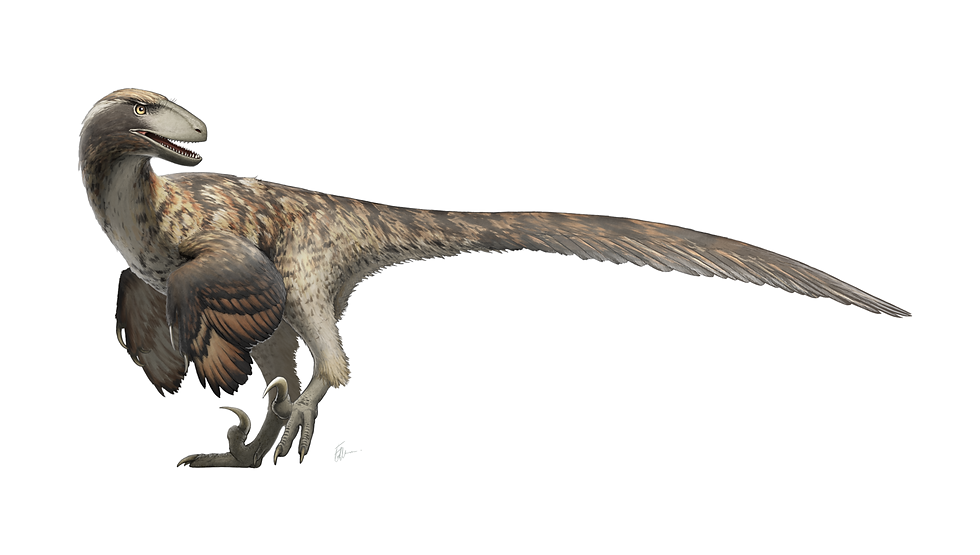
Caihong juji is a paravian theropod dinosaur. Its holotype (PMoL-B00175) represents an adult individual, with an estimated total skeletal length of approximately 40 cm and a body mass of about 475 g. It is characterized by a pair of prominent lacrimal crests located anterior to the orbit, projecting dorsolaterally and giving the skull a distinctive profile. The skull is elongate and low, with a long rostrum. The anterior teeth are slender and closely packed, whereas the middle and posterior teeth are more robust, more widely spaced, and bear serrations.
The forelimbs are relatively short, measuring only about 60% of the hindlimb length. However, the ulna and radius are longer than the humerus, a proportion that is uncommon among contemporaneous theropods. The manual phalanges are elongate, while the manual unguals are comparatively small. The hindlimbs are overall elongate, with an extremely short metatarsal I. The tail is complete but proportionally short relative to other closely related taxa, consisting of approximately 26 caudal vertebrae.
Feathers are preserved over nearly the entire body. Feathers on the head and neck can be divided into longer, nearly linear forms and shorter, slightly sinuous forms. The chest and other parts of the body bear relatively long contour feathers. The wing feathers are well developed, with the longest primary and secondary feathers exceeding 10 cm in length. Large feathers are also preserved on the hindlimbs. The tail bears an extensive feathered surface, and some tail feathers exhibit asymmetrical vanes.

Etymology
Generic name Caihong is derived from the Mandarin word for "rainbow," referring to the coloration and microstructural features of the feathers.
Specific name juji comes from the Mandarin words for "large crest," referring to the prominent lacrimal crests on the skull.
Biological description
Caihong juji is recovered as a basal member of Deinonychosauria. The fossil was discovered in the Tiaojishan Formation of Qinglong County, Hebei Province, China, and dates to the Oxfordian stage of the Late Jurassic, approximately 161 million years ago. This interval corresponds to the Yanliao Biota, which has yielded numerous taxa relevant to the origin of birds.
The holotype preserves evidence related to feather coloration. The feathers contain platelet-shaped nanostructures interpreted as possible melanosomes arranged in an organized pattern. In extant birds, platelet-shaped melanosomes are associated with iridescent coloration. When light interacts with such nanostructures, it can produce angle-dependent color changes through nanoscale structural organization. Therefore, certain feather regions of Caihong juji were likely capable of producing iridescent effects.

However, the study explicitly indicates that the precise coloration cannot be reconstructed. The final tone and hue of structural color depend not only on melanosome shape, but also on spacing, arrangement, keratin distribution, and, in some cases, the presence of additional pigments such as carotenoids or pterins. As a result, although iridescence is supported, it is not possible to determine whether the feathers appeared blue, green, purple, or coppery. The iridescent feathers were not distributed across the entire body, but were restricted to specific regions, including parts of the head, chest, and tail.
The fossil of Caihong juji preserves one of the earliest known occurrences of asymmetrical feathers in theropods. In modern birds, asymmetrical feathers are commonly associated with flight, as they influence airflow and lift generation. In Caihong, however, this feature does not fully correspond to a typical flight-adapted skeletal configuration. The forelimbs are not particularly long, yet they are associated with elongated flight feathers and proportionally long forearms. This combination suggests that the evolution of feathers and skeletal structures may have proceeded at different rates. Some features that resemble flight adaptations may initially have served functions such as control, display, competition, or courtship, before being incorporated into more advanced aerodynamic systems.
Living in Jurassic forest environments, Caihong juji was likely a highly visual animal. Despite its small size, it possessed prominent cranial crests, extensive feathering across the body, and large feather surfaces on the tail and limbs. Certain feather regions may have reflected shifting colors depending on viewing angle. Such a body plan is consistent with roles in visual signaling, including courtship display, intraspecific competition, territorial signaling, and close-range recognition.
The discovery of Caihong juji supports an evolutionary perspective in which features related to flight, signaling, and body appearance were assembled in a mosaic pattern near the origin of birds. Rather than emerging in a single coordinated sequence, these traits appear to have evolved in different combinations across closely related taxa, indicating that the paravian lineage had already explored a wide range of body plans and ecological strategies prior to the emergence of true avian flight.

Reference
Hu D et al. (2018). A bony-crested Jurassic dinosaur with evidence of iridescent plumage highlights complexity in early paravian evolution. Nature communications.
40.41, 118.95


Comments