
Ceratosaurus nasicornis

Updated: Apr 9
Age
Jurassic(Oxfordian-Tithonian)
161.2-145 Ma
Taxonomy
Kingdom: Animalia
Phylum: Chordata
Class: Sauropsida
Superorder: Dinosauria
Order: Saurischia
Suborder: Theropoda
Family: Ceratosauridae
Genus: Ceratosaurus
Species: Ceratosaurus nasicornis
Morphological description
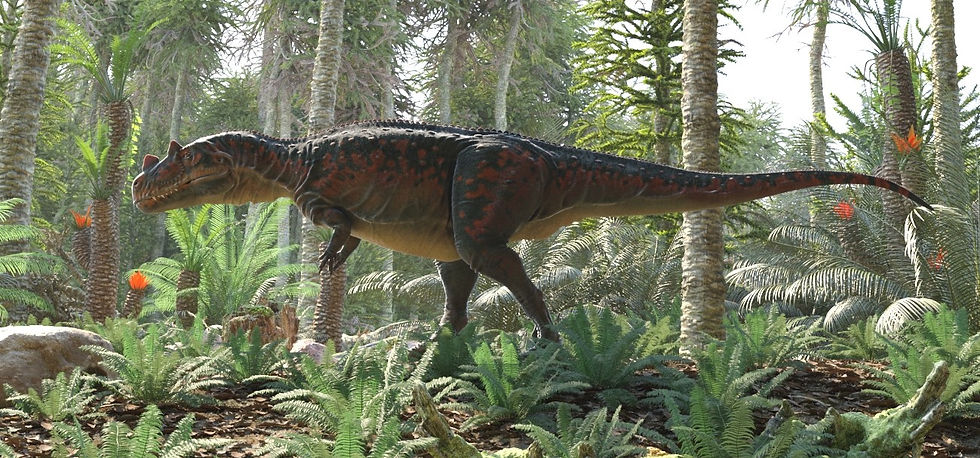
Ceratosaurus nasicornis was a relatively slender ceratosaurian theropod characterized most prominently by horn-like projections on the skull. Within Ceratosauria, its skull is comparatively elongate and low in profile. The nasal bones are fused along the midline, forming a rounded median nasal horn. In addition, the lacrimal bones above the orbits give rise to a pair of dorsal horn-like projections.
The anterior teeth of the premaxilla and dentary are conical in shape and bear longitudinal flutes on their lingual surfaces. In contrast, the lateral teeth toward the posterior of the jaws are more typical of theropods, with blade-like cutting edges. This differentiation suggests a degree of functional specialization between the anterior and posterior dentition.
The tail of Ceratosaurus nasicornis has historically attracted ecological interpretations due to the relatively deep neural spines and chevrons in the anterior caudal vertebrae. However, although these proximal neural spines are tall, they do not extend along the tail in the manner seen in crocodilians, where they form structures suited for aquatic propulsion. Likewise, the chevrons in the mid-caudal region retain the typical morphology of terrestrial dinosaurs and do not represent a highly specialized adaptation for swimming.

Etymology
Genus name Ceratosaurus: derives from the Greek keras "horn" and sauros "lizard", meaning "horned lizard."
Species name nasicornis: comes from the Latin nasus "nose" and cornu/cornis "horn", meaning "horned nose" or "bearing a horn on the nose."
Biological description
Ceratosaurus nasicornis was first described in 1884 based on a skull and partial postcranial skeleton from the Late Jurassic Morrison Formation of the United States. Subsequent discoveries of more complete and better-preserved specimens have significantly improved anatomical knowledge, making this species an important reference point for understanding early ceratosaur evolution and ecology.

The cranial horns of Ceratosaurus nasicornis are most plausibly interpreted as structures related to sexual selection, visual signaling among individuals, or low-intensity head interactions. The combination of a nasal horn and supraorbital projections is highly distinctive among theropods, and such features would have been effective for species recognition, mate competition, or the establishment of social hierarchies.
From an evolutionary perspective, Ceratosaurus nasicornis occupies a relatively basal position within Ceratosauria. It retains several primitive features, such as an elongate skull, while also exhibiting traits seen in more derived abelisaurids, including cranial ornamentation and fused nasals. For this reason, it is often regarded as a transitional form within ceratosaur evolution.
The Morrison Formation ecosystem in which Ceratosaurus nasicornis lived was populated by a wide range of predatory theropods occupying different ecological niches. Smaller taxa included Koparion, Coelurus, Ornitholestes, and Tanycolagreus; medium to large forms included Marshosaurus and Stokesosaurus; and even larger predators such as Allosaurus, Saurophaganax, and Torvosaurus were also present. The long-term coexistence of Ceratosaurus nasicornis within such a predator-rich environment suggests ecological partitioning rather than direct competition with all other large theropods.
Some earlier hypotheses attempted to explain this niche differentiation by proposing a semiaquatic lifestyle for Ceratosaurus nasicornis, suggesting that it preferred water-margin environments, was capable of swimming, and preyed upon aquatic organisms. This idea was primarily based on three observations: relatively tall neural spines in the anterior caudal vertebrae, deep chevrons, and a tail and torso that appeared less stiff than those of other large theropods, potentially allowing greater flexibility during swimming.
However, more detailed comparative analyses have shown that this semiaquatic hypothesis is not well supported. Tall neural spines are also found in many fully terrestrial theropods and therefore do not constitute evidence for aquatic adaptation. In true aquatic or semi-aquatic vertebrates such as crocodilians, specialized tail structures are maintained throughout the mid and distal caudal regions, whereas Ceratosaurus nasicornis lacks such modifications. Furthermore, deep chevrons are not indicative of swimming ability; their primary roles include protecting blood vessels and nerves and providing attachment sites for major musculature such as the caudofemoralis. Taken together, current evidence does not support the interpretation of Ceratosaurus nasicornis as a semiaquatic predator.
Nevertheless, rejecting a semiaquatic lifestyle does not imply ecological uniformity. Available evidence instead suggests that Ceratosaurus nasicornis was likely an opportunistic generalist predator. The conical anterior teeth with lingual fluting resemble those of predators adapted to capturing slippery prey such as fish, while the fused nasals may have enhanced structural stability under torsional stress. These features indicate a capacity to exploit a variety of food resources, potentially including fish, wetland animals, and other small, slippery prey.
It is therefore plausible that Ceratosaurus nasicornis inhabited environments where rivers, floodplains, and semi-arid terrestrial landscapes intersected, taking advantage of both aquatic and terrestrial resources within a dynamic Late Jurassic ecosystem.
(Author: Shui-Ye You)
References
Delcourt R. (2018). Ceratosaur palaeobiology: new insights on evolution and ecology of the southern rulers. Scientific Reports.
Rowe AJ et al. (2026). Southern hemisphere ceratosaurs evolved feeding mechanics paralleling those of Northern hemisphere tyrannosaurids. Scientific Reports.
Yun C. (2019). Comments on the ecology of Jurassic theropod dinosaur Ceratosaurus (Dinosauria: Theropoda) with critical reevaluation for supposed semiaquatic lifestyle. Volumina Jurassica.


Comments